
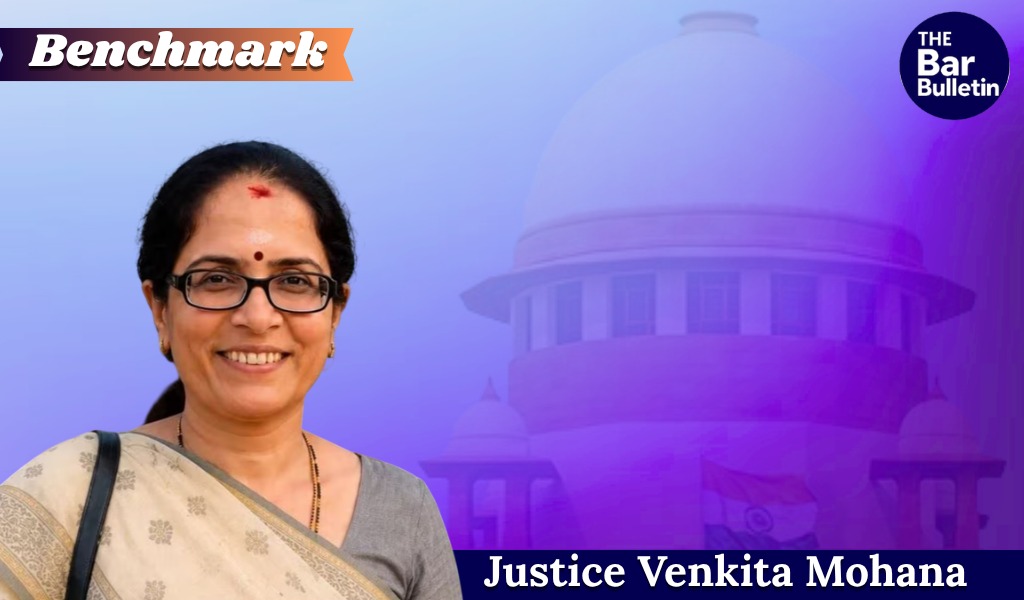

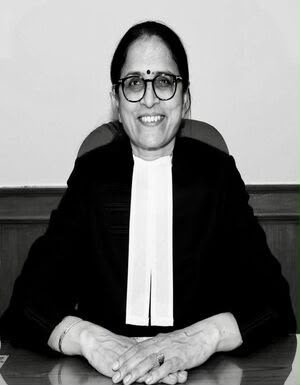
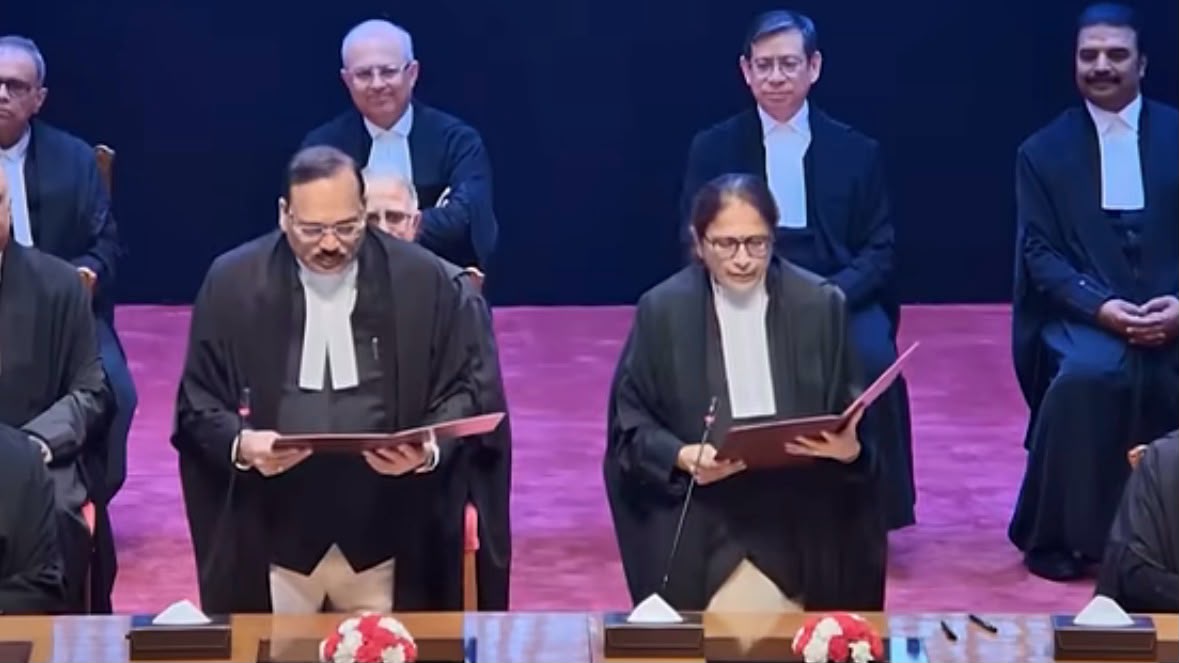
Widely celebrated for her historic elevation from the Bar to the Supreme Court Bench, Justice Venkita Subramani Mohana, a sitting Supreme Court Judge, stands as the 12th female judge in the history of the Supreme Court as she broke barriers to become only the second woman in the Indian legal history to be appointed directly from the Bar on 02-06-2026. As a first-generation lawyer with nearly four decades of rigorous litigation experience, Justice V. Mohana’s exceptional career spans roles as an Advocate-on-Record, a Senior Advocate, and a fierce champion of gender justice.
Early Life and Commencement of Legal Journey
Born on 27-06-1966, in Pollachi, Coimbatore district, Tamil Nadu, Justice V. Mohana grew up in a non-legal background. Her parents instilled a highly disciplined environment focused on education. She was enrolled in the historic first batch of India’s newly introduced 5-year integrated law course (1983–1988) at the Coimbatore Law College. Out of 83 students, she was one of only about nine women. Before graduating in 1988, she honed her fundamentals in law and trial court acumen under leading civil lawyer M. Panchapakesan.
Journey at the Bar
Justice V. Mohana relocated to New Delhi in May 1992 and entered the chambers of Ms. Indu Malhotra (who was then an Advocate-on-Record and would later become a Supreme Court Judge). Later, she also associated with Mr. C.S. Vaidyanathan, Senior Advocate and former Additional Solicitor General of India. Thereafter, she cleared the rigorous Supreme Court Advocate-on-Record examination, officially securing her qualification on 09-05-1996. For nearly two decades, she managed a robust, highly respected independent practice crossing diverse domains including the Delhi High Court, National Consumer Commission (NCDRC), and specialized federal tribunals. On 23-04-2015, Justice Mohana was designated as a Senior Advocate.
Notable Legal Battles
Before her elevation to the Bench, Justice V. Mohana established a significant practice. Her legal legacy is anchored by high-stakes litigation in gender rights, family inheritance, personal freedoms, and major constitutional structure. A few legal battles that shaped her career are:
● Sucheta EDN v. Union of India 2026 INSC 280 and Related Military Gender Equality Litigations
Justice V. Mohana represented women Short Service Commission (SSC) officers fighting for institutional equality. Her fierce advocacy targeted systemic prejudices regarding women’s physical and long-term capabilities in the military. Her efforts successfully secured a historic ruling establishing that qualified female officers cannot be denied a Permanent Commission. This fundamentally altered the framework of career progression and pensionary rights for women across the Army, Navy, and Air Force.
● Revanasiddappa v. Mallikarjun 2023 INSC 783
Justice Mohana addressed the highly complex intersection of personal laws and property rights while arguing that children born out of void or voidable marriages under the Hindu Marriage Act, 1955, should hold inheritance claims strictly confined to parental property rather than ancestral coparcenary property. The Supreme Court meticulously evaluated these arguments to balance child protection laws with traditional joint family property systems.
● Aishat Shifa v. State of Karnataka AIR 2022 SC 842 (The Karnataka Hijab Ban Case)
Justice V. Mohana represented the respondent teachers who supported institutional uniform mandates and navigated the multi-layered debate on secularism, right to education, freedom of expression, and reasonable restrictions in public educational institutions. The resultant split verdict by the Supreme Court became a foundational reference for Article 25 parameters in public spaces.
● Sharmila Velamur v. V. Sanjay 2025 INSC 299
Justice Mohana championed for individuals with severe neurodevelopmental disorders, specifically Ataxic Cerebral Palsy. She secured a major ruling establishing that the opinions of certified medical experts must be given legal supremacy over general legal assumptions when determining a disabled person’s capacity to exercise independent or assisted decision-making.
● Secretary, Ministry of Defence v. Babita Puniya (2020) 7 SCC 469
This is one of Justice Mohana’s most celebrated legal battles. While the landmark 2020 verdict established the right to a permanent commission, she played a pivotal role in enforcing the order. In 2021 and 2022, she fiercely argued before the Supreme Court against systemic institutional resistance, fighting the indignity of senior women officers serving under their promoted juniors.
● Jamia Masjid v. KV Rudrappa (2022) 9 SCC 25
Justice Mohana represented appellants in a property ownership dispute, and weaved complex arguments centred on trust ownership as well as the doctrine of res judicata.
● Supreme Court Advocates-on-Record Association v. Union of India (2016) 5 SCC 1
Justice Mohana served as a panel lawyer of the Government of India with a mandate to defend the 99th Constitutional Amendment and the National Judicial Appointments Commission (NJAC) Act.
● Selvaraj v. Revathi 2023 INSC 1054
Justice Mohana played a critical role in this landmark child custody case, assisting the Court as Amicus Curiae being the court-appointed mediator and counsellor. Her specific contributions included breaking the ice with the child and apprising him of the importance of maternal affection, facilitating a compromise for monthly meetings and phone calls, and strategic recommendations. The Court relied heavily on her comprehensive report and ruled accordingly.
● In re: Refixation of Pension Considering Service Period in District Judiciary and High Court 2025 INSC 726
This landmark ruling was successfully argued by Justice Mohana and the One Rank One Pension principle for the judiciary was upheld, establishing that all retired High Court judges must receive equal terminal benefits regardless of their service path, duration, or service breaks.
Notable Decisions
● Union of India v. Nai Bhor Sanstha & Anr. (2026)
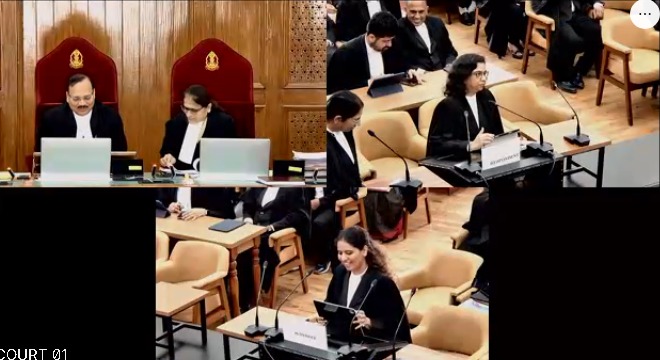
Justice V. Mohana heard this matter alongside the Chief Justice of India Surya Kant. The Bench issued notice on the Central Government’s transfer petition and ordered an immediate stay on all ongoing challenges to the Transgender Persons (Protection of Rights) Amendment Act, 2026, which were pending across the High Courts of Rajasthan, Delhi, Karnataka, and Kerala.
● Rakesh Kumar Singh v. State of Bihar & Ors. (2026)
Forming a part of the Bench alongside Chief Justice of India Surya Kant, Justice V. Mohana took cognizance of the case and issued notice on social activist Rakesh Kumar Singh’s petition filed to challenge the constitutionality of re-appointing Deepak Prakash as Bihar’s Panchayati Raj Minister.
● Anas Chaudhary v. Union of India & Anr. (2026)
Justice Mohana formed a part of the Bench along with Chief Justice of India Surya Kant to preside over a PIL alleging that the State of Punjab had continuously failed to effectively implement the mandatory 25% reservation for the Economically Weaker Sections required under Article 21A of the Constitution and the Right to Education Act, 2009. The Bench directed the State to produce concrete, district-wise operational data to assess how many entry-level EWS seats had been filled in contrast to the statutory requirement.
● Jitendra Kumar v. The Hon’ble High Court of Judicature at Allahabad, Lucknow Bench & Ors. (2026)
A Division Bench of Chief Justice of India Surya Kant and Justice V. Mohana accepted the petitioner’s argument that a candidate who had demonstrated merit by clearing the prelims should not be absolutely barred due to a procedural formality and permitted the barred candidates to sit for the Uttar Pradesh Higher Judicial Service Mains Exam.
● Varadhan v. Union of India & Ors. (2026)
The Chief Justice of India Surya Kant and Justice V. Mohana monitored the implementation of a 30% women’s reservation quota within State Bar Council leadership. The Bench accepted the need for a flexible yet uniform approach and directed the BCI to consult newly elected members of the State Bar Council as well as other stakeholders before finalising a proposal.
● Friends of People for Active Democracy v. Union of India & Ors. (2026)
A Bench comprised by the Chief Justice of India Surya Kant and Justice Mohana refused to grant interim protection in a petition challenging the implementation of the CBSE’s three language policy and tagged the matter with a connected batch of petitions already pending before the Supreme Court.
● Sarika Tyagi & Ors. v. Union of India & Ors. (2026)
The Chief Justice of India Surya Kant and Justice V. Mohana heard a PIL filed by a group of women advocates raising concerns regarding inadequate facilities for women lawyers and the broader challenges faced by young members of the legal profession. The Bench suggested the formation of a Young Lawyers’ Professional Assistance Fund, which could be financed through contributions from successful lawyers, a portion of court fees collected by the judiciary, and even costs imposed in the judicial proceedings.
Significant Milestones
● Justice Mohana was a panel lawyer in the Supreme Court Legal Services Committee and was an Honorary Editor for the Supreme Court Reports.
● She was trained as a Mediator by participating in the Supreme Court’s training programme.
● Justice Mohana has been an elected as well as a nominated member of the Gender Sensitization and Internal Complaints Committee of the Supreme Court.
● She has been a member of the Supreme Court Middle Income Group Legal Aid Committee and a member of the Supreme Court Legal Services Committee.
● In 2018, Justice Mohana assisted a Commission of Enquiry headed by Justice U.U. Lalit in the matter of removal of a member of Railway Claims Tribunal, as a counsel for the Commission.
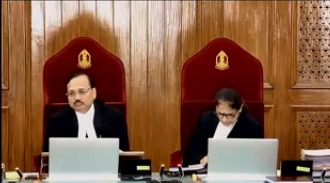
Bridging Advocacy and Bench
The career trajectory of Justice V. Mohana reflects a profound commitment to human dignity, institutional accountability, and constitutional pragmatism. It also represents a deliberate shift away from rigid formal equality toward a substantive model of justice that actively dismantles historical and systemic disadvantages. Her professional path demonstrates a careful balance: fiercely defending the independence of the judiciary while respecting the institutional domain of the legislature and executive. This pragmatic approach ensures that the law remains steady yet responsive to the evolving needs of a democratic society.