
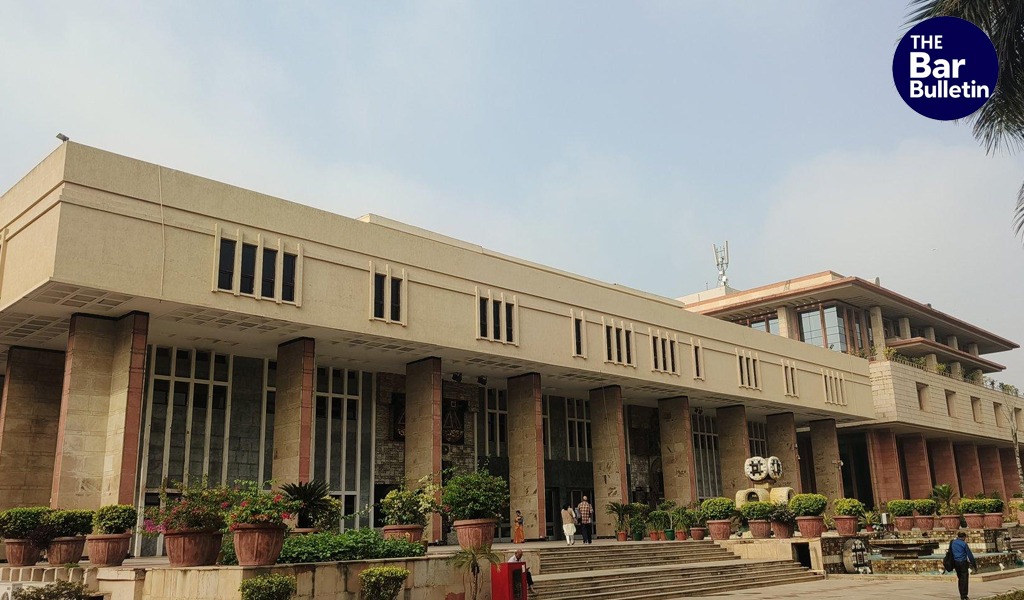

The Delhi High Court has reaffirmed the settled legal position on family arrangements and family settlements, and held that a bona fide family settlement, particularly one recording an already completed oral partition or past arrangement, does not require compulsory registration if it is merely a memorandum of what had already been agreed and acted upon, and does not itself create or extinguish rights in immovable property. The Court clarified that such a memorandum can be used to evidence a past family arrangement and that once parties have acted upon the arrangement, they are estopped from resiling from it.
Applying these principles, the Court held that the 1986 memorandum was admissible and that the First Appellate Court had erred in discarding the partition and the plaintiff’s exclusive entitlement to the suit property. The High Court set aside the judgment dated Sep 17, 2013 passed by the ADJ in the first appeal and restored the decree passed by the Civil Judge in favour of the plaintiff. As a result, the plaintiff’s suit for possession stood decreed, and the finding that defendant no. 1 was liable to restore possession of Shop ‘A’ and portion ‘AA’ to the plaintiff was revived.
A Single Judge Bench of Justice Neena Bansal Krishna found from the material on record that the jointly purchased land had long been divided and dealt with separately by the brothers. It noted that separate sale deeds had been executed by the brothers in respect of portions of the land, which itself reflected an earlier oral division.
The Bench also relied on the Memorandum of Oral Partition of October 1986, signed by all four brothers, along with the site plan identifying their respective shares. It observed that the parties had acted upon this arrangement by obtaining separate electricity connections, paying development charges, and paying house tax separately for their respective portions.
The Bench held that the ADJ had overlooked these admitted facts and documents, and had wrongly concluded that there was no proof of partition or of the suit shop having fallen to the plaintiff’s share. On facts, the Bench accepted that Shop ‘A’ and portion ‘AA’ had come to the plaintiff’s share and that defendant no. 1’s possession was unauthorized after he forcibly dispossessed the plaintiff.
Briefly, the dispute arose out of a family property conflict between four real brothers who had jointly purchased land in Village Pipal Thala, Delhi, including land in Khasra No. 429/135/1, under a sale deed dated July 14, 1954. According to the plaintiff, after part of the land was developed and sold, the remaining portion of about 1300 sq. yards was orally divided among the brothers under a family settlement, and each brother began using and constructing upon his respective portion.
The plaintiff claimed that the suit property, namely Shop ‘A’ and rear portion ‘AA’, had fallen to his share; that he had raised construction thereon; and that defendant no. 1 later forcibly dispossessed him in February 1992 during the pendency of earlier injunction proceedings. The suit was therefore filed for possession, damages, injunction, and in the alternative, partition. Defendant nos. 2 and 3 supported the plaintiff and acknowledged the family settlement, while defendant no. 1 denied the plaintiff’s claim and asserted his own possession and ownership. The Trial Court decreed the suit for possession, but the First Appellate Court reversed that decree.
