
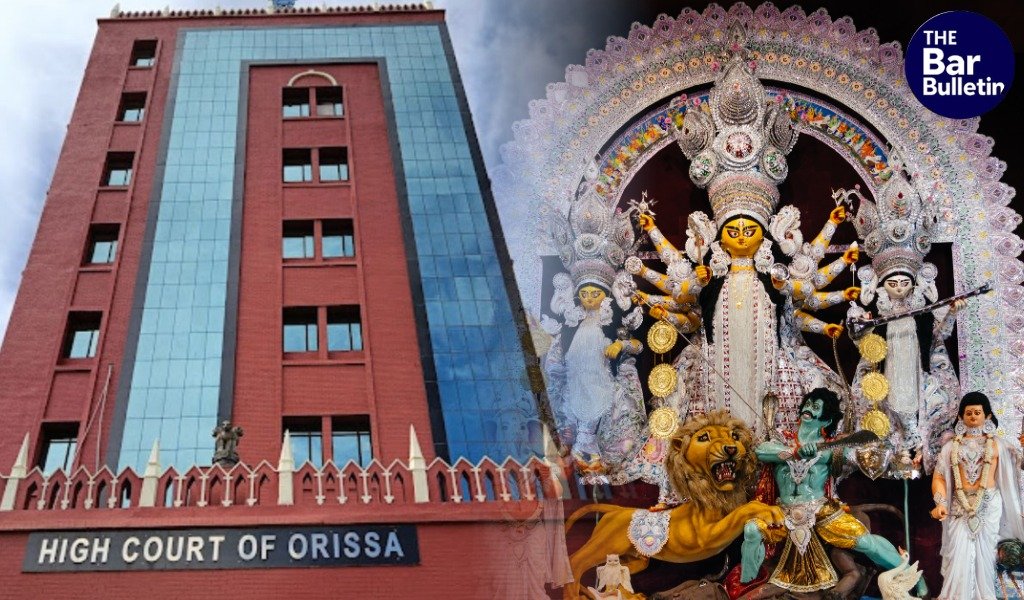

The Orissa High Court has held that while granting permission for religious festivals on public roads, the State must ensure that temporary pandals do not completely obstruct vehicular movement or deny residents access to their homes. The Court emphasised that adequate space must be maintained for emergency vehicles, including ambulances and fire engines, and directed authorities to strictly adhere to permissible sound limits and prescribed deadlines for loudspeakers.
A Division Bench of Chief Justice Harish Tandon and Justice Mruganka Sekhar Sahoo observed that the right to freedom of religion under Article 25 of the Constitution is subject to restrictions relating to public order, morality and health, and must be harmoniously read with other fundamental rights, including the right to free movement.
The Court was hearing a public interest litigation filed by a resident whose house was situated around 50 metres from a temporary religious pandal. The petitioner alleged that the pandal completely blocked the road, making access to his residence difficult.
The State submitted that the pandals did not block the road entirely and that a 22-foot passage was being maintained for vehicular movement. Taking note of the State’s stand and the larger public interest in facilitating community religious festivals, the Court declined to issue a writ of mandamus to stop the ceremonies.
The Court disposed of the petition with observations that authorities must ensure adequate passage for ingress and egress, maintain sufficient space for emergency vehicles and regulate the dimensions of temporary structures so that the public’s right of movement is not unduly restricted.
