
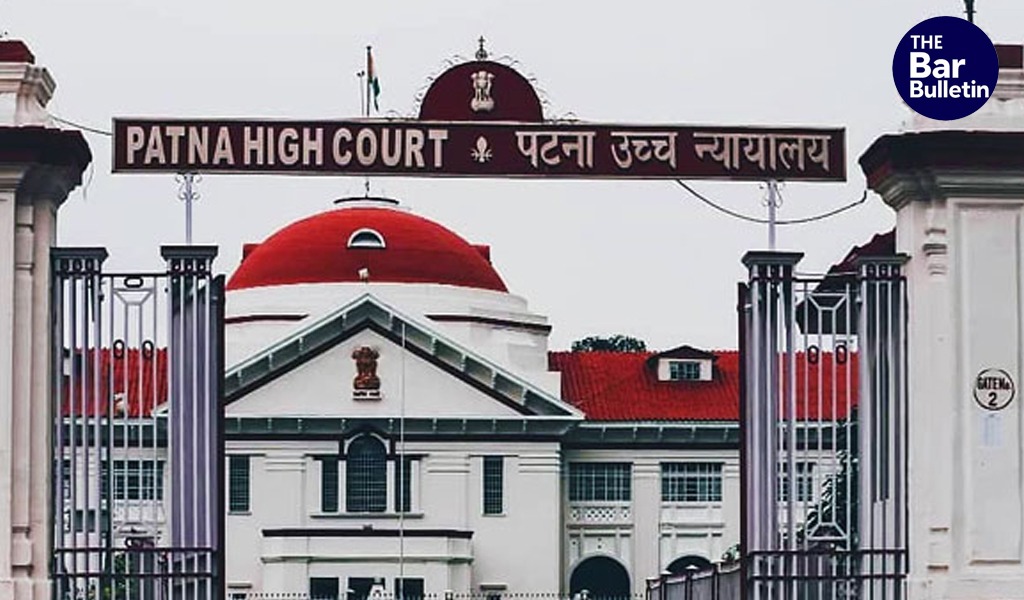

The Patna High Court has held that minor inconsistencies in eyewitness testimony relating to peripheral details do not undermine the prosecution case where the core accusation is consistent and supported by medical evidence; however, where the ocular version against an accused is contradicted by the medical evidence on a material aspect going to the root of the allegation, such contradiction creates reasonable doubt entitling that accused to acquittal.
The Bench further held that a plea of alibi must be established by strict proof, and once the prosecution has satisfactorily established the presence of the accused at the scene through reliable evidence, the burden on the accused to prove alibi is heavy and cannot be discharged casually.
The Division Bench comprising Justice Bibek Chaudhuri and Justice Chandra Shekhar Jha observed that the contradictions regarding whether the deceased was dragged by hand or leg, and whether he was dragged on the roof or through the stairs, were minor contradictions which did not affect the core prosecution case. The Bench reiterated that such minor inconsistencies are bound to occur in criminal trials and cannot, by themselves, discredit otherwise reliable eyewitness testimony.
The Bench found the plea of alibi raised by Harendra Singh not proved, observing that plea of alibi requires strict proof and that no photographs, videography, or testimony of persons connected with the marriage function were produced. The Bench also noted that the marriage venue was not so far away as to make it extremely impossible for him to reach the place of occurrence at the relevant time.
Further, the Bench treated the prosecution witnesses as natural witnesses since they were family members sleeping with the deceased on the roof at midnight, and found their evidence consistent to the extent that Harendra Singh fired upon the deceased from very close range above the left pinna. Their presence at the place of occurrence was considered natural and their testimony on the first firing was accepted in light of medical corroboration.
As regards Ramesh Singh, the Bench found a major contradiction between the ocular version and the medical evidence. While family members stated that Ramesh Singh fired on the neck of the deceased after he was dragged downstairs, the postmortem disclosed only one gunshot injury, with the second wound being merely the exit wound of the same shot. The Bench held that non-finding of any second gunshot injury was a material contradiction, particularly in the background of prior enmity, and therefore the prosecution failed to prove his involvement beyond reasonable doubt.
Accordingly, the conviction of Ramesh Singh was set aside and he was acquitted, while the conviction of Harendra Singh was affirmed as the Bench found no reason to disbelieve the testimony of prosecution witnesses, insofar as his role in the first firing was concerned.
Briefly, the appeals arose from a common judgment and order of sentence dated August 07, 2018 passed in Sessions Trial, whereby both appellants, Harendra Singh and Ramesh Singh, were convicted under Sections 302 read with 34 and 120-B of the IPC and sentenced to life imprisonment, with sentences directed to run concurrently.
The prosecution case was based on the fardbeyan of Chandrawati Devi, wife of the deceased Mundrika Singh, stating that in the night of May 24/25, 2014, while she was sleeping on the roof with her husband and daughters, she woke up on hearing screams and saw Harendra Singh, Ramesh Singh and Aman Kumar having caught hold of her husband; on the order of Ramesh Singh, Harendra Singh fired from a katta at the head of the deceased, after which the deceased was dragged downstairs, and when Aditya Singh stated that he was still alive, Ramesh Singh took the katta from Harendra Singh and fired again, leading to his death on the spot. She further alleged that ornaments and two mobile phones were found missing, and the motive was stated to be a land dispute.
On the basis of the fardbeyan, a police case was registered for offences under Sections 302, 379, 120-B IPC and Section 27 of the Arms Act. The prosecution examined six witnesses, namely the two daughters of the deceased, the informant-wife, an independent neighbour, the Investigating Officer and the doctor who conducted the postmortem. The prosecution witnesses supported the occurrence and consistently stated that Harendra Singh fired at the deceased on the roof from close range. They also stated that the deceased was dragged down and that Ramesh Singh fired again on the ground floor, though there were variations as to whether the deceased was dragged by hand or leg and regarding the exact sequence of movement.
The Investigating Officer stated that he found blood on the mattress and blood drops on the roof and recovered one .315 bore cartridge from the roof, but in cross-examination admitted that he did not find any mark of dragging towards the stairs and did not seize the clothes or bed of the deceased. The doctor found one firearm entry wound over the left temporal region and one exit wound over the right occipital region, with fracture of skull bones and laceration of brain substance, and opined that death was caused by haemorrhage and shock due to firearm injury. In cross-examination, he stated that no abrasion was found on the body, that dragging would ordinarily cause abrasion, and that apart from one firearm injury he did not see any other fire injury on the body.
Appearances:
Senior Advocate Krishna Prasad Singh, along with Advocates Mr. B.N. Mishra, Manoj Kumar Singh, and Bhaskar Shankar, for the Appellants
APP Sujit Kumar Singh, for the Respondents
