
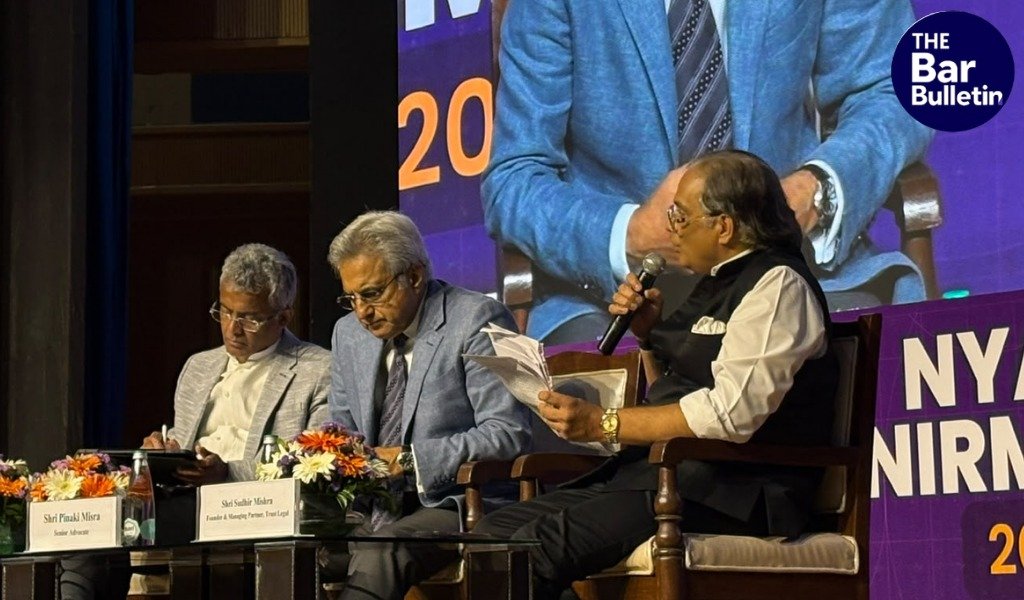

Senior Advocate Pinaki Misra raised concerns over India’s legislative and regulatory framework, arguing that the country’s legal architecture has not kept pace with its global economic ambitions.
‘We have just got bogged down completely with all kinds of nonsensical legislation, which doesn’t help us at all in the global arena’, Misra said while speaking at Shastrartha – Vasudhaiva Kutumbakam and Global Commerce organised by GCAI.
The session was based on the proposition: The future of global prosperity requires greater convergence of legal systems and regulatory frameworks across nations. Misra was joined by Senior Advocate Sajan Poovaya, while Sudhir Mishra, Founder & Managing Partner, Trust Legal, moderated the discussion.
Discussing the role of legislation in economic development, Misra emphasised that effective legislation can facilitate economic activity and need not be contrary to political interests.
Good legislation is not antithetical to good politics. It is coterminous with good politics, he said, stressing the need for legislation that creates an environment conducive to development and investment.
Pinaki Misra argued that India had missed important opportunities to develop an effective legislative framework and said the country remained really far from achieving its global ambitions in terms of legislation.
He also criticised the increasing complexity of India’s legislative framework, referring to the new criminal laws and questioning whether their terminology and structure made them accessible to ordinary citizens. He further flagged concerns over the functioning of tribunals and the development of environmental legislation.
The discussion then moved to India’s position in the global digital economy, particularly the country’s ambitions in the data-centre sector.
Senior Advocate Sajan Poovaya said India had not emerged as a global leader in developing a legislative and regulatory framework governing the cross-border flow of data.
According to Sajan Poovaya, India had an opportunity in the 2000s to develop a framework that could have provided a distinctive approach for the Global South, but instead largely followed regulatory principles emerging from the European Union and the United States.
Poovaya also highlighted the infrastructure requirements associated with India’s expanding data-centre industry. He identified electricity, transmission infrastructure and water availability as significant challenges.
He pointed out that while India’s power-generation capacity, particularly renewable-energy capacity, has been expanding, transmission infrastructure has not necessarily developed at the same pace. He also noted that the concentration of data centres around major cities could intensify infrastructure pressures.
Water availability, Poovaya observed, was another important concern, particularly in urban centres where water resources are already under pressure.
The discussion also examined the implications of international regulatory requirements for businesses operating in India. Poovaya noted that global sustainability and regulatory requirements increasingly have implications beyond the jurisdictions in which they originate, raising questions about India’s ability to meet such standards.
The speakers also discussed environmental regulation, Delhi’s air pollution, institutional responsibility, arbitration and mediation, and the broader implications of India’s legal and regulatory environment for investment.
Addressing the broader investment climate, Misra questioned whether India’s regulatory environment was sufficiently conducive to attracting and retaining investment. He identified the need for an appropriate institutional and regulatory architecture as an important factor in enabling India’s economic growth.