
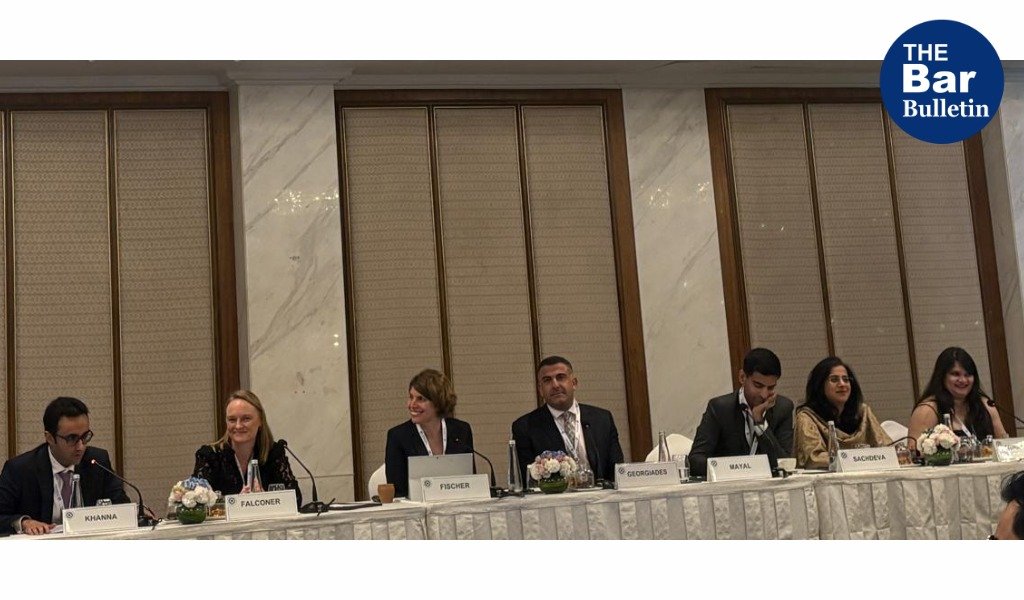

The growing impact of international sanctions on arbitration, the limits of party autonomy, the need for procedural flexibility, the enforceability of emergency arbitration orders and the strategic use of cross-examination were among the key issues discussed during a session titled The Future of Dispute Resolution – The Progressive Pathway at the IBA Next Gen Legal Summit in New Delhi.
The session featured Caroline Falconer, SCC Arbitration Institute; Neeti Sachdeva, Registrar, Mumbai Centre for International Arbitration (MCIA); Agis Georgiades, Christos Georgiades & Associates; Eliane Fischer, Rothorn Legal; and Montek Mayal, Partner, Osborne Partners. Arush Khanna, Partner, Numen Law Offices and Oindrila Mukherjee, Senior Associate, Dentons Link Legal moderated different rounds of the discussion.
Introducing the session, Arush Khanna described the five themes as issues that had moved into the mainstream of international arbitration. The first round followed a speed-dating format, with each speaker addressing one of the five subjects in a short presentation, followed by brief interventions.
Caroline Falconer opened the discussion on sanctions, geopolitical tensions and arbitration. Drawing on the experience of the SCC Arbitration Institute, she explained that the institution had historically administered disputes involving parties from the CIS region, including Russia and Belarus. She noted that approximately 15–20% of the SCC’s ongoing cases in recent years had been affected in some way by sanctions.
Falconer emphasised that counsel handling a sanctions-affected arbitration should remain in close contact with the arbitral institution from the outset. She explained that the SCC seeks to identify the involvement of sanctioned parties even before proceedings commence, as such cases require additional know-your-customer checks and compliance procedures.
She also highlighted the need to identify the applicable sanctions regime, whether under the United Nations, European Union or United States framework. Where US sanctions, including those administered by the Office of Foreign Assets Control (OFAC), are involved, parties must examine whether transactions could pass through US financial channels, including through the use of US dollars. Close coordination with banks is therefore essential.
Sharing the SCC’s experience, Falconer explained that its first sanctions-affected case in 2022 took approximately six months longer than expected because of delays in obtaining the necessary licences. With subsequent experience and an established working relationship with the relevant authorities, the institution had been able to assist parties in obtaining licences within approximately one to two weeks. She urged counsel to initiate licensing applications in good time and highlighted the practical assistance institutions can provide in navigating compliance requirements.
Adding an Indian practitioner’s perspective, Arush Khanna observed that sanctions had become a significant consideration in arbitration practice. He noted that when he began practising in 2012, sanctions rarely featured in the drafting of choice-of-law or arbitration clauses. Their relevance had since expanded beyond drafting and was now also being felt at the enforcement stage, including in light of recent developments in EuroChem and SR Energy.
The next theme, party autonomy vis-à-vis institutional control, was taken up by Neeti Sachdeva. Drawing on her experience at MCIA, she examined whether institutional rules that regulate procedure necessarily interfere with the parties’ freedom to determine how their arbitration should be conducted.
Referring to Sections 18 and 19 of the Arbitration and Conciliation Act, 1996, Sachdeva explained that party autonomy in determining procedure must operate alongside the requirement of equal treatment of parties. She questioned when procedural freedom could become procedural excess, particularly where parties spend a substantial part of the arbitration disputing how the proceedings should be conducted.
She discussed MCIA’s expedited procedures, including the possibility of document-only arbitration. Such procedures, she explained, are intended to offer parties an efficient alternative rather than impose a mandatory process. She illustrated the point through a straightforward payment dispute involving invoices, purchase orders and delivery records, questioning the need for a three-member tribunal, multiple hearing days and extensive pleadings in a matter that could potentially be resolved through a more streamlined process.
Neeti Sachdeva also addressed the role of institutions in ensuring that proceedings remain fair and efficient. Referring to an arbitration in which one party had not proposed any witness, she explained that the tribunal could not compel a party to produce a witness or insist on cross-examination merely because the opposing counsel considered it necessary. The burden of proving the claim remained with the claimant.
A more difficult question, she acknowledged, concerned MCIA’s rule on the appointment of a presiding arbitrator. Under the rule, where parties have agreed to a three-member tribunal, MCIA will appoint the presiding arbitrator. She explained that the purpose was to ensure the appointment of a neutral and independent presiding arbitrator acceptable to all sides, while retaining the parties’ autonomy to nominate their respective arbitrators.
Sachdeva’s position was that party autonomy could be adjusted where necessary to make arbitration work more effectively, but its fundamental promise of fairness should not be compromised.
Agis Georgiades then addressed the question of specialised arbitration rules and procedural flexibility. Drawing on his experience in common-law jurisdictions and the adoption of newer civil procedure rules in Cyprus, he explained how greater powers for judges and tribunals could help tailor proceedings to the requirements of individual disputes.
He observed that flexibility was one of arbitration’s principal advantages, but that parties often entered proceedings with different procedural expectations. Recalling his experience in an ICC arbitration in Paris, he described how his preparation for cross-examination was disrupted when the tribunal adopted a different approach, requiring questions to be put through the arbitrator rather than directly to the witnesses. The example illustrated the procedural differences that can arise in international arbitration.
Georgiades emphasised that tribunals must understand the dynamics of a case before deciding how proceedings should be organised. Relevant considerations include the number of witnesses, the volume of documents, whether the dispute is primarily factual or legal, the applicable procedural and evidentiary laws, and the need to preserve equal access to justice.
He also discussed the growing use of procedural templates and guidelines, including the IBA Rules on the Taking of Evidence, explaining that these can be particularly useful for younger practitioners who may otherwise have to develop procedural frameworks from scratch. However, such standards should not be treated as rigid or automatically applied to every dispute.
Turning to case management, Georgiades stressed the importance of the first case management conference. He explained that this meeting sets the tone for the proceedings and should be used to establish a workable procedural framework, including a timetable extending to the final hearing. He also emphasised the need to agree in advance how procedural requests and additional submissions would be handled.
While supporting flexibility, Georgiades cautioned against excessive procedural uncertainty. He highlighted the importance of retaining a clear timetable and providing mechanisms to adapt the procedure when circumstances require it.
Eliane Fischer addressed emergency arbitration, focusing on the balance between urgent relief and due process. The discussion examined the scope of emergency arbitrators’ powers, the availability of relief before constitution of the full tribunal, and the difficulties that may arise when emergency orders have to be enforced across jurisdictions.
Fischer also addressed the question of whether the ICC Rules’ extension of emergency arbitration provisions to certain non-signatories undermines the principle of consent. She explained that this does not mean that any third party can automatically be compelled to participate in emergency arbitration. The relevant consideration is whether the third party’s conduct demonstrates that it is bound by the arbitration agreement, even if it has not signed the agreement in writing.
She further explained that an emergency arbitrator’s decision is provisional and can be revisited by the subsequently constituted arbitral tribunal. A decision granting interim relief against a third party does not, by itself, mean that the third party becomes a party to the arbitration for the determination of the merits.
On enforcement, Fischer noted that the position varies across jurisdictions. While more countries are increasingly willing to recognise and enforce emergency arbitration orders, obtaining effective relief remains challenging in some jurisdictions. Nevertheless, she explained that such orders can have a deterrent effect. For instance, a bank may hesitate to make payment under a bond when an order restraining payment has been issued, giving the parties time to pursue further measures. A subsequently constituted tribunal may also take the emergency arbitrator’s reasoned decision into account when considering further interim measures or the final award.
Montek Mayal while speaking on the use of cross-examination in arbitration observed that “cross-examination is overplayed as a theatre and underused as an effective forensic tool.” Drawing on his experience as an expert witness, Mayal explained that cross-examination is often not an opportunity to secure a ‘gotcha’ moment or otherwise impress a client, but focused on testing the premise and assumptions underlying an expert’s opinion.
He identified three important considerations for effective cross-examination: testing the premise on which an expert’s opinion is based, examining that opinion against contemporaneous documents, and understanding the evidentiary foundation of the calculations or conclusions being advanced. In the context of damages claims, for instance, projections relied upon by an expert may be inconsistent with contemporaneous business plans or other documents prepared before the dispute arose.
Mayal also cautioned against increasingly unnecessary aggression during cross-examination, observing that aggressive questioning can often have the opposite effect. He emphasised that a well-prepared counsel should know which questions need to be asked and, equally importantly, when to stop.
In the second round, Oindrila Mukherjee led a series of focused questions to the panellists, inviting them to apply their presentations to practical situations encountered in arbitration.
On sanctions, the discussion considered what counsel should do when sanctions threaten access to arbitral proceedings and what assistance they could reasonably expect from arbitral institutions. Falconer reiterated the importance of institutional support and suggested that parties involved in cross-border disputes, particularly those involving sanctioned parties or a risk of sanctions, should consider institutional arbitration rather than proceeding on an ad hoc basis. Institutional assistance can help counsel, parties and arbitrators navigate licensing, compliance and payment-related difficulties.
The discussion on party autonomy returned to the question of how far institutions could intervene in procedural arrangements without undermining the parties’ agreement. Neeti Sachdeva explained the rationale behind institutional intervention, including the appointment of a presiding arbitrator and the consolidation of proceedings. She acknowledged that consolidation could raise questions of party autonomy, particularly where it affects the constitution of tribunals and the costs payable by parties, but noted that institutional intervention could also improve efficiency.
Agis Georgiades was asked how flexible an arbitrator should be when organising proceedings. He emphasised that procedural standards should be adapted to the particular case after considering the applicable law, the parties’ expectations, the nature of the dispute and the resources involved. He identified the first case management conference as a crucial stage for agreeing on the procedural framework, the timetable and the manner in which procedural applications would be dealt with. He cautioned against overestimating the ability to predict every eventuality and stressed the need to build in mechanisms for adapting the procedure.
Fischer was asked whether extending emergency arbitration to non-signatories under the ICC Rules undermines consent to arbitration. She reiterated that the extension does not dispense with consent, as the relevant third party must have demonstrated through its conduct that it is bound by the arbitration agreement. She also underlined the provisional nature of emergency arbitrator decisions and the need for caution when extending arbitration agreements to non-signatories.
Mayal was asked to share an instance where choosing not to cross-examine, or keeping cross-examination short, proved more effective. He recounted an investment dispute concerning a mining project in South America, where a substantial damages claim was made even though the mine had not commenced construction or production.
Although counsel had four hours available for cross-examination of the opposing expert, the questioning was confined to approximately 15 minutes. Instead of examining every input in the valuation exercise, counsel focused on contemporaneous documents that raised doubts about whether the mine would ever become operational. These included documents concerning difficulties in obtaining a social licence from local communities, securing financing and engaging the personnel required to construct and operate the mine.
Mayal explained that focusing on these foundational issues was more effective than questioning every assumption in the damages calculation. The claimants ultimately did not recover the substantial damages sought and were awarded only a comparatively small amount representing expenditure incurred up to that point. The example reinforced his view that effective cross-examination depends on preparation, focus and the ability to stop once the essential point has been established.
In the concluding round, Arush Khanna returned to moderate a common question for all the panellists on the skills that young practitioners should develop to build a successful career in international arbitration and cross-border practice.
Montek Mayal identified financial literacy and commercial judgement as two essential skills. He explained that commercial arbitration frequently revolves around financial issues and that counsel must be able to understand the commercial and financial dimensions of a dispute. He further observed that while artificial intelligence may increasingly undertake analytical work, commercial judgement and the ability to understand the nuances behind a dispute would remain important human skills. He emphasised that legal advice should be directed towards achieving the appropriate commercial outcome for the client, rather than focusing exclusively on legal questions.
Georgiades identified adaptability and creativity as important attributes. He explained that the skills required of a junior lawyer such as research, diligence and technical preparation are different from those needed to become a successful partner, who must also be able to build relationships, attract clients and earn trust. He encouraged young practitioners to develop their own approach rather than merely imitate senior professionals, while learning from both their successes and mistakes.
He also highlighted the importance of professional credibility, noting that arbitration practitioners are assessed not only during hearings and conferences but also through their professional interactions, conduct and public presence. A reputation for diligence, honesty and seriousness remains important in a field where potential clients and appointing authorities may be observing practitioners over time.
Neeti Sachdeva emphasised the importance of building meaningful professional networks. She encouraged young practitioners to use conferences and professional gatherings to engage in substantive discussions rather than limiting interactions to casual conversations. She also advised them to exercise care in professional communication, particularly when applying for internships or positions. Applicants should ensure that they address the correct institution or organisation and understand the role for which they are applying. She cautioned against seeking appointments as arbitrators without the requisite experience.
Falconer identified language skills and professional conduct as important advantages in international arbitration. While proficiency in English is essential, the ability to understand another language can be particularly useful where documents or evidence are presented in languages other than the language of the arbitration. She also stressed the importance of maintaining professional and courteous relationships with arbitral institutions, counsel and other members of the tribunal, noting that the ability of arbitrators to work collaboratively across different nationalities and legal cultures is an important consideration.
The session concluded with a discussion on the evolving demands of international arbitration practice, bringing together institutional experience, procedural innovation and practical advice for young practitioners seeking to build cross-border careers.