
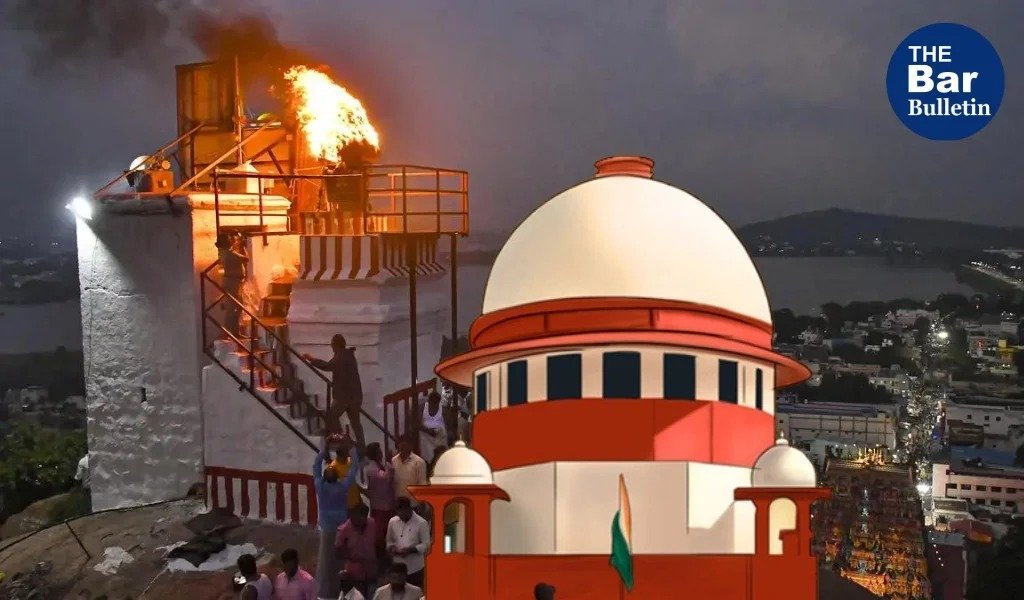

The Supreme Court on Friday directed that the ceremonial lamp (Deepam) be lit at the Deepathoon on Thiruparankundram hill on Saturday, while issuing contempt notices to senior Tamil Nadu officials and temple authorities over the failure to implement its earlier direction permitting the ritual on November 24.
A Bench of Justice Aravind Kumar and Justice Vipul M Pancholi also suspended the Board of Trustees of the Arulmigu Subramaniya Swamy Temple and appointed two former judges as receivers to take over its administration. The Court directed the Central Reserve Police Force (CRPF) to take over security of the temple and the entire hill, including the area around the Sikandar Dargah.
The Court was hearing contempt proceedings alleging non-compliance with its November 20 order, which had permitted the lighting of the lamp at the Deepathoon through a restricted team authorised by the temple Devasthanam, subject to safeguards.
Petitioners allege deliberate disobedience
Senior Advocate Guru Krishnakumar, appearing for the petitioners, argued that the responsibility for implementing the Supreme Court’s direction rested with the District Collector and other authorities. He described the Collector’s status report as a “confessional statement” and alleged that the temple trustees had taken a decision to light the lamp only at the customary location, thereby frustrating the Court’s order.
He also questioned the constitution of the Board of Trustees and submitted that the trustees had not challenged the earlier High Court orders directing the lighting of the lamp at Deepathoon.
Senior Advocate J Sai Deepak, appearing for a devotee, submitted that the November 20 order did not leave it to the State or temple administration to decide whether the lamp should be lit at Deepathoon. He argued that the Collector’s role was confined to coordinating the composition of the authorised team with the temple Executive Officer, ASI and Commissioner of Police. Senior Advocate J Sai Deepak submitted:
“
“The lighting of the lamp was permitted by this Court at the stone pillar identified as Deepathoon. The composition and number of persons were to be settled by the District Collector in consultation with the temple Executive Officer, the ASI and the Commissioner of Police. The existing religious observance at the customary location was to continue undisturbed, but that could not be a reason to not implement the specific direction issued by this Court.”
He further alleged that the trustees had been used as a vehicle to frustrate the Court’s order and sought a direction for the lamp to be lit on another day during the ongoing Karthigai month.
Solicitor General Tushar Mehta, appearing for the Archaeological Survey of India (ASI), submitted that the ASI officials had been prevented by the police from reaching the stone pillar and were asked to return later. He argued that the filing of a review petition could not justify non-compliance with the Supreme Court’s order. SG described the conduct as aggravated contempt and submitted that a deliberate decision by executive authorities to disobey the Court’s direction could also attract criminal contempt jurisdiction under Article 129 of the Constitution.
He urged the Court to consider having the contempt purged by ensuring that the lamp was lit, and suggested that security arrangements be placed under a neutral authority.
Senior Advocate Gopal Sankaranarayanan, appearing for the Madurai District Collector, denied that there had been any deliberate attempt to disobey the Supreme Court’s order. He referred to meetings held by the Collector on November 21, 22 and 23, and submitted that the administration had coordinated with the temple authorities, police and ASI.
He argued that the Collector had acted as the nodal officer and that arrangements had been made for the authorised team to reach the hilltop. He also maintained that the Collector had not undertaken to personally light the lamp, but had stated that the Supreme Court’s order would be complied with. He submitted:
“
“The mere fact that we have filed a review petition cannot be a ground for us not to comply. I made this submission to the High Court as well. The District Collector is answerable only to this Court in the matter, and the Collector has taken steps to ensure compliance with the directions. The fact that the lamp was not lit is not in dispute, but the question is whether it was on account of any fault on our part.”
Senior Advocate Siddharth Luthra, appearing for the Commissioner of Police, submitted that extensive security arrangements had been made for the occasion. He told the Court that a total of 5,797 police personnel had been deployed, including local police, armed reserve police, Tamil Nadu Special Police personnel and Home Guards.
He argued that the police were prepared to escort the authorised team to the hilltop and that the deployment was sufficient to maintain law and order.
Senior Advocate Jaideep Gupta, appearing for the temple Executive Officer, submitted that the Board of Trustees was responsible for taking decisions concerning religious observances and that the Executive Officer could not override a decision taken by the Board.
Senior Advocate Abhishek Manu Singhvi, appearing for the HR&CE Commissioner, argued that the November 20 order was carefully calibrated and that paragraph 11 gave the trustees some leeway in deciding the manner of implementation. He denied any wilful disobedience or pre-planned conspiracy, while submitting that the trustees may have committed an error in exercising their discretion. Mr Singhvi submitted:
“
“Your Lordships, on the contrary, were extremely circumspect and calibrated in the order. There may have been an error, but to suggest almost a pre-planned conspiracy of the nature that has been argued is not justified. The trustees may have wrongly exercised their discretion, and they may have violated the order, but that does not by itself establish wilful disobedience. To raise it to the pitch of an overall conspiracy is totally wrong and out of place.”
The Bench rejected the argument that the November 20 order had given the trustees any discretion to decide whether the lamp should be lit at Deepathoon.
Supreme Court finds prima facie administrative chaos
In its order, the Bench observed that the failure to light the lamp at Deepathoon, when considered alongside the resolution passed by the temple trustees, prima facie disclosed wilful and flagrant disobedience of its earlier direction.
The Court expressed concern over what it described as a state of “administrative chaos” in Tamil Nadu, at least in Madurai district, and said that executive officers appeared to have acted on the dictates of their political superiors. The Bench observed:
“
“An executive authority that presumes to decide whether an order of this Court deserves to be obeyed arrogates to itself a power the Constitution has never conferred upon it. Wilful defiance by the officers charged with carrying the orders of this Court into effect is itself a flagrant breach of constitutional duty. The wilful non-compliance of the order of this Court, especially by the executive authorities, cannot go unnoticed and it has to be dealt with iron hands.
An order of this Court is not an invitation to negotiate; it binds the State functioning under the Constitution until this Court itself modifies it. Therefore, when an order of this Court is flouted, we cannot sit in silos. Any attempt, direct or indirect, to undermine this constitutional mandate would be firmly curbed without any misplaced sympathy.”
The Bench added that the matter had reached a stage where it had to be dealt with firmly, warning that the situation could otherwise lead to constitutional chaos.
Contempt notices to Tamil Nadu Chief Secretary, DGP and other officials
The Court issued notices to the Tamil Nadu Chief Secretary M Sai Kumar, DGP Mahesh Kumar Agarwal, Madurai District Collector, Madurai Commissioner of Police, Madurai Superintendent of Police, Joint Commissioner of the HR&CE Department, the temple Executive Officer and members of the Board of Trustees.
The State Government was directed to ensure personal service of the notices within three days and the Chief Secretary was asked to file an affidavit confirming service. The persons named in the order were directed to appear personally before the Court on December 15, 2026.
The Bench clarified that the notices were based on a prima facie view and that it would examine the status report and other material before arriving at a final conclusion on contempt.
The Supreme Court ordered that the Board of Trustees be suspended for the time being and appointed former Meghalaya High Court Chief Justice S Vaidyanathan and former Madras High Court judge V Parthiban as receivers to take immediate charge of the temple administration.
The receivers were directed to administer the temple in accordance with its traditions and rituals and to comply with applicable laws, rules and regulations.
CRPF to take over security; Deepam to be lit tomorrow
Observing that the police administration had failed to implement its earlier order, the Court directed the CRPF to take over security of the temple and the entire hill. It said the force must ensure that devotees visiting both the temple and the Dargah are able to perform their respective religious rituals without obstruction.
The receivers were directed to ensure that the Deepam is lit at Deepathoon on November 28, 2026. The Court also directed that devotees be permitted to light the lamp at a distance of at least 50 metres from the Sikandar Dargah, with the CRPF authorised to take necessary steps to protect the Dargah and ensure that its visitors are not hindered.
The Bench further clarified that the interim arrangement would not create any equities in favour of either party and would not determine the underlying dispute.