
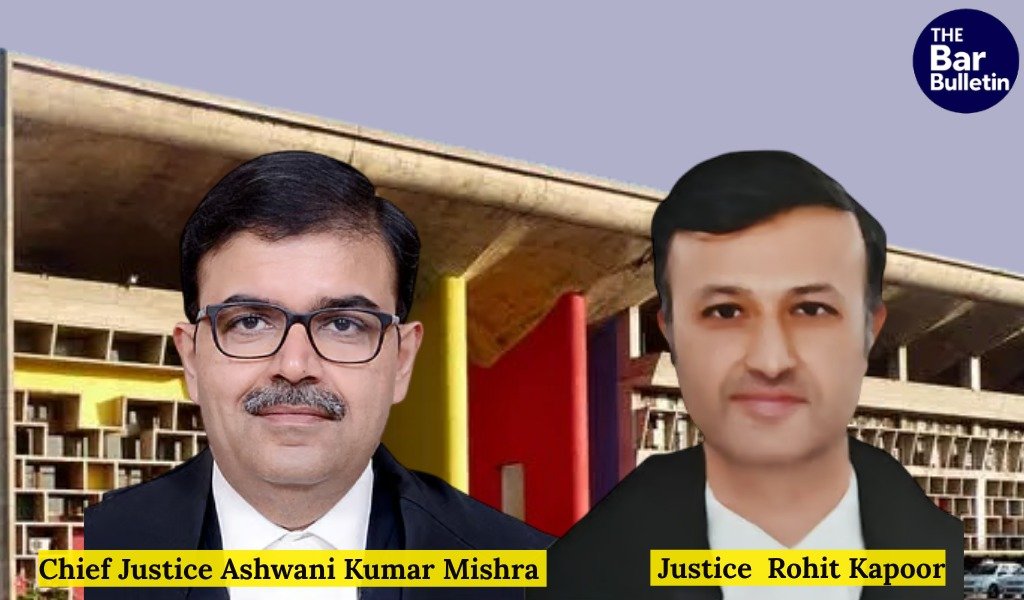
The Punjab and Haryana High Court has rejected an application seeking intervention in a pending suo motu Public Interest Litigation to challenge the continued occupation of a government residence in Chandigarh by Tej Parkash Singh, son of former Punjab Chief Minister Beant Singh, holding that the case was distinguishable in view of the security threats faced by his family.
A Division Bench comprising Chief Justice Ashwani Kumar Mishra and Justice Rohit Kapoor observed that the Supreme Court’s directions against former public functionaries retaining government accommodation beyond their tenure could not be relied upon to contend that Tej Parkash Singh must vacate the premises, particularly after the Chandigarh Administration reconsidered the matter based on threat assessments and intelligence inputs.
The application was filed by Kulwant Singh, who sought to be impleaded as an intervener and Tej Parkash Singh as a respondent in the pending PIL. The applicant contended that the allotment of House in Chandigarh, had been cancelled on May 20, 2020, and that the cancellation order had not been challenged. He alleged that the continued occupation of the premises by a former MLA violated the law governing government accommodation.
The Chandigarh Administration informed the Court that the residence had originally been allotted to Beant Singh’s family and that the allotment was cancelled in 2020 following the Supreme Court’s directions concerning government accommodation for former public functionaries. However, after Tej Parkash Singh sought continuation of the allotment, the competent authority reconsidered the matter in light of security concerns.
The Administration’s affidavit referred to a Joint Security Committee assessment identifying continuing threats to the family, including alleged threats from extremist organisations, grenade attacks and other terror-related incidents, threat calls, hostile social media campaigns and intelligence inputs. The Committee recommended that the existing residence was strategically suitable and appropriate from a security perspective.
Taking these circumstances into account, the High Court found no merit in the application seeking enforcement of the earlier cancellation of the allotment and rejected the intervention application.
Separately, in the pending suo motu PIL, the Court directed the Chief Engineer of the Chandigarh Administration to file a personal affidavit explaining why necessary repairs had not been carried out in government houses allotted to High Court employees. It further directed that the repairs be undertaken on priority and that compliance be intimated to the Court.
The matter has been listed for November 26, 2026.
