
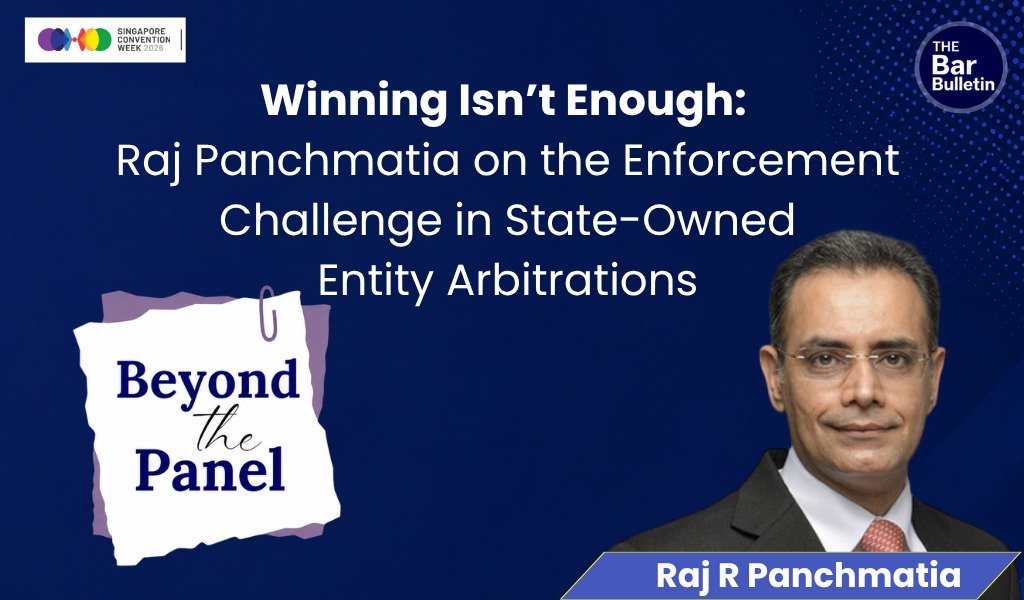

Raj Panchmatia, Partner at Khaitan & Co, recently participated in a panel discussion during Singapore Convention Week 2026 on “Disputes Involving State-Owned Entities: Emerging Issues in International Arbitration.” The session examined the distinctive challenges that arise when State-owned entities are involved in international disputes, including sovereign immunity, enforcement against State assets, attribution, investment treaty protection and damages.
In this Beyond the Panel conversation with The Bar Bulletin, Raj Panchmatia shares his perspective on navigating disputes involving State-owned entities and the practical considerations that can shape strategy long before an arbitration begins.

1. When entering a contract with a State-owned entity, what is the one risk private parties most often fail to assess at the outset?
The single greatest oversight is the failure to think beyond the four corners of the contract and ask a deceptively simple question, if things go wrong, can I actually recover? Private parties devote enormous energy to negotiating terms such as price, delivery, indemnities, Limitation of liability, Compensation for Termination, Sunk Costs yet rarely pause to stress-test the enforceability architecture against a sovereign or quasi-sovereign counterparty.
What this means in practice is that parties must assess, at the contracting stage itself, the legal personality of the entity they are dealing with, the extent to which it can claim sovereign immunity, Change in Law, Tariff Regulations, Regulatory Changes and the nature and location of assets that might be available for satisfaction of an award. A State-owned enterprise may appear to operate on commercial terms, but its assets may be sometimes shielded by domestic legislation, or its obligations may be disclaimed by the State on the basis that the entity acted independently.
Equally important is the choice of seat and the governing law of the arbitration agreement. These are not merely procedural niceties, they determine the legal framework within which any eventual challenge to enforcement will be adjudicated.
“
A well drafted dispute resolution clause, ought to clarify it’s a commercial contract, and includes an express waiver of immunity clause, a carefully chosen institutional framework, and a seat in an enforcement-friendly jurisdiction, can make the difference between a paper victory and a meaningful remedy.
In my experience, the parties who fare best in disputes with State-owned entities are those who treated the dispute resolution clause as a commercial term and gave it its fair due and importance, not a midnight clause to be settled at the last moment. The contracting stage is when the outcome of a future dispute is often determined. The commercial pressure to close transaction can lead parties to accept ambiguous language or to defer difficult issues, and it is those very ambiguities that become the battleground years later.
2. How should parties think about enforcement differently when the counterparty ultimately has State-linked assets?
Enforcement against State linked assets requires a fundamental shift in mindset. In ordinary commercial arbitration, enforcement is typically the final chapter, you obtain an award and pursue assets in a relatively predictable fashion. When a State or State owned entity is on the other side, enforcement must be the first chapter of your strategic thinking, not the last. Enforcement against state or SOE is different from enforcement against a private company, but the difference is navigable and Indian courts have taken a notably progressive approach on the issue.
The critical distinction lies in the doctrine of sovereign immunity from execution, which operates independently of immunity from jurisdiction. A State may consent to arbitration, and even waive jurisdictional immunity, without thereby consenting to the seizure of its assets. The result is that award holders often find themselves with a binding award but no straightforward path to recovery. This asymmetry between the right to an award and the ability to enforce it is, in many ways, the defining tension in disputes involving sovereign parties. Delhi High Court in KLA Const. Technologies Pvt Ltd. V. Embassy of Islamic Republic of Afghanistan, 2021 SCC OnLine Del 3424 delt with this issue.
Practically, this means parties must map the asset landscape early. Where are the counterparty’s commercial assets located? Are they held directly by the State or through intermediary vehicles? Do they enjoy immunity under the law of the jurisdiction where enforcement is sought? The answers to these questions will vary considerably depending on the domestic legislation of each relevant jurisdiction, and in many States, the line between commercial and sovereign assets remains blurred.
“
Parties should also consider diversifying their enforcement options.
The interplay between contract claims and investment treaty claims is increasingly a live strategic consideration, and building optionality into your dispute resolution framework from the outset is no longer a luxury, it is a necessity.
3. In disputes involving States and SOEs, is the bigger challenge winning the arbitration or making sure the eventual award is actually enforceable?
I would say the greater challenge, without question, lies in enforcement, and I think most practitioners who have navigated these disputes would agree. Winning the arbitration is demanding, these are complex proceedings, often involving sensitive political dimensions and questions of attribution. But the arbitral process, for all its difficulty, operates within a structured framework with well-established procedural safeguards.
Enforcement, by contrast, is where the architecture of international arbitration confronts its most stubborn limitation. The New York Convention provides a robust framework for the recognition and enforcement of arbitral awards, but it was probably not designed with sovereign respondents principally in mind. The moment you move from obtaining an award to executing against State linked assets, you enter a patchwork of domestic legal regimes, each with its own conception of sovereign immunity, its own rules on what constitutes commercial property, and its own judicial temperament towards foreign arbitral awards.
“
What makes enforcement particularly challenging is that it is often a moving target. States can restructure asset holdings, invoke immunity defences at multiple stages. The enforcement landscape is also fragmented, a strategy that succeeds in one jurisdiction may be entirely unavailable in another.
This is precisely why I emphasise that enforcement must inform strategy from the very beginning. The most effective practitioners in this space do not treat arbitration and enforcement as sequential phases, they treat them as a single, integrated exercise. The question is never simply “can I win?” it is “can I win in a way that leads to a meaningful, recoverable outcome?”