
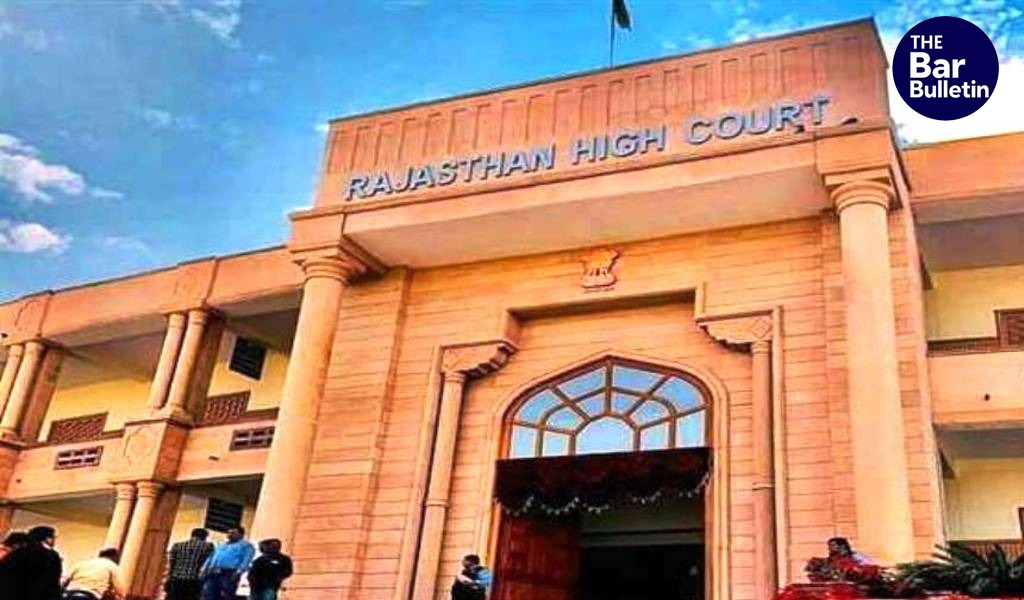

In a writ petition arising from illegal termination of a Post-Graduate Hindi Teacher with 20 years of unblemished service, the Rajasthan High Court (Jaipur Bench) has modified the Rajasthan Non-Government Educational Institutions Tribunal’s compensation award, holding that a measly Rs. 1 Lakh for an illegal termination spanning over 67 months was “shockingly disproportionate” and amounted to permitting the employer to take benefit of its own wrong.
The Court clarified that where termination is found to be illegal and wrongful, reinstatement with continuity of service and back wages is the normal rule, and the burden lies on the employer to prove that the employee was gainfully employed during the intervening period if it seeks to avoid payment of full back wages.
Emphasising that compensation for wrongful termination should neither be ‘measly’ nor a ‘bonanza’, and must be determined having regard to aggravating and mitigating circumstances, the Court held that while reinstatement is not an automatic remedy, lump-sum monetary compensation in lieu thereof must meet the minimum respectable yard-stick, both in monetary terms and in restoring the dignity and honour of the employee.
A Single Judge Bench of Justice Anuroop Singhi observed that the reason for terminating the services of the petitioner, who was a Post-Graduate Teacher and had rendered services for around 20 years with the respondent-School, was that there were no students for the subject ‘Hindi’, which cannot by itself constitute a valid ground for termination of her services, a finding which had also been recorded by the Tribunal vide the impugned order dated April 16, 2024. The Court further observed that having held so, it was equally incumbent upon the Tribunal to determine the dues payable to the petitioner, which would have met the minimum respectable yard-stick, not only in monetary terms, but also to pay back the respect and honour which the petitioner would have earned, if she had rendered the services for the entire period.
The Court noted that the services of the petitioner were terminated with effect from May 14, 2015 and the date of her superannuation was Dec 31, 2020, and thus, the period between the date of termination and the date of superannuation spanned more than sixty-seven months. The last pay drawn by the petitioner, as stated before the Court, was approximately Rs.50,000/- per month. A simple mathematical computation, by applying the last drawn salary to the interregnum period, would result in a figure of approximately Rs. 33.50 lakhs.
The Court further observed that it is a settled position of law that no one can be permitted to take benefit of its own fault. Once the Tribunal had arrived at a categorical finding that the termination was bad in law, under no circumstances could the quantification of the amount to be paid to the petitioner have been such which would have kept the respondents in a win-win position and left the petitioner high and dry, and which was shockingly disproportionate.
The Court also took note of the fact that the petitioner was a Post-Graduate Teacher of the subject ‘Hindi’ and had rendered services for around 20 years to the respondent-School. It was also a matter of record that her services were not terminated on account of any misconduct on her part, and nothing had been placed on record to establish that she was gainfully employed during the interregnum period.
Briefly, the petitioner, Rani Gupta, was appointed as a Teacher with the respondent-School, Maheshwari Public School (a unit of Mahesh Shikshan Sansthan), Ajmer, with effect from July 05, 1995. She was subsequently promoted as Lecturer/Post-Graduate Teacher in the subject of ‘Hindi’ with effect from July 01, 1998 and was confirmed as Lecturer with effect from July 01, 2000, thereby rendering approximately 20 years of service with the respondent-School.
The Managing Committee of the respondent-School, in its meeting held on Jan 28, 2015, vide resolution No.6, resolved to discontinue the services of the petitioner on the sole ground that there were no students for the subject ‘Hindi’ being taught by her, and accordingly, a three months’ notice was issued. In consequence of the said resolution, a communication dated Feb 11, 2015 was issued, whereby it was ordered that the services of the petitioner would come to an end with effect from May 14, 2015.
Aggrieved by the said order, the petitioner filed an appeal before the Rajasthan Non-Government Educational Institutions Tribunal, Jaipur, under Section 19 of the Rajasthan Non-Government Educational Institutions Act, 1989. In reply, the respondents submitted that the services of the petitioner had been terminated in compliance of Rule 29(2) of the CBSE Bye Laws, which permits termination of a confirmed employee in the event of abolition of a post due to closure of school, a class, reduction in number of sections, or discontinuance of a teaching subject, by giving three months’ notice in writing or three months’ salary including all allowances.
The Tribunal, while considering the entire facts placed before it, arrived at a categorical finding that the termination of the services of the petitioner had neither been done in compliance of Rule 29(2) nor in compliance of the provisions of Section 18 of the Act of 1989, and therefore, the said termination was bad in law. However, considering the fact that the petitioner had already reached the age of superannuation and had not rendered any service from the date of her impugned termination till the date of her superannuation, the Tribunal awarded a lump-sum compensation of Rs. 1 lakh only, to be paid within one month from the date of the order.
