

“
“Who truly holds the reins, when the machinery of justice is powered by artificial intelligence?”:
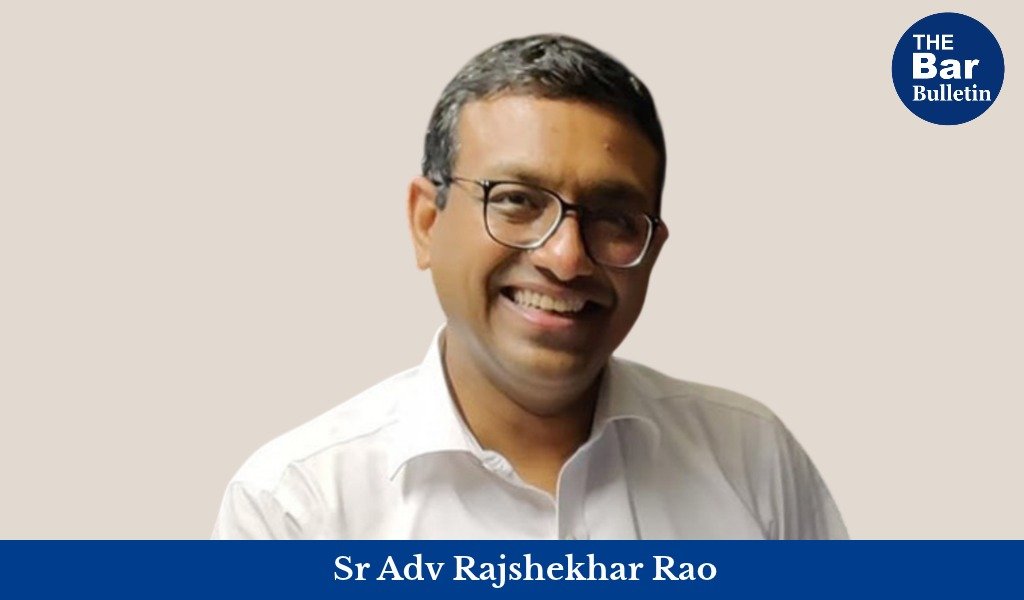
Sr. Adv. Mr. Rajshekhar Rao on AI, Humanity and the Future of Adjudication
“
“The responsibility for administering justice cannot be outsourced. It must remain firmly rooted in the judge, and more importantly, it must remain human.”
Sr Adv Rajshekhar Rao at the 1st DNLU ‘JUSTECH’ National Conclave.
Delivering his address at the 1st DNLU ‘JUSTECH’ National Conclave. Mr. Rajshekhar Rao reflected on the interplay between AI and the future of justice, examining whether technology can transform the administration of justice while preserving the human element at its core. Beginning with a deeply personal anecdote from his early years at the Bar, he illustrated why the edifice of justice must remain humanity, even as technology assists its administration.
The Defining Moment: A Lesson in Humanity
Mr. Rao recounted a morning in December 2011, when as a young legal aid lawyer he appeared before the late Justice Valmiki Mehta in the Delhi High Court. He was representing a woman with a minor child who had been evicted from her house by her father-in-law. The law at the time was emphatic that a daughter-in-law had no claim to the estate of her in-laws. Struggling to find a solution, Mr. Rao recalled entering the courtroom and hearing the Judge lashing out at a senior advocate, quoted:
“
“This is the problem with you lawyers. You don’t advise your clients. How can you advise a lady that she has a right in her father-in-law’s estate?”
“
That, in my mind, is the defining aspect of what justice is,” Mr. Rao said.
The Question of the “Driver’s Seat”
Mr. Rao observed that the question is not whether artificial intelligence will transform the judiciary it almost certainly will. The more consequential question to my mind is, who or what, as the topic suggests, should be in the driver’s seat when justice is being administered. On that, he said, there is no doubt, “It is the judge.”
“
He noted that notwithstanding references to AI bot judges,
“We will, at least in our lifetime hopefully and going forward, always see a human presence on that chair a human presence who answers and adorns that chair by swearing an oath, at least in the High Court and the Supreme Court, in terms of Article 60.”
Quoting Sir Edward Coke from the late 1500s, “reason is the life of the law. Nay, the common law itself is nothing else but reason” and contrasting it with Sir Oliver Wendell Holmes’s observation about law being experience not logic, Mr. Rao said these conflicting viewpoints reflect the very issues one faces when looking at the interplay of law and technology.
Technology as an Instrument of Democratizing Justice
Addressing the first question, Mr. Rao noted that technology is an instrument of democratizing justice. He observed that in the last five to seven years, India has seen a jurisdiction that embraced technology during COVID, making the West look and marvel.
“
“I have friends from abroad who have come here, seen our courtrooms, and are wondering how we don’t use a piece of paper in most of our courtrooms today. That is a remarkable situation, given the pressures that the Indian judiciary operates under.”
He noted that the numbers are staggering, the volume exorbitant, and the backlog incredible. Adding that legal aid programmes have scratched the surface and there is a lot more to be done.
On what AI can do, Mr. Rao observed that AI has helped in translating judgments, reading procedural documents, making legal information more accessible to persons who cannot navigate legal databases, assisting persons with disabilities, and improving filing and efficiency on the procedural front.
“
“These are not marginal improvements. They have the potential to alter the economics of accessing justice.”
He cited the example of Orissa, where access points established across district courts enabled lawyers to appear directly before the High Court, improving litigants’ access to legal representation. This reduced dependence on intermediaries and allowed lawyers familiar with their clients’ grievances to present them more effectively. He further noted that 817 of Orissa’s 845 courts had ICT infrastructure and video-conferencing facilities, facilitating approximately 7.61 lakh virtual hearings till June 2026. He highlighted this as an example of technology advancing access to justice, while cautioning that:
“
“Access to a chatbot is not access to justice. Access to a translated document does not necessarily mean that the person has the right translation. A word misunderstood by the chatbot alters the entire thesis. And that is why we have this whole aspect of hallucination.”
Efficiency Cannot Substitute Adjudication
Addressing the constitutional and institutional risks, Mr. Rao emphasised that efficiency cannot become a substitute for adjudication. There is a fundamental distinction between the judge and the machine. Adjudication is not simply the processing of information. It involves the evaluation of competing claims, assessment of evidence, interpretation of legal principles, the application of law to facts, and more importantly, the exercise of judicial discretion.
He illustrated this by referring to the definitional sections of statutes:
“
“Section 2 or Section 3 in some instances, the definitional section in most statutes, says, unless the context otherwise requires. And that tells us that the same word can have multiple meanings in the same statute, depending upon where it is placed. I am not certain that technology, at present and in the near future, has the ability to make that distinction. Or will have the ability to make a choice between two competing interpretations when called upon to do so at a defining moment.”
Referring to his own case from 2011, he said:
“
“Technology would have probably said, sorry, Supreme Court says, this is a daughter-in-law asking for a right in a father-in-law’s estate. No belief. Would not have taken that additional step forward and found a way to do justice.”
He emphasised that the legitimacy of judicial power rests not only upon the correctness of the result, but upon the process through which that result is reached.
Bias, Opacity and Privacy
Mr. Rao flagged the problem of bias, noting that technology is dependent on the input that it receives.
“
“We are still not certain as to what inputs go in. A judge’s experiences define his or her response to a problem. Technology is an aid, therefore, and only helps that experience to address a situation in a more efficient and emphatic manner.”
On privacy, he shared an anecdote:
“I was logging in for my flight today, and when I sent my ticket to Digi Yatra, I was asked to give consent on eight data points. If I didn’t want one of those, I would not have been able to take Digi Yatra, and I would have had to stand in line. Do I have the confidence as a litigant that the information that I’m feeding in is available only to those that matter and is not going to be misused or is not going to be used elsewhere?” He also noted the lingering debate on the right to be forgotten.
The Need for Clear and Consistent Regulation
Mr. Rao referred to the draft regulations on the use of AI in courts, describing them as:
“
“One of the most defining moments because any use of technology, A, must be sanctioned right from the very top, number two, must be clear and consistent so that there is no ambiguity for any lawyer where he practices.”
He noted that the beauty of the Indian system is that a lawyer enrolled in the Bar Council of Nagaland can still practice in the highest court of the land:
“There must be one standard and that standard, fortunately, is now being laid down.”
He also commended the Supreme Court’s practice of maintaining an official database and the ability to use a QR code to verify whether a judgment is authentic. “These are basic rules.”
Mr. Rao urged the younger generation to remember that reliance on technology must not replace fundamental legal skills. He posed a question:
“
“What happens if your iPad or your computer suddenly decides to stop working or refuses to open and it happened to be two minutes before I came up? Are you confident as youngsters and as the future that you have the ability to still argue that case, to still remember those page numbers and more importantly to be able to assist in the most solemn obligation that as lawyers we have to assist the judge there to do complete justice.”
Mastering the Tool
Mr. Rao concluded with practical guidance:
“
“A lawyer who uses AI to identify authorities must read the judgments. Use AI to summarise, please look at it and at times please note your opponent who relies on a summary may miss that one little comma in a document which defines the entire outcome of that case.”
He emphasised:
“
“The lawyer of the future will certainly need technological competence but technological competence without legal judgement will be a dangerous combination. We have to build in safeguards, we have to hold ourselves accountable. Once we start doing that the system works for itself.”
Quoting in Gen Z’s language, he said, “Use Harvey, don’t let Harvey overpower you.” He added:
“
“It’s very easy to say that AI is going to take away our jobs, AI is going to transform lives. Of course it is going to transform lives. The test is, are you allowing it to become a master or are you allowing it to become a master? He who masters the ability to deal with the tool is ultimately going to be the person who will honour or discharge his obligations to the fullest.”
Conclusion: The Buck Stops with Us
Mr. Rao’s address underscored that while technology may assist the administration of justice, the responsibility for administering justice must remain human.
“
“No matter what technology you use, no matter what tools
you use, the buck ultimately does stop with us.”
His reflections served as a reminder that the pursuit of efficiency must never eclipse the foundational principles of fairness, empathy and human judgment that define the judicial function.
***
Mr. Guru Krishna Kumar Subramaniam (Senior Advocate, Supreme Court of India)
“
“Algorithmic Justice & the Reincarnation of the Judiciary”:
Mr. Guru Krishna Kumar on the Role of AI in Transforming the Justice System while speaking in Session I of the Conclave
“
“I read a very interesting article which spoke about how adoption of AI is like choosing between human arbitrariness and machine arbitrariness. Human arbitrariness is capable of correction. Machine arbitrariness is not. AI is a Wonderful Servant but Can Be a Dangerous Master.”
Mr. Guru Krishna Kumar Subramaniam,
Sr. Adv., Supreme Court of India
at the 1st DNLU JusTech National Conclave.
Delivering his address at the 1st DNLU ‘JUSTECH’ National Conclave, Mr. Guru Krishna Kumar began by sharing an anecdote about his junior colleague’s experience with ChatGPT, highlighting how AI-generated responses depend on the information fed into the system and may reflect limitations or biases.
Tracing the concept of algorithmic justice to MIT’s Algorithmic Justice League, he emphasised the need for equitable and accountable integration of technology into the justice delivery system. While acknowledging challenges such as judicial delays, pendency and limited access to justice, he cautioned against placing technology in the driver’s seat.
“
“When we talk of integrating technology in an equitable and accountable manner into administration of justice, the first question that will come to you is, can it be in the driver’s seat? I would respectfully say that for deciding whether algorithmic justice should be in the driver’s seat in integration of technology into law, one has to understand the role it has to play.”
The Limitations of AI
Drawing parallels between the Bhagavata Purana and artificial intelligence, Mr. Guru Krishna Kumar used the example of Prahlada to explain how AI generates outputs based on its training data. Citing Amazon’s AI-based recruitment tool, which reportedly favoured male candidates due to gender imbalances in its training data, he highlighted the risks of biased datasets:
“
“When you talk of AI, when you talk of algorithmic participation or algorithmic involvement, you are talking of spotting patterns where the extent to which you feed an information, the quality of the data that you put in, the quality of the output is determined entirely by that.”
He further emphasised that AI systems are task-specific and time-bound, making their outputs susceptible to becoming outdated. While AI may assist in evaluating objective parameters, judicial discretion and decision-making must ultimately remain with human judges.
Applications of AI in Judicial Administration
Turning to the practical applications of AI, Mr. Guru Krishna Kumar identified judicial pendency, delays in trials and prolonged consideration of bail applications as areas where technological intervention could be particularly useful. He highlighted the potential of AI in examining voluminous documentary evidence and preparing concise summaries to assist judges. Explaining the role that AI could play in such processes, he observed:
“
“AI can be extremely useful in helping and I use the expression helping and assisting in decision making as to prioritization of cases. You have large tomes and tomes of paper of evidence. You want to get a gist of what that evidence says. There you can harness AI.”
However, he clarified that these applications must remain confined to assisting judicial decision-making rather than determining the outcome of disputes independently.
Regulation of Artificial Intelligence: A Risk-Based Approach
Mr. Guru Krishna Kumar emphasised the need for a risk-based regulatory framework for AI, referring to the European Union’s AI Act and the Supreme Court’s draft regulations, which envisage varying levels of risk, human intervention and approval mechanisms.
Citing examples from Amazon’s recruitment tool, the Netherlands’ automated welfare system and China’s AI-based traffic adjudication, he highlighted the risks of algorithmic bias and erroneous outcomes. Referring to the safeguards envisaged under the Supreme Court’s draft guidelines, he observed:
“
“One important aspect of every type of AI, be it the highest risk AI or the medium risk AI or the lowest risk AI, each type of AI is subject to human intervention under the Supreme Court Draft Regulations Guidelines and is subject to approval by the competent authority.”
Through these illustrations, he explained and demonstrated that technological efficiency alone could not guarantee fairness or accuracy. The use of AI in judicial processes therefore required safeguards proportionate to the risks involved, along with meaningful human supervision at every stage.
AI in Legal Practice: Efficiency, Ethics and Employment Concerns
Mr. Guru Krishna Kumar observed that AI had become increasingly prevalent in legal practice, remarking:
“
“Somebody told me jokingly that there are two types of lawyers. There are these lawyers who use AI and there are these lawyers who lie that they don’t use AI. To that extent, use of AI has become so rampant.”
While acknowledging its efficiency in tasks such as generating legal notices, he cautioned against unverified AI-generated content and highlighted concerns surrounding human involvement, employment opportunities and professional ethics. Referring to UNESCO’s principles on ethical AI, he emphasised that technological advancement must not compromise human dignity.
Learning, Unlearning and Relearning in the Age of AI
Reflecting on the changing demands of the legal profession, Mr. Guru Krishna Kumar invoked the observation of futurist Alvin Toffler:
“
“The illiterate of the 21st century are not those who can’t write and speak, but those who cannot learn, unlearn and relearn.”
He emphasised that legal professionals must adapt their approaches to legal research and practice, using AI to improve efficiency and access to information while ensuring that its outputs are carefully verified.
Conclusion: Keeping Human Agency in the Driver’s Seat
Concluding his address, Mr. Guru Krishna Kumar acknowledged the growing necessity of AI in the legal profession and justice delivery system while cautioning against its unregulated adoption. Highlighting the risks of machine-driven arbitrariness, he observed:
“
“I read a very interesting article which spoke about how adoption of AI is like choosing between human arbitrariness and machine arbitrariness. Human arbitrariness is capable of correction. Machine arbitrariness is not.”
Using the analogy of a supersonic aircraft without a pilot aware of its direction, he cautioned against technological advancement without human control. He concluded that “AI is a wonderful servant but can be a dangerous master,” reaffirming that algorithmic justice must necessarily operate with human intervention.
***