
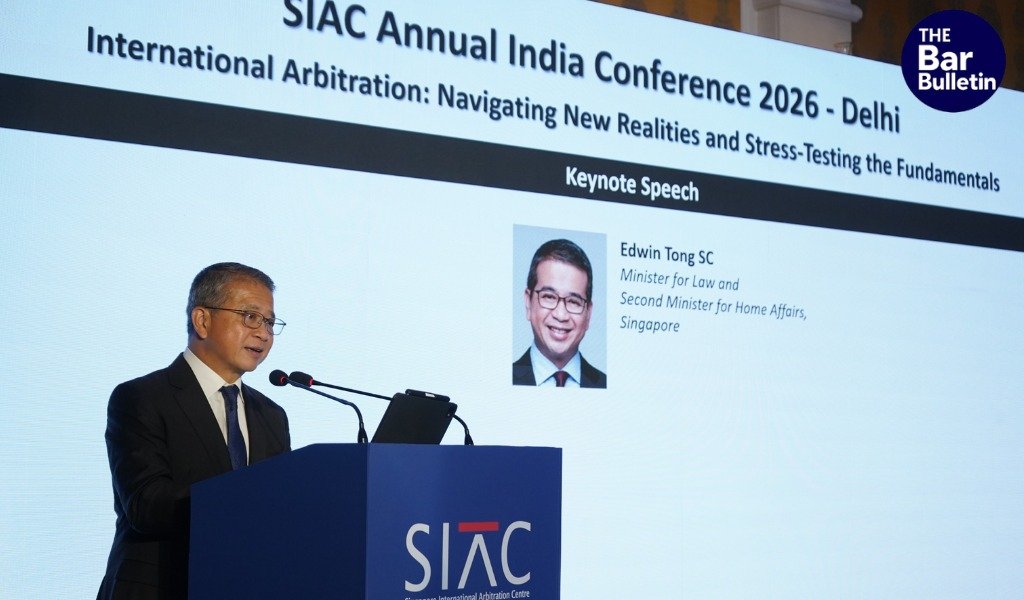
Delivering the keynote address, Singapore’s Minister for Law and Second Minister for Home Affairs Edwin Tong SC said India’s emergence as a global economic powerhouse has been accompanied by an equally important strengthening of its legal and arbitration framework.
He observed that India is no longer merely participating in global markets but increasingly leading them across sectors including pharmaceuticals, renewable energy, manufacturing and digital innovation.
With India already the world’s fifth-largest economy and projected to become the third-largest economy within the next decade, he said sustained investment depends not only on market opportunities but also on confidence in legal institutions.
“…the confidence that contracts will be honoured, that the rights that we have will be protected, and that when disputes arise, as they do in the ordinary course of business, they will be resolved fairly, efficiently, and predictably” is what attracts serious long-term investment, he said.
Tong highlighted India’s legislative reforms in arbitration, the growth of Indian arbitral institutions and the increasing sophistication of Indian counsel and arbitrators, noting that Indian courts have adopted a pro-arbitration approach that closely mirrors Singapore’s jurisprudence by respecting party autonomy and minimising judicial intervention.
Tracing the historical relationship between the two countries, Tong said Singapore’s legal foundations share deep institutional links with India, from the influence of the Indian Penal Code to India’s early recognition of Singapore’s independence in 1965.
He noted that Singapore is today India’s largest source of foreign direct investment, with Singapore-based companies investing nearly US$195 billion in India since 2000, while bilateral trade has expanded more than five-fold under the Comprehensive Economic Cooperation Agreement.
Highlighting SIAC’s engagement with India, Tong said that between 2011 and 2025, SIAC administered over 1,600 arbitrations involving more than 2,600 Indian parties, accounting for nearly 24% of its total caseload, with India-related disputes valued at over SGD 33 billion.
He also noted that Indian parties account for approximately 30% of SIAC’s emergency arbitrator applications and 15% of expedited procedure applications, demonstrating the maturity and sophistication of Indian users of international arbitration.
Explaining the significance of SIAC’s Delhi office, Tong said the institution was not seeking to compete with Indian arbitration centres but to complement India’s growing arbitration ecosystem by strengthening collaboration among practitioners, institutions and law schools.
“
“It [the office] reflects our confidence in India’s future, in India’s legal profession, and in India’s arbitration community. But more than that, it reflects our commitment to grow alongside India for a long time”, he said.
Concluding his address, Tong quoted Prime Minister Narendra Modi’s recent observation at the G7 Summit that “the world today does not suffer from a shortage of resources; it suffers from a shortage of trust.”
He said arbitrators, lawyers, institutions and academics collectively form the trust infrastructure that underpins global commerce.
“
“Every award fairly decided, every argument honestly made, every principle upheld, these are the building blocks of the confidence that businesses and investors rely on,” Tong said.