
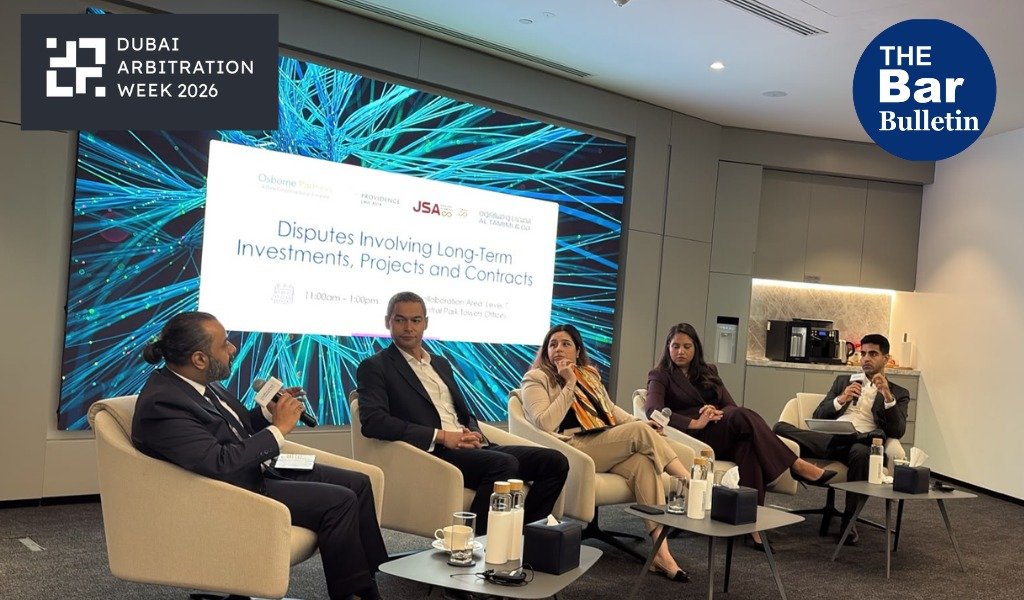

Long-term infrastructure and investment projects are increasingly vulnerable to disputes arising from geopolitical uncertainty, regulatory changes, rising project costs and breakdowns in commercial relationships, with lawyers highlighting the importance of contractual risk allocation, timely notices, documentary evidence and effective enforcement remedies. These issues were discussed at a panel discussion on the theme “Disputes Involving Long-Term Investments, Projects and Contracts” at Dubai Arbitration Week 2026 on November 12, 2026 at the Al Tamimi & Co. venue. Osborne Partners organised the session, with Al Tamimi & Co., JSA Advocates & Solicitors, and Providence Law Asia as co-organisers.
The session examined how long-term projects can unravel amid geopolitical uncertainty, regulatory changes and commercial disruptions, and how parties can safeguard their interests when disputes arise. The panel was moderated by Montek Mayal, Partner and Practice Head – Asia & Middle East at Osborne Partners. It included following speakers:
● Khushboo Shahdadpuri, Partner at Al Tamimi & Co.;
● Asiyah Arif, Managing Director at Providence Law Asia;
● Dheeraj Nair, Partner at JSA Advocates & Solicitors; and
● Tsegaye Laurendeau, Partner at Signature Litigation.
Opening the discussion, moderator Montek Mayal asked the panellists to identify the one development that was fundamentally changing long-term investment disputes in their respective practices. The speakers highlighted geopolitical uncertainty, changing state attitudes towards investment disputes, the growing importance of alternative arbitration seats and the efforts of arbitral institutions to introduce more efficient procedures.
Asiyah Arif highlighted how geopolitical developments are reshaping not only investment decisions but also the choice of jurisdictions and institutions for resolving disputes. Drawing on her practice in Asia, she referred to the impact of the Russia-Ukraine conflict, observing that parties affected by geopolitical realities were increasingly looking towards Dubai, Singapore and Hong Kong as seats of arbitration and venues for dispute resolution. Explaining this shift, she said:
“
“We’re not just seeing a change in the way we think about how we do business, but also where we resolve our disputes. So arising out of the Russian conflict with Ukraine, we have seen in the last few years an enormous amount of movement and a lot more conscious thought about where you would resolve disputes with states that are affected by geopolitical reality. Russia has been shut out effectively from the Western world as far as resolving disputes are concerned. They’ve turned eastward. So they’re now looking to Dubai, to Singapore, and to Hong Kong as seats and as arbitral institutions.”
Arif said she expected this shift to continue to influence long-term projects over the next decade. She also pointed to the way arbitral institutions are adapting to the changing needs of businesses by introducing expedited procedures for smaller claims. Citing the Singapore International Arbitration Centre’s (SIAC) streamlined procedure, she said it provides for an award within three months of the tribunal’s appointment in qualifying claims below USD 1 million. Such procedures, she noted, allow parties to resolve smaller disputes quickly while the larger project continues.
She further referred to the ICC and SIAC introducing mechanisms for multi-party and multi-contract disputes, which are particularly relevant to long-term infrastructure projects involving several interconnected contracts.
Tsegaye Laurendeau said states were becoming increasingly assertive in investment disputes. He observed that governments which were previously reluctant to engage in investor-state arbitration had developed strategies to defend their positions and were now more willing to exercise regulatory powers and raise jurisdictional and admissibility objections.
Khushboo Shahdadpuri said a similar shift was visible in the Middle East. According to her, government and semi-government entities that had earlier sought to avoid arbitration were now increasingly willing to pursue proceedings and were even taking steps to correct defective arbitration clauses to ensure that disputes could be heard by tribunals.
Contractual notices and documentation can determine the outcome
Discussing the contractual risks in long-term projects, the speakers highlighted the importance of incorporating mechanisms dealing with force majeure, changes in law, stabilisation, hardship, renegotiation and price adjustments.
Tsegaye Laurendeau said parties frequently overlook notice provisions and other contractual preconditions while concentrating on the day-to-day execution of projects. This can result in otherwise legitimate claims being lost when disputes eventually arise. Explaining the consequences, Tsegaye Laurendeau said:
“
“You may absolutely be entitled to an extension of time through no fault of your own, but because you didn’t raise the notice in time, when it comes down the line to a dispute, you have lost it.”
He added that tribunals were increasingly adopting a strict approach to contractual notice requirements. He also pointed to difficulties in maintaining contemporaneous records, particularly in long-term projects where personnel change and important decisions or variations may not be properly documented.
Khushboo Shahdadpuri also identified the absence of adequate documentary records as a recurring problem in arbitration. Even sophisticated clients, she said, may struggle to establish their claims when records are lost due to cybersecurity breaches or discarded under internal document-retention policies.
Disputes can begin at the boardroom level
Montek Mayal asked Dheeraj Nair what turns an initially manageable commercial problem in a long-term joint venture or project arrangement into a major dispute, and what strategic choices parties should consider when a project begins to fail.
Responding to the question, Dheeraj Nair said that disputes can arise from several factors, including rising raw material costs, unforeseen funding requirements, disagreements between nominee directors and promoters, and differences in the expectations of private equity investors and joint venture partners. He noted that private equity investors often seek returns within a defined exit timeline, while joint venture partners may be more concerned with keeping the project operational.
Emphasising the importance of resolving disagreements before they escalate, he said:
“
“I think the first level to mitigate any kind of risk is to start talking at the boardroom level. It is important to get into a mediation circuit before you get into a dispute circuit, and avoid multiplicity of proceedings.”
Khushboo Shahdadpuri, addressing the question from the perspective of major construction and infrastructure projects in the Middle East, stated that government-backed projects may continue despite becoming commercially unviable because of publicity and reputational concerns. She said this can eventually lead to further disputes, including arbitrations over dismantling stalled projects. She also highlighted the difficulty of building a case when crucial project documents are unavailable due to cybersecurity breaches or document-retention practices.
Setting out possible approaches when a project is failing, she identified continuing the project while preserving legal rights, commercially resetting the relationship, or suspending and terminating it. She favoured a commercial reset where parties are willing to negotiate, saying:
“
“I think option two, which is the most fair, is to reset. And I think that’s the best commercial outcome for both parties. There has to be that sense of goodwill between both sides, sometimes three or four sides, to be able to do this reset because of the amount of claims that people have against each other.”
Parties may need practical remedies beyond monetary compensation
The third part of the discussion focused on remedies available when long-term projects break down and whether monetary compensation is sufficient to address the resulting losses.
Khushboo Shahdadpuri said parties often seek practical remedies, including interim measures to preserve assets, prevent a project from stalling or facilitate the sale of assets or a project that is no longer viable.
She explained that the choice between approaching a court or an arbitral tribunal depends on the applicable law, the seat of arbitration and the nature of the relief sought. She also discussed the use of emergency arbitration and the need to ensure that the relief sought falls within the tribunal’s powers.
Dheeraj Nair said parties in India often approach courts for interim relief under Section 9 of the Arbitration and Conciliation Act, 1996. He observed that courts, in some cases, preserve the status quo for a limited period while parties approach an emergency arbitrator.
He added that approaching a court may be more effective where assets are at risk of being transferred to third parties, since the relief required may extend beyond the parties to the arbitration agreement.
On enforcement, Dheeraj Nair said recovery becomes particularly difficult when the counterparty enters insolvency proceedings, as the claimant may have to stand in line with other creditors. He suggested that parties should examine whether the counterparty has assets in other jurisdictions, including the Middle East, Singapore or London, where enforcement may offer an alternative route to recovery.
Concluding the discussion, moderator Montek Mayal asked the panellists how parties should choose between approaching courts and arbitral tribunals for interim relief, particularly when projects face financial distress and the counterparty’s assets are at risk. Khushboo Shahdadpuri highlighted the need for practical remedies, including preserving assets and facilitating the sale of stalled projects, while Dheeraj Nair explained that court intervention may be more effective when relief is required against third parties or assets are at risk of dissipation. He also cautioned that insolvency proceedings can complicate recovery, making it important for claimants to identify and secure assets in other jurisdictions.