
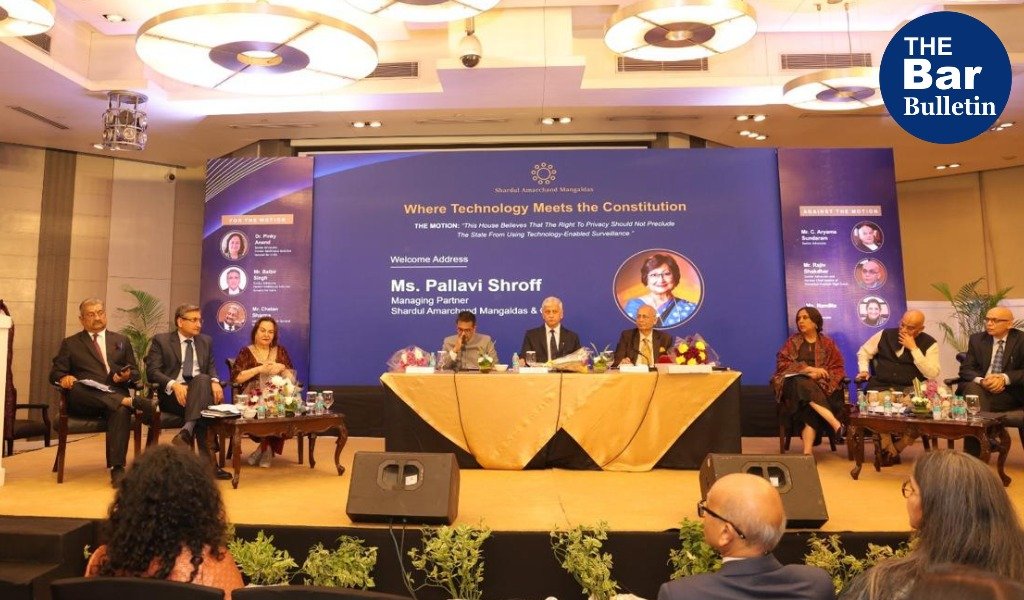

Shardul Amarchand Mangaldas & Co. (SAM) brought together some of India’s leading voices from the judiciary, government, legal profession and business community for a high-level debate on November 22, 2026, examining one of the most pressing constitutional questions of the digital age: whether the State’s use of technology-enabled surveillance can be justified in the interests of public safety without compromising the fundamental right to privacy.
The debate centred on the motion, “This House Believes That the Right to Privacy Should Not Preclude the State from Using Technology-Enabled Surveillance.” With distinguished Senior Advocates arguing on opposing sides and a panel comprising two former Chief Justices of India and an eminent jurist and parliamentarian adjudicating the debate, the discussion explored the constitutional, legal and practical implications of an increasingly technology-driven surveillance framework.
The debate was adjudicated by former Chief Justices of India Justice U.U. Lalit and Justice Dr. D.Y. Chandrachud, along with Dr. Abhishek Manu Singhvi, eminent jurist and parliamentarian. Ms. Barkha Dutt, Founder-Editor of Mojo Story, moderated the discussion.
Surveillance as a tool of State protection or an intrusion into private life?
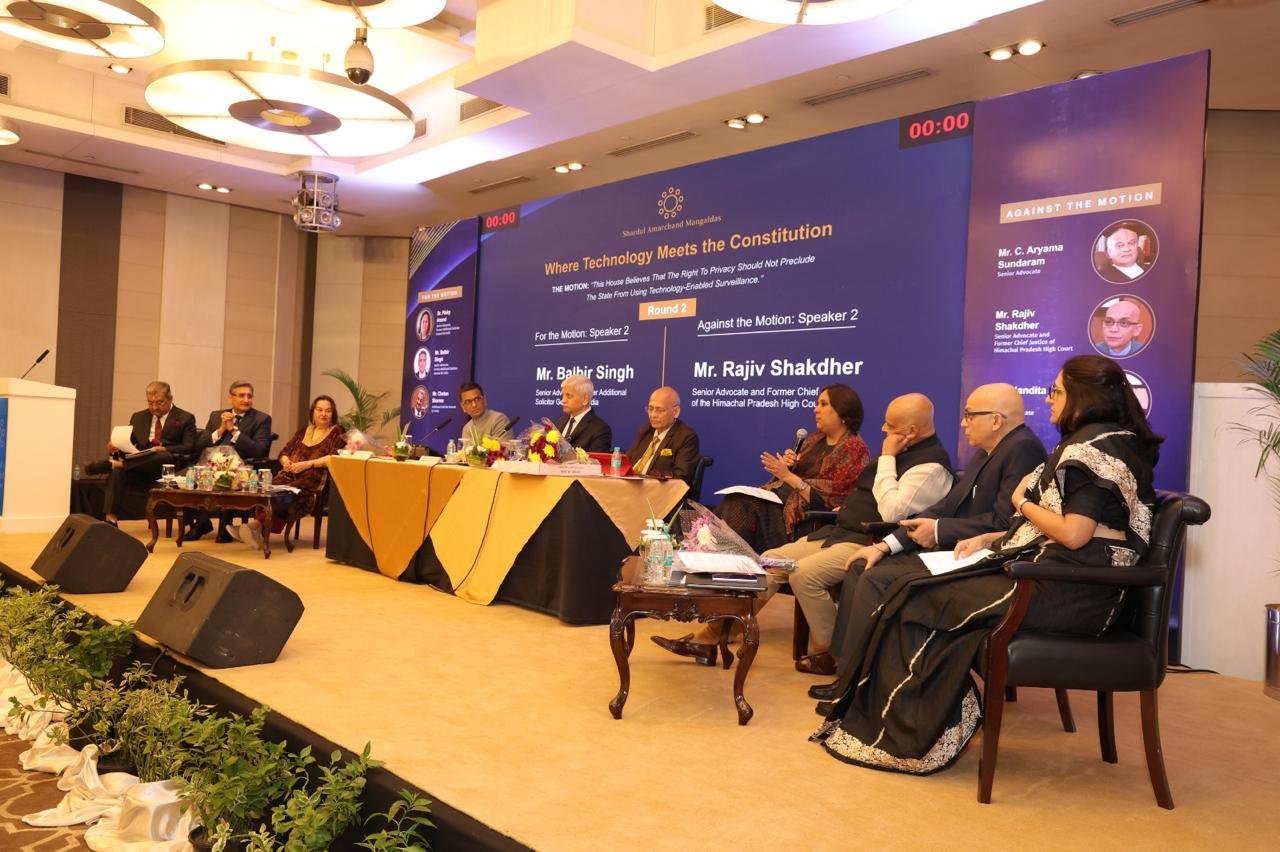
Arguing in favour of the motion, Dr. Pinky Anand, Senior Advocate and former Additional Solicitor General of India, maintained that the State has an obligation to protect citizens against crime, terrorism and threats to national security. Referring to the 26/11 Mumbai terror attacks, she highlighted how CCTV surveillance helped investigators trace the movement of the perpetrators and establish crucial details of the attack.
She argued that surveillance, when deployed for legitimate purposes, is an important instrument of State protection and that the real constitutional question concerns the manner and extent of its use. Referring to the COVID-19 pandemic and the broader understanding of privacy under Justice K.S. Puttaswamy v. Union of India, she emphasised that privacy, though fundamental, cannot be understood as an absolute right that overrides every competing obligation of the State.
Dr. Anand also drew attention to financial fraud, impersonation and the misuse of personal information, arguing that the State must possess the technological capacity to identify and prevent emerging threats.
Opposing the motion, Senior Advocate C.A. Sundaram distinguished between voluntarily adopting technology and having technology imposed upon citizens through State surveillance.
He cautioned that the ability of the State to reconstruct an individual’s private life through financial and communication records could have far-reaching consequences. Illustrating this through everyday financial transactions, he pointed out that access to banking information could reveal deeply personal details, including medical treatment, financial liabilities and family circumstances.
In a pointed observation, Sundaram said:
“
“Sometimes, taking care of the perceived danger is worse than the danger itself.”
He cautioned against allowing concerns surrounding terrorism and money laundering to become justifications for unrestricted surveillance, emphasising that the consequences of technological intrusion extend well beyond the immediate purpose for which information is collected.
Senior Advocate Balbir Singh, former Additional Solicitor General of India, supported the motion, arguing that the State is uniquely positioned to protect citizens against increasingly sophisticated threats posed by non-State actors and large private corporations.
He highlighted the growing vulnerability of individuals and public institutions to data breaches, cybercrime and the misuse of personal information, contending that individual citizens and private entities often lack the capacity to effectively counter such threats.
Referring to international examples of intelligence-led crime prevention, including the interception of communications to prevent planned criminal activities, Singh argued that technology-enabled surveillance can enable authorities to identify threats before they materialise.
He also referred to digital arrest scams and financial frauds in India, emphasising that the State must have the necessary technological and legal tools to protect citizens and institutions.
Sr Advocate Balbir Singh argued that the State is uniquely positioned to protect citizens and constitutional institutions from data abuse and threats arising from increasingly pervasive digital surveillance by private corporations. He submitted that individuals cannot effectively safeguard their personal, financial and medical information against large corporate entities, making State intervention necessary. He also highlighted the vulnerability of institutions such as the Supreme Court Registry, the Election Commission, SBI and RBI to digital threats. Citing examples of surveillance-led crime prevention in Europe, including the interception of communications that reportedly helped uncover plans for bombings and kidnappings, he argued that technology-enabled surveillance allows the State to prevent threats before they materialise.
Senior Advocate Rajiv Shakdher, former Chief Justice of the Himachal Pradesh High Court, opposed the motion, clarifying that the debate was not about whether the State could undertake surveillance in cases involving national security, public order or ongoing criminal activity. The real concern, he argued, was what happens when surveillance extends beyond these recognised exceptions and who determines when such surveillance is justified.
Drawing attention to the Telecommunications Act, 2023 and the applicable interception framework, Justice Shakdher questioned whether the existing legal safeguards adequately protected citizens against arbitrary State action.
Invoking the constitutional principles laid down in Justice K.S. Puttaswamy v. Union of India and subsequent decisions, he emphasised that any restriction on privacy must satisfy the requirements of legality, legitimate State purpose and proportionality.
He argued that surveillance cannot become an unrestricted executive power and must operate within a constitutionally valid legislative framework.
Senior Advocate Chetan Sharma, Additional Solicitor General of India, supported the motion, focusing on the wording of the proposition itself. He argued that the motion did not seek to make privacy irrelevant or permit unrestricted surveillance, but rather to establish that the right to privacy should not operate as an absolute bar against legitimate State action.
He observed:
“
“The debate turns on one word. It’s not privacy, it’s not surveillance. It is ‘preclude’.”
He maintained that the constitutional framework recognises regulation rather than an absolute prohibition, and that the State cannot remain passive when technological developments have created new avenues for crime and threats to public institutions.
Referring to the increasing digital footprint of individuals, he argued that technology-enabled surveillance may be necessary to trace and investigate threats that would otherwise remain undetected.
He further maintained that surveillance must be governed by appropriate safeguards, but the existence of privacy rights cannot mean that the State must remain blind to threats emerging in the digital space.
Senior Advocate Nandita Rao opposed the motion, bringing a gender-based and lived-experience perspective to the debate. She argued that technological surveillance could deepen existing power imbalances, particularly in a patriarchal society, by giving those exercising surveillance the ability to coerce, blackmail or discriminate against those being watched.
Referring to the experience of women, she questioned the assumption that surveillance necessarily translates into safety. She cited instances of misuse of police authority and surveillance mechanisms to illustrate how the very institutions expected to protect citizens could become sources of intimidation.
Rao also questioned the effectiveness of surveillance-centric approaches to preventing crimes against women, arguing that the presence of cameras does not necessarily address the social and structural circumstances in which such crimes occur.
In a pointed observation, she said:
“
“In the lived experience of women, the watchers are never the protectors.”
She further argued that the State should invest in women’s education, public healthcare, public transport and other structural measures rather than relying excessively on technological surveillance.
Judges raise probing questions on Jantar Mantar, Mahakumbh surveillance and financial transactions
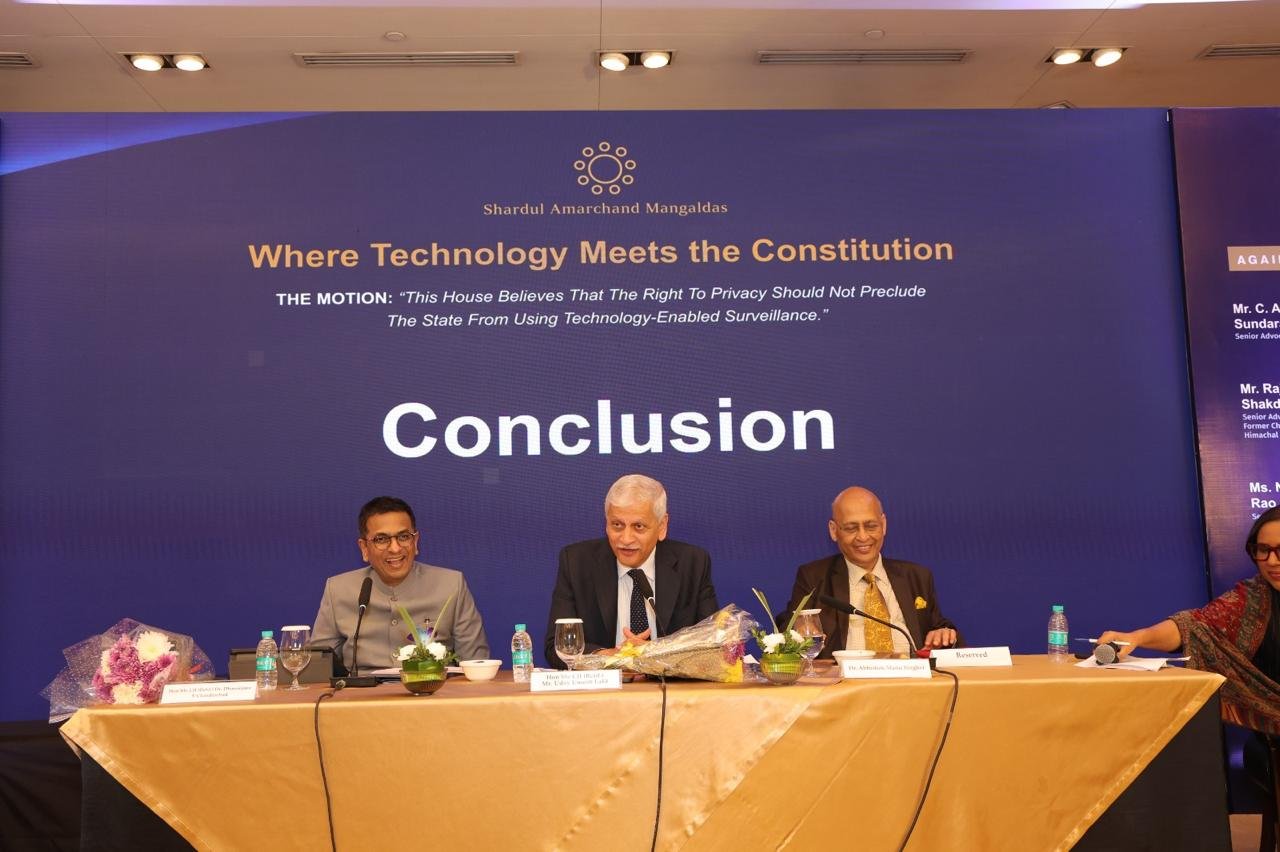
The question-and-answer round brought the constitutional tensions into sharper focus, with the adjudicators and moderator raising questions that tested the arguments advanced by both sides against real-world situations.
Dr. Abhishek Manu Singhvi questioned Dr. Pinky Anand on the competing responsibilities of the State and the courts in the surveillance framework. Responding, Anand emphasised the role of the State in watching potential threats while recognising the courts’ role in examining and regulating the legality of State action.
Singhvi also questioned C.A. Sundaram on his position on privacy, particularly in light of his earlier submissions in a case concerning the recognition of privacy as a fundamental right. Sundaram responded by invoking Lord Denning’s well-known observation:
“
“I may have been wrong yesterday, but that does not mean I should be wrong today.”
A significant exchange followed when Justice Dr. D.Y. Chandrachud questioned Balbir Singh on the reported use of facial recognition technology by the Delhi Police during the Jantar Mantar protests. He asked whether a police standing order permitting the filming of crowds to regulate their numbers could qualify as a law under the constitutional exceptions to Articles 19 and 21, and whether permission to film a crowd could automatically extend to identifying every individual present.
Responding, Singh referred to the legal framework governing interception under the Telecommunications Act, 2023 and the applicable rules. He indicated that the reported use of facial recognition technology would have to be examined against the requirements of a valid legal framework and constitutional safeguards. He also acknowledged that the particular instance might not satisfy the requirements of law and noted that the matter was already before the Court.
Justice Chandrachud also questioned Sr Adv Rajiv Shakdher on the use of AI-enabled cameras during the Mahakumbh, where technology reportedly helped reunite missing pilgrims, and whether the same technology could be deployed to identify individuals at a protest site such as Jantar Mantar.
The question brought out the distinction between the legitimate use of technology for public safety and its potentially intrusive use against individuals exercising constitutional rights. Shakdher emphasised that the purpose for which technology is deployed cannot be examined in isolation from the existence of a valid legal framework. He maintained that any such deployment must satisfy the constitutional tests of legality, legitimate purpose and proportionality.
Moderator Barkha Dutt further pressed Justice Shakdher on the possibility of surveillance initially authorised for a legitimate purpose subsequently being expanded to other areas, either deliberately or inadvertently, and whether the discovery of incriminating information could justify such expansion.
Justice Shakdher questioned whether the existing framework provided adequate safeguards against such misuse. He stressed the need for a proper legislative architecture, pointing out that authorisation by the Home Secretary and executive review alone could not substitute for constitutionally adequate oversight.
When Dutt specifically asked whether he advocated judicial warrants for surveillance, Justice Shakdher answered in the affirmative, highlighting the importance of judicial oversight.
Justice U.U. Lalit questioned the argument made by ASG Chetan Sharma that the State must be able to follow the digital trail to identify threats, including the possibility of identifying individuals who may constitute the “bad apples”. The discussion examined whether this approach could justify monitoring every financial transaction or whether surveillance should be confined to specific persons, transactions or suspected irregularities.
Justice Lalit also raised the example of everyday devices such as Alexa and Google, which continuously respond to user commands, questioning how the voluntary use of such technology differs from State-imposed surveillance.
Pinky Anand defended the need for financial monitoring, arguing that the regulatory framework already operates through multiple stages. She referred to banking and regulatory mechanisms under which transactions are initially monitored for suspicious patterns, with further investigation and interception being subject to the applicable legal process.
However, the discussion also brought out the question of what happens to information relating to innocent transactions collected during such monitoring.
Senior Advocate C.A. Sundaram, responding to the discussion on financial surveillance and voluntary technology use, shared his own experience of having his entire bank account frozen following a disputed payment. He emphasised that voluntarily choosing to use a device or platform is fundamentally different from being compelled by the State to surrender personal information.
He remarked that using devices such as Alexa was an individual’s choice, adding that the same principle could not be used to justify compelling citizens to use platforms such as WhatsApp or surrender their privacy.
Justice Lalit also questioned Nandita Rao on her assertion that surveillance could weaponise existing gender inequalities and that watchers could never be protectors.
Responding, Rao explained that the possibility of surveillance being misused for coercion, blackmail or intimidation was central to her argument. She emphasised that the issue was not merely the existence of surveillance technology but the discretion it places in the hands of those exercising it.
Justice Lalit then referred to the potential of surveillance technology to help trace and reunite missing children, particularly at large public gatherings. Rao responded that effective and accountable policing could achieve such objectives without resorting to mass surveillance.
She referred to instances where children had been located and reunited with their families through conventional policing mechanisms, maintaining that:
“
“Where there is robust policing, we don’t need mass surveillance.”
The debate concluded with the larger constitutional challenge remaining firmly in focus: as technology expands the State’s capacity to monitor, identify and analyse individuals, how can a constitutional democracy ensure that the pursuit of collective security does not come at the cost of individual liberty?