
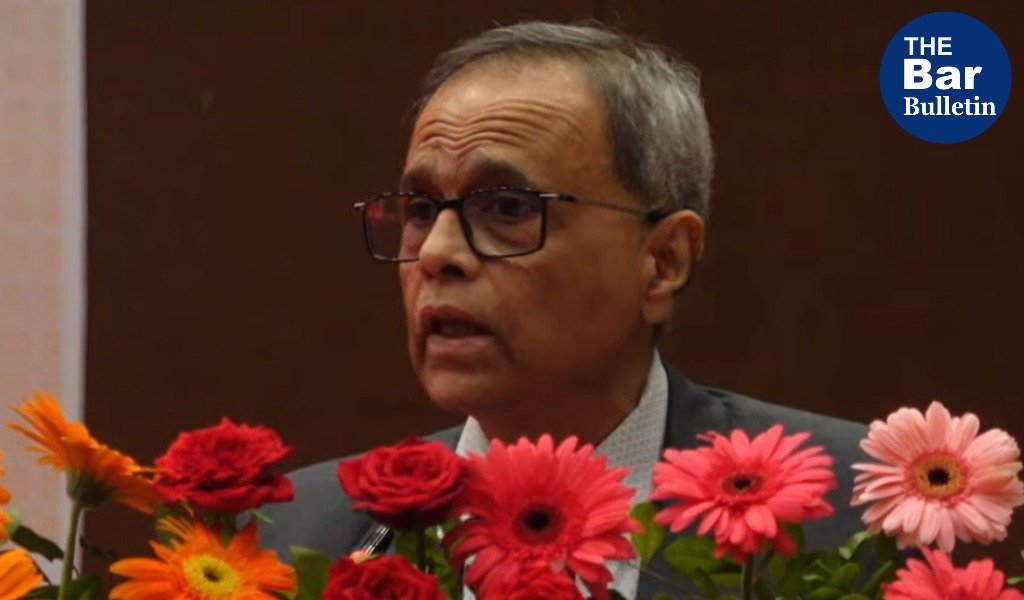

Supreme Court Justice Joymalya Bagchi has suggested that routine and predictable cases, including mutual divorce matters, could be shifted to AI-based adjudication, proposing the possibility of round-the-clock AI divorce courts to improve access to justice and reduce the burden on human judges.
Speaking at the 1st DNLU JusTech National Conclave, organised by Dharmashastra National Law University (DNLU), Jabalpur, on November 21, 2026, on the theme, “The Intersection of Technology, Artificial Intelligence & Access to Justice in the Indian Context”, Justice Bagchi discussed the growing role of artificial intelligence in the justice delivery system and questioned how far judicial functions could be delegated to algorithms.
He began by referring to the growing public discourse around artificial intelligence and the fear that it could eventually challenge human capabilities. Referring to the words of the year selected by the Cambridge Dictionary, he noted that while 2023 was associated with AI and hallucination, the word chosen for 2026 was ‘human’.
Addressing the theme of algorithmic justice, he observed that India was facing a pendency of over five crore cases and the existing judicial infrastructure and human resources would not be sufficient to ensure timely justice without transformative technological interventions.
He suggested that AI could be deployed for case management, categorisation of cases, tracking disposal timelines and identifying matters that require priority attention. He also proposed that routine procedural matters, such as applications seeking extensions of time, directions for preparation of cases and early hearing requests, could be handled through AI-based tools instead of occupying the time of human judges.
“
“We are sitting on a pile of over five crores cases and with the given infrastructure and human resources, we are not going to go anywhere near in delivering quick, efficient and timely justice until and unless we have transformative interventions through artificial intelligence tool deployments.”
Suggests AI courts for mutual divorce cases, routine matters
Moving beyond administrative assistance, Justice Bagchi suggested that AI could also be used in adjudication, particularly in cases involving routine, predictable issues governed by established legal principles.
Citing traffic challan cases as an example where algorithmic systems were already being used, he proposed that mutual divorce cases could also be considered for AI-based adjudication. He said such a system could operate round the clock, improving access to justice while avoiding the use of valuable judicial time for matters that do not require extensive human adjudication.
“
“We should have 24/7 AI divorce courts so that there will be ease to access to justice and no wastage of human valuable human resources on completely non-adjudicatory exercises.”
He also suggested that routine procedural applications, including requests for extensions of time to file affidavits, directions for preparation of cases and applications seeking early hearing, could be handled through AI-based tools.
On early hearing applications, he proposed that an AI system could consider factors such as the age of litigants, the nature of the case and other relevant circumstances before generating a predictive assessment of priority. Justice Bagchi further suggested the use of predictive AI tools in cheque dishonour cases, land acquisition disputes and commercial money recovery matters. According to him, once pleadings and affidavit evidence are completed, AI could analyse the material and generate a predictive outcome, allowing arguments to proceed from that point.
He explained that such an approach could reduce the time spent by human judges on routine stages of litigation and allow them to concentrate on matters requiring substantive adjudication.
‘AI can sharpen justice delivery, but cannot reincarnate the justice system’
Despite advocating wider use of AI, Justice Bagchi cautioned that the pursuit of speedy and efficient adjudication should not result in losing sight of the fundamental purpose of justice. He observed that justice is not merely about delivering decisions quickly but also about fairness, the common good and the realisation of rights. He warned that a system focused entirely on speed and efficiency could overlook the human beings for whom justice exists.
“
“In the mad humdrum of achieving speedy and perfect adjudication, we may forget that justice is fairness. We may forget that justice is for common good. We may forget that justice is realization of rights. And we may finally forget that justice is for the persons who seek justice, that is human beings.”
He further explained that AI trained on past data may be able to predict outcomes based on existing patterns, but judicial development often requires judges to move beyond established approaches and recognise new dimensions of rights and injustice. Referring to landmark constitutional decisions such as Kesavananda Bharati and Maneka Gandhi, he said the evolution of constitutional principles required human judicial reasoning and creativity.
“
“We must admit that without human beings Keshawadandanda Bharti wouldn’t have been delivered. We must admit that from earlier judgments of dealing in fundamental rights in silos to a cornucopia of rights in Maneka, it needed the genius of the judges in the Supreme Court.”
Justice Bagchi also raised concerns about the ethical foundations of AI-led justice delivery, questioning whose consciousness and ethical values would be incorporated into systems entrusted with judicial functions. He pointed to the challenges posed by generative AI, where the developers may not be able to determine how the system evolves or the outcomes it produces.
Concluding his address, he emphasised that AI should be used to assist the judiciary and handle routine work, but the human role in adjudication must remain central.
“
“The human agency must be preserved as the most precious virtue and the tool of adjudication and used sparingly where necessary in a country overpopulated as India where specialized human resources are rare.”
Also Read: No One’s Belonging To India Should Be Suspected: Faizan Mustafa On Constitutional Fraternity
‘AI-Assisted, Not AI-Driven Adjudication’: Mr. Siddharth R. Gupta on Access to Justice and the Promise and Perils of A
“
“What we need is AI-assisted adjudication and not AI-driven adjudication.”
Mr. Siddharth R. Gupta, Advocate, Supreme Court of India
Setting the tone for the Chief Guest’s address, Mr. Siddharth R. Gupta spoke on how technology and AI can make justice more accessible, what is already being tried across the world, and the risks to guard against.

Access to Justice: An Old and Constitutional Idea
Mr. Gupta noted that the idea is very old. The Magna Carta said justice must not be sold, denied or delayed, but Indian tradition recognised it thousands of years earlier. He recalled the Vedic prayer “Sarve Bhavantu Sukhinah”, which wishes that everyone be happy, healthy and free from sorrow. Linking it to the rule of law, he said
“
“the promise that no one shall suffer sorrow remains a paper promise, if the poorest of the society lacks the means of having access to justice.”
He referred to Anita Kushwaha v. Pushap Sudan, which moved access to justice from the Directive Principles into Articles 14 and 21. Citing Justice V.R. Krishna Iyer’s 1973 report on “Processual Justice to People”, he said equality in law means little if people cannot use the legal process. Access to justice, he stressed, must be judged by how well those with the fewest resources can reach fair and independent justice, never by the experience of the well-off. The real test of any technology is whether it reaches the poor, whose first worry each morning is their next meal.
What AI Means for the Judicial System
He described four uses:
● Machine learning, which goes through huge volumes of legal records and court files many times faster than a person.
● Natural language processing, which handles translation and transcription and pulls information out of dense legal text, making research far easier.
● Predictive analysis, which spots patterns in past decisions and can make outcomes more consistent, fair and swift.
● Automated administrative systems, which cut costs, reduce delays and clear backlogs.
As an Indian example, he cited the Supreme Court’s SUPACE, which pulls out key points, rules, citations and precedents. It can turn a brief of 800 to 900 pages into a 3-pager note in four to five minutes. He called this a glimpse of how technology can change the way justice is administered.
Lessons from Abroad
Mr. Gupta said Estonia, an european nation reportedly piloted a robot judge for small claims under €7,000, which was said to have cleared about half the pending cases within six months. It combined predictive analysis with automated procedures, and it helped litigants round the clock by answering queries, verifying documents and deciding claims quickly.
In Singapore and China, traffic violations, motor accident claims and cheque bounce cases have reportedly been shifted to AI systems. These disputes consume the most judicial time but follow set patterns and formulas, so handing them to machines frees human judges for more important matters. He felt such practices should be adopted by all stakeholders, but only while avoiding the known pitfalls.
The First Challenge: Hallucination
Mr. Gupta then turned to the challenges, which he called less discussed but very serious. He shared an incident from February 2026. While the AI summit at Bharat Mandapam, backed by 88 countries, endorsed human-centred AI, counsel before the Chief Justice of India cited a judgment titled Mercy v. Mankind and read out paragraph after paragraph. The Court then found that no such judgment existed. How it reached the counsel’s iPads, nobody could explain. He said the timing “was not ironic, but it was instructive and incidental.” Hallucination, he said, means “being shown something which does not exist at all.”
He compared this to Maya, the illusions Ravana created in his war with Lord Rama: something that looks real but is not. He also referred to Pooja Ramesh Singh v. State of J&K, where the Supreme Court set aside an NCLAT judgment because it relied on non-existent citations. The Court likened such citations to methyl isocyanate, the gas behind the Bhopal disaster, which is present in the air but cannot be seen. Such instances mislead the judicial process and defeat the purpose of the justice system. For that reason, he said, “we must, therefore, adopt a zero-tolerance approach towards any such misuse of AI.”
The Second Challenge: Data Bias and Opacity
AI can only produce answers from the data it has been trained on. Mr. Gupta compared it to a student, who can answer only from what has been studied. If that data carries social prejudice or historical bias, the system may simply repeat it. In his words, “rather than ensuring fairness and impartiality, AI may reinforce existing inequalities,” and leave already marginalised communities worse off. He noted that algorithmic decisions in parts of Europe and America have been criticised for racial bias and lack of transparency.
The European Ethical Charter on AI in judicial systems therefore requires respect for fundamental rights, fairness, equality, openness in decision-making and effective human supervision. Without these safeguards, he warned, there is a risk of the black box problem, where an outcome is produced but the reasoning behind it cannot be understood, examined or questioned.
Conclusion: Assisting, Not Replacing, the Judge
However convenient technology may be, Mr. Gupta said, it must not replace human reasoning, fairness and conscience. AI can transform the judiciary, but control of the process must not be handed over to it. AI should help judges deliver justice more efficiently and effectively, while final decisions and responsibility remain with human judges. That, he said, is what separates AI-assisted adjudication from AI-driven adjudication.