
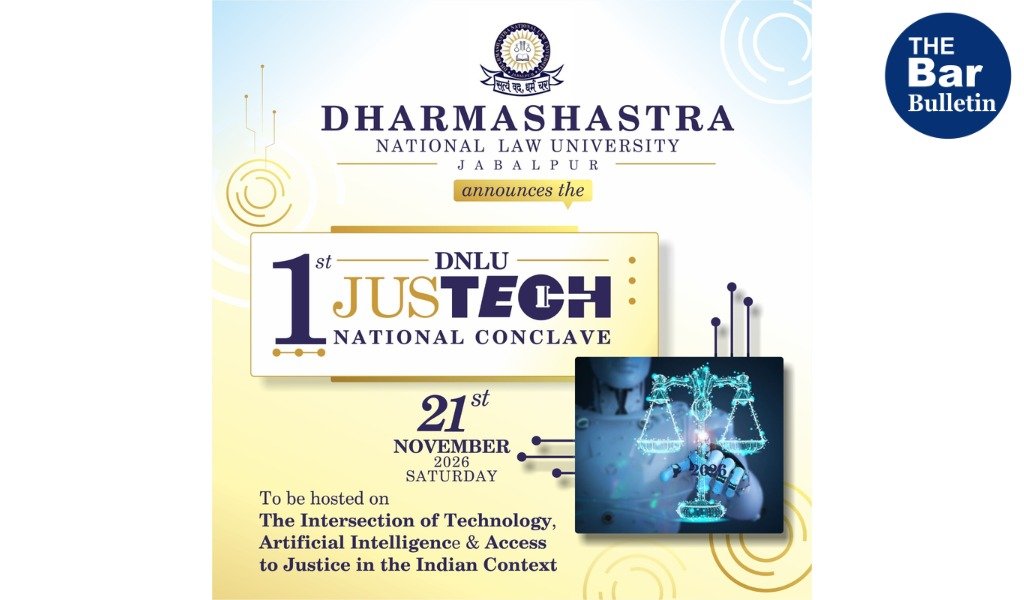

As the Indian judiciary stands at the cusp of a profound digital metamorphosis, Dharmashastra National Law University (DNLU), Jabalpur, is poised to catalyse a much-needed national dialogue. The premier legal institution is all set to host its maiden “JUSTECH” National Conclave on Saturday, November 21, 2026. Themed “The Intersection of Technology, AI & Access to Justice in the Indian Context,” the event promises to be a seminal gathering of legal luminaries, tech innovators, and policy architects.
The conclave will be elevated by the presence of a towering figure from the Indian Judiciary. Mr. Justice Joymalya Bagchi, Judge, Supreme Court of India, will grace the occasion as the Chief Guest. Justice Bagchi’s participation signals the Supreme Court’s deep engagement with the challenges of modernizing the judicial system while upholding constitutional morality. His insights on the apex court’s vision for a tech-enabled, transparent, and accessible judiciary will undoubtedly be the highlight of the event. As a sitting Judge of the Supreme Court, his perspective on the delicate balance between technological efficiency and the fundamental principles of natural justice will be central to the day’s deliberations.
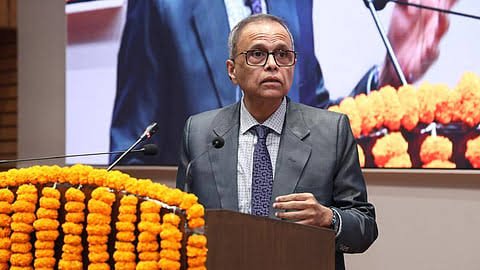
The Conclave will also host Mr. Justice Alpesh Y. Kogje, Chief Justice of Madhya Pradesh as the Guest of Honour and Mr. Justice Anand Pathak, Judge, High Court of Madhya Pradesh as the Distinguished Guest, chairing both the sessions.
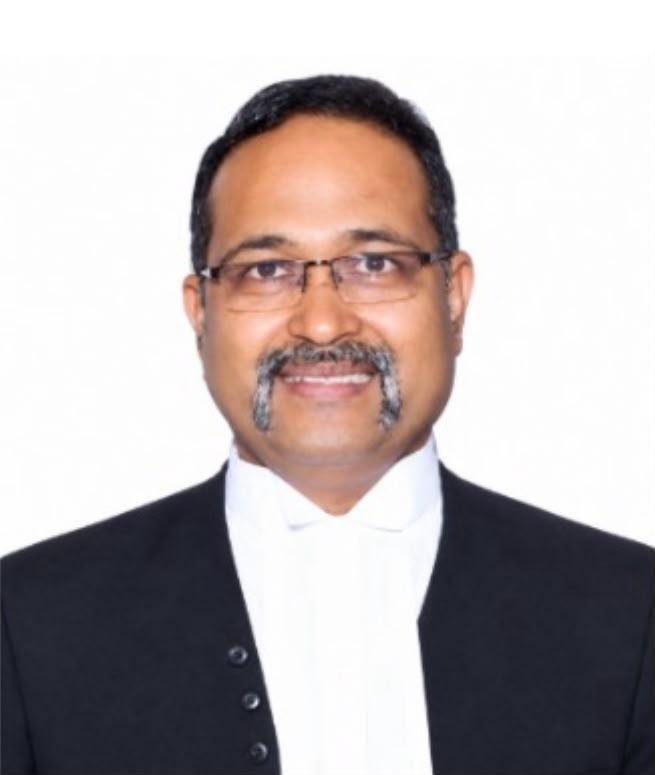
The Welcome Address in the Inaugural Session shall be delivered by Prof. Manoj Kumar Sinha, Vice-Chancellor, DNLU, Jabalpur, opening the conclave for the guests. According to Prof. Sinha,
“
“The topic of the conclave has been kept centric on AI and Technology for the fundamental reason that the rapid infusion of Artificial Intelligence into the legal ecosystem is no longer a futuristic conjecture; it is an unfolding reality. From AI-driven legal research and predictive analytics to automated case management and e-filing systems, technology is fundamentally reshaping the administration of justice.”
However, this digital leap raises a labyrinth of complex questions: “Can algorithms be trusted to remain impartial? How do we safeguard against the entrenchment of existing societal biases within machine-learning models? Most critically, in a nation as diverse and unequal as India, does the digitalization of courts risk widening the chasm of access to justice for the marginalized, or can it be the great equalizer that democratizes legal aid?” Prof. Sinha explained whilst elaborating on the them of the National Conclave.
According to Mr. Siddharth R. Gupta, Advocate, Supreme Court of India, one of the keynote speakers at the event, it is the precisely above pressing dilemmas that the inaugural edition of the “JUSTECH” National Conclave seeks to address. By convening stakeholders from across the legal and technological spectrum, DNLU aims to move beyond theoretical debate and towards actionable frameworks that ensure the digital transformation of the Judiciary is both ethical and inclusive.
The day-long conclave will feature a meticulously curated series of panel discussions, technical sessions, and paper presentations. The deliberations are expected to traverse a wide spectrum of sub-themes: the ethical deployment of AI in judicial decision-making, the role of e-courts and virtual hearings in bridging the rural-urban justice gap, the imperative for robust data protection and privacy frameworks in legal tech, and the need for capacity building among judges and lawyers to adapt to a rapidly evolving digital landscape.
DNLU, hosting such an event is both a privilege and an institutional responsibility. By facilitating a critical dialogue between the guardians of the Constitution and the architects of modern technology, the “JUSTECH” National Conclave is poised to become a cornerstone event in India’s legal-tech calendar. In an era where bytes and briefs increasingly intersect, such academic and institutional initiatives are vital to ensure that the transition to ‘e-justice’ remains inclusive, equitable, and firmly rooted in the principles of natural justice. The conclave promises to be an intellectually stimulating experience, setting a new benchmark for legal discourse on technology in the country.
***