
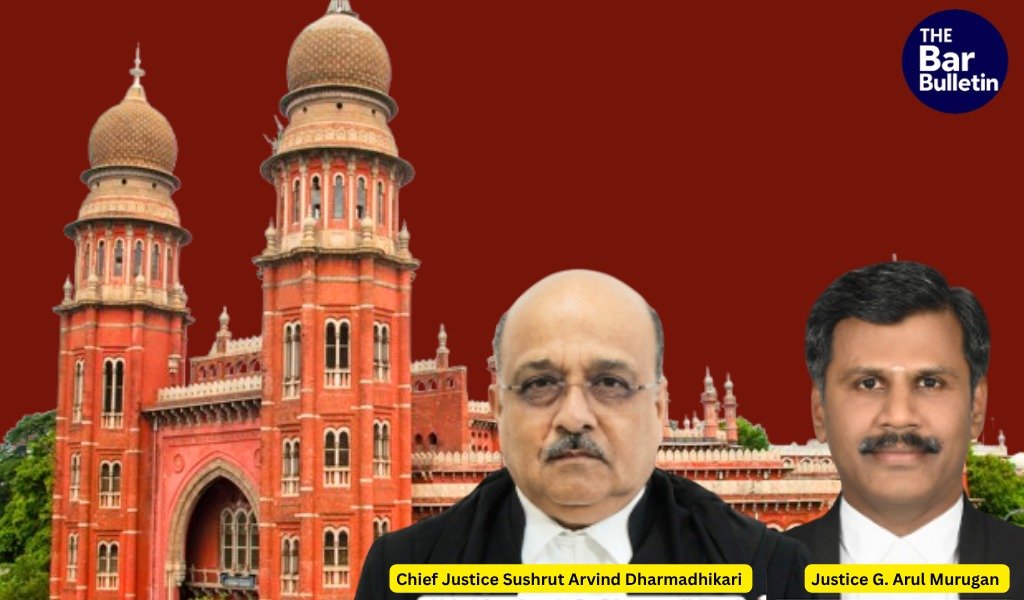

In a public interest litigation (PIL) filed before the Madras High Court seeking a writ of mandamus to direct the respondents to control the free-roaming cattle on the roads, which as per the petitioner, causes inconvenience to the public and disrupts traffic, a Division Bench of Chief Justice Sushrut Arvind Dharmadhikari and Justice G. Arul Murugan disposed of the petition along with specific directions.
The petitioner, a practising advocate stated that Thiruverkadu was a busy municipal area with lakhs of residents, famous temples such as the Karumari Amman Temple and Vedapuriswarar Temple, many schools, colleges and hospitals, and major roads connecting Ambattur, Avadi, Koyambedu and Poonamallee. According to him, stray cattle roamed freely on these streets, blocked traffic, and caused frequent accidents. He asserted that two-wheeler riders slipped on cow dung, cattle rested on poorly lit roads at night startling drivers, that the animals attacked pedestrians, and damaged goods in vegetable shops. He submitted a representation on 11-11-2024, but the authorities took no concrete action.
The Commissioner of Revenue Administration (respondent 3) filed a status report stating that the State Government was strictly enforcing the Tamil Nadu Urban Local Bodies Act, 1998, the Tamil Nadu Animals and Birds in Urban Areas (Control and Regulation) Act, 1997, and the Cattle-Trespass Act, 1871. The report also stated that a government order dated 20-09-2022, had sharply increased daily impounding fines to cover the rising cost of fodder, water, and pound maintenance.
The Court perused a resolution dated 04-12-2024 by the Thiruverkadu Municipal Council, wherein it admitted that stray cattle caused accidents and public nuisance. It also stated that because it lacked trained staff, it resolved to hire private agencies at an estimated cost of Rs. 2 lakhs. It also proposed fines of Rs.2,000/- for a first offence and Rs.5,000/- for a second offence, failing which the cattle would be handed over to a Gaushala.
It was stated that public roads are meant for the safe movement of people and vehicles, and that no cattle owner had the right to let livestock wander onto public streets. The Court said that although the municipality had taken a positive step by passing the said resolution, resolutions on paper meant little unless strictly enforced on the ground. It noted that the law already provided clear tools in the form of Section 3 of the 1997 Act, which forbade keeping notified animals like cattle and buffaloes in urban areas without a valid licence.
The Court also took note of Section 10, which empowered authorities to seize stray or unlicensed cattle and lock them in municipal pounds, and to sell them at public auction if owners failed to claim them within forty-eight hours. It was said that Section 12 made violations punishable with imprisonment up to three years or a fine up to Rs.5,000/-. Further, the Court relied on a government order, under which owners had to pay Rs.500/- per day for impounded cows, oxen, buffaloes, camels and horses, and Rs.200/- per day for calves, donkeys, pigs and goats.
The writ petition was disposed by the Court with directions and guidelines. The Municipal Commissioner was directed to consider the petitioner’s representation on its merits and pass a speaking order within four weeks. The authorities were directed to enforce Section 3 of the 1997 Act, require licences for all cattle owners, inspect sheds under Section 9, and tag every licensed animal. They were also directed to execute the said resolution immediately through dedicated teams conducting daytime and night-time drives, and the police were directed to provide protection to municipal teams under Section 11 of the Cattle-Trespass Act, 1871.
Further, the Court directed that impounded cattle were not to be released casually, and that enhanced charges as well as the Council’s penalties had to be collected. Unclaimed animals were directed to be auctioned or handed over to recognised Gaushalas under Section 10(4) of the 1997 Act, repeat offenders were to be prosecuted before the jurisdictional Magistrate under Sections 11 and 12, and public notices were to be issued. Because the menace affected commuters across the State, the Court extended every direction, except the first direction, to all municipal corporations, municipalities, town panchayats and village panchayats in Tamil Nadu.
Lastly, the Commissioner of Revenue, Administration and the Chief Secretary, Animal Husbandry and Fisheries Department, along with the Principal Secretary to Government, Municipal Administration, Water Supply Department, and the Director General of Police, were directed to issue circulars within four weeks to ensure State-wide compliance. Thus, the petition was disposed of.
