
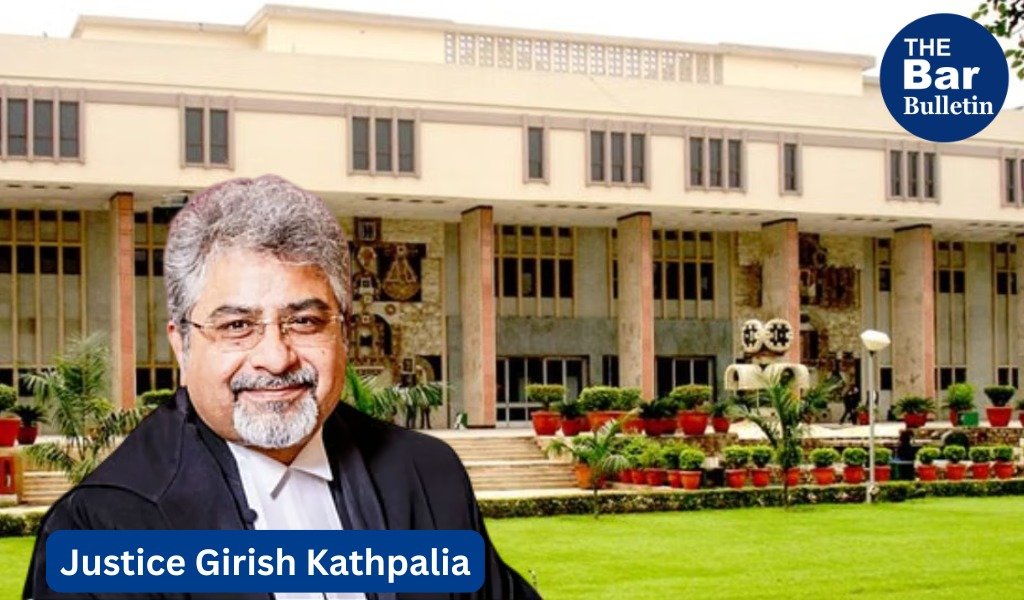

In a criminal petition filed before the Delhi High Court seeking directions upon the trial court to decide and pronounce orders on his application under Section 175(3) of the Bharatiya Nagarik Suraksha Sanhita, 2023 (BNSS) within a week, a Single Judge Bench of Justice Girish Kathpalia allowed the petition and directed the trial court to pass orders on the petitioner’s application within 15 days.
The petitioner submitted that the arguments on the pending application were advanced thrice and that the matter was posted for orders thrice before the matter was last argued on 31-10-2026 and was posted to 28-01-2027 for order. The State, in all fairness, did not object to the petition.
The Court was conscious after perusal of the order sheets that after conclusion of arguments, the trial court had been posting the matter for orders or for clarifications, if any. However, the Court did not find the mention of the word “clarifications” to be convincing and stated that the same appeared to be mechanical so as to served as justification for failure to pronounce the order in time. The Court found substance in the petitioner’s submission that after conclusion of arguments, orders should be pronounced as soon as possible, so that while dictating the order, the arguments raised are fresh in the mind of the judge.
Stating that posting matters to unjustifiably long dates after hearing arguments gives rise to need for obtaining clarifications, the Court found that the procedural criminal law was silent on time within which orders on miscellaneous applications must be passed by courts. However, the Court said that one must take cue from Section 258(1) of BNSS, which stipulated the trial court of sessions to give a judgment within 30 days of completion of arguments, which may be extended to 45 days upon reasons recorded in writing.
The Court stated that keeping a matter undecided over an unreasonable period after conclusion of arguments either final or miscellaneous, erodes confidence of public in the justice delivery system, and said that the logic applies equally to court of sessions and the court of Magistrate dealing with criminal trials. Thus, the Court allowed the petition and directed the trial court to pass orders on the petitioner’s application within 15 days.
Further, the Court directed that a copy of the present order be sent to all Principal District & Sessions Judges for circulation to every criminal court in Delhi to ensure that once arguments on any issue, final or miscellaneous, before a Sessions Court or a Magistrate, are concluded, the order or judgment must be pronounced within a reasonable time. It was directed that for a final judgment, the reasonable time is at most 30 to 45 days, as contemplated by Section 258(1) BNSS, and not more than 15 days in other cases, so that the faith of public in criminal justice machinery is not eroded.
