
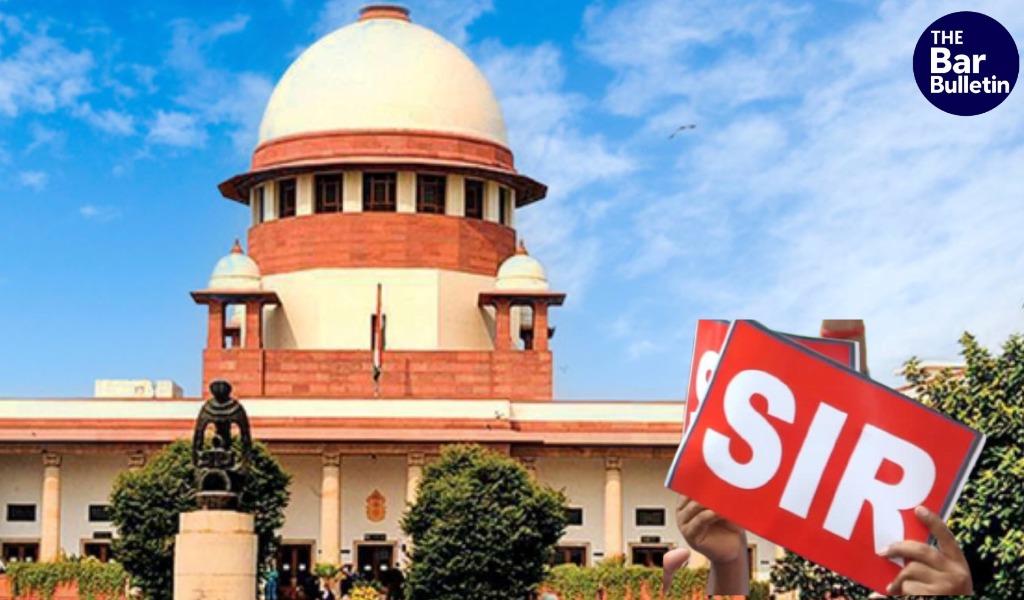
The Supreme Court on Monday declined to grant interim relief in pleas arising out of the Special Intensive Revision (SIR) of electoral rolls in West Bengal, directing parties to pursue remedies before the appellate tribunal constituted for the purpose.
The Bench led by the Chief Justice observed that the grievance regarding non-listing of appeals and procedural irregularities ought to be raised before the tribunal itself. The petitioner had sought extension of the “freezing date” of electoral rolls, alleging that appeals were not being taken up and, in some cases, orders were not even placed before the tribunal.
The Court, however, termed the plea premature, noting that if the appeals succeed, appropriate consequences would follow. It emphasised that it could not place appellate tribunals headed by former Chief Justices and judges under pressure by issuing directions on timelines.
Justice Joymalya Bagchi highlighted the importance of due process, observing that the appellate mechanism was introduced precisely because initial verification processes did not involve full-fledged hearings. He highlighted concerns regarding rejection rates, “logical discrepancy” filters, and inconsistencies with earlier positions taken by the Election Commission of India, particularly in relation to the 2002 electoral rolls.
Senior Advocate D S Naidu, appearing for the Election Commission, submitted that records had been duly placed and that a large volume of appeals running into lakhs was being processed.
The Court noted the massive scale of litigation, with approximately 34 lakh appeals pending, but reiterated that adjudication must proceed through the designated tribunal framework. It clarified that it had not expressed any opinion on the merits of the case.
Emphasising that courts intervene to facilitate, not obstruct elections, the Bench observed that the right to vote carries both constitutional and democratic significance, while cautioning against treating the proceedings as a ‘blame game’ between institutions.