

The Supreme Court on Monday clarified that the statutory provisions governing liability for nuclear accidents do not prevent a constitutional court from determining fair and just compensation, while hearing a challenge to the nuclear liability framework under the SHANTI Act.
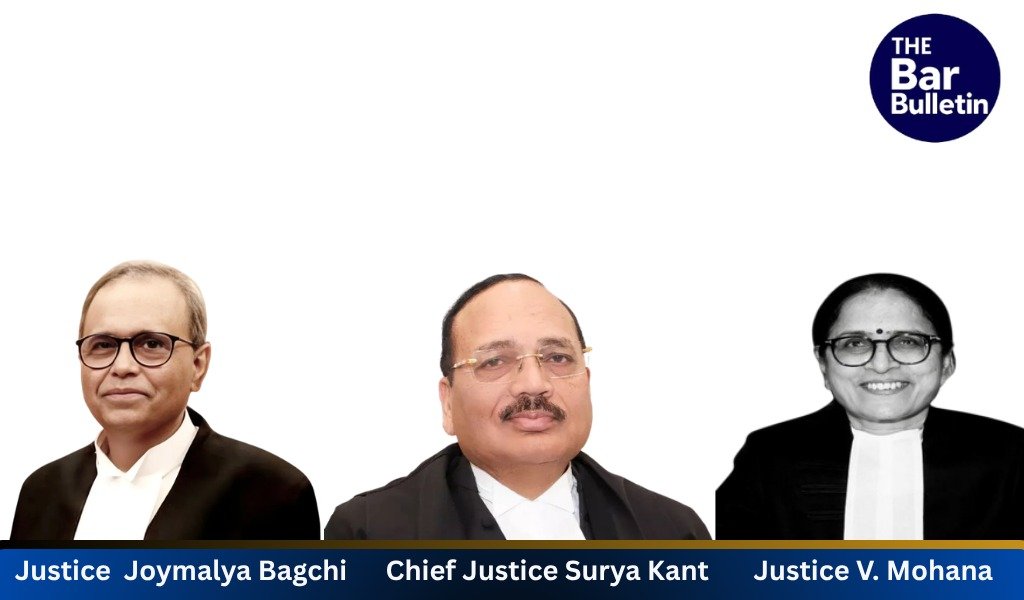
The matter was heard by Chief Justice Surya Kant, Justice Joymalya Bagchi and Justice V Mohana.
The petition has been filed by E.A.S. Sarma, a former bureaucrat and former Secretary to the Government of India. Senior Advocate Prashant Bhushan appeared for the petitioners. The petitioners have challenged provisions of the SHANTI Act concerning the liability of nuclear plant operators and suppliers, arguing that the legislation imposes an unreasonably low ceiling on liability and completely exempts suppliers from liability.
Mr Bhushan submitted that the liability of even the largest nuclear plant operator is capped at ₹3,000 crore, while the Central Government’s residual liability is capped at ₹4,500 crore. He contrasted these limits with the potentially enormous consequences of a nuclear accident. He relied on the Supreme Court’s jurisprudence on hazardous industries and argued that the statutory framework was inconsistent with the principle of strict and absolute liability.
“
“This Act is in the teeth of the judgment laid down by Constitution Benches of this Court. This Court says that if you run a hazardous industry then there cannot be a cap. Then there is the principle of strict and absolute liability which arises against you and here, my Lord, the plant supplier has been completely exempted by this Act and that is why, my Lord, we have challenged this.”
Mr Bhushan clarified that the petitioners were not opposed to nuclear power or private participation in the nuclear sector, but were challenging the liability structure under the legislation.
“
“We are not proposing nuclear power, we have not said that private companies should not be allowed, etc. in this petition. We have only primarily opposed two things, one is the capping of liability, the exemption of suppliers’ liability and the capping of total liability.”
He submitted that the consequences of a nuclear accident could far exceed the statutory caps, referring to the Chernobyl and Fukushima disasters. The Court, while considering the statutory liability framework, clarified the position regarding the powers of constitutional courts to grant compensation. The order records:
“
“Irrespective of the provisions of the Act, it is clarified for the limited purpose that nothing shall preclude a constitutional court to determine the amount of fair and just compensation.”
Mr Bhushan further submitted that the Court should clarify that liability can be fixed on both the supplier and the operator, depending on the circumstances of a nuclear accident. The Court, however, observed that the legal position on this aspect was already settled.
Also Read: Supreme Court Hears Challenge to SHANTI Act Provisions Capping Nuclear Accident Liability
The petitioners also challenged the independence of the nuclear regulatory mechanism, arguing that the framework creates a conflict of interest because the Atomic Energy Commission, which is involved in operating nuclear power plants, has a role in the appointment of members of the regulatory body.
Mr Bhushan pointed to the statutory mechanism under which the Chairperson and members of the regulatory board are appointed by the Central Government on the recommendation of a search and selection committee constituted by the Atomic Energy Commission. He argued that a regulator overseeing nuclear power plants must be institutionally independent from the body involved in their operation. Mr Bhushan further warned of the consequences of limiting liability in a sector where accidents can have long-lasting effects: “The consequence of a nuclear accident is so serious.”
However, the court was not inclined to issue any clarification on this issue.