

The Supreme Court on Wednesday fixed the schedule for hearing the long-pending reference concerning the extent of legislative privileges under Article 194 of the Constitution and their interplay with fundamental rights.
The matter, pending since 2003, was listed for case-management directions, with the Bench discussing the schedule for filing written submissions, preparation of compilations and commencement of the final hearing.
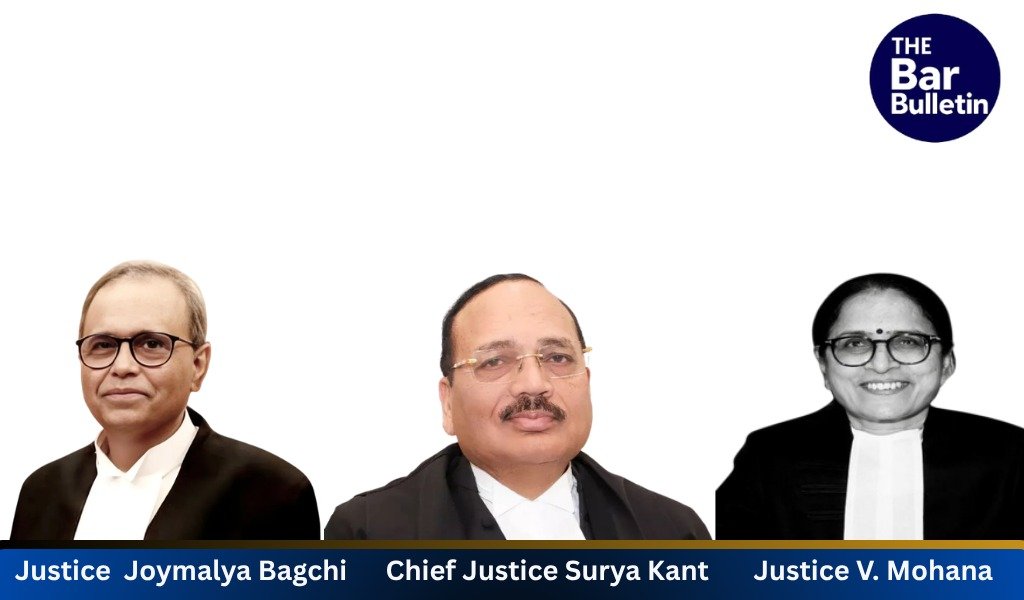
The hearing is proposed to be scheduled from October 6, 2026, with Nodal Counsel being asked to coordinate and prepare a time schedule so that the arguments can be completed within the proposed period. The Bench of Chief Justice Surya Kant, Justice Joymalya Bagchi and Justice V Mohana ordered:
“
“Ms Devyani Gupta, continuing as a nodal counsel, may complete the written submission on or before September 28, 2026, and also facilitate a first formal compilation of submissions, pleadings, documents and precedents. The matter is listed for October 6 2026, preferably at 11 AM. The Nodal counsel, in consultation with the other arguing counsels, will arrange a time schedule so that the hearing can be completed in time.
Background of the case
The dispute began in April 2003, when The Hindu published an editorial criticising the then Tamil Nadu government led by Chief Minister Jayalalithaa. The editorial and other reports commented on the functioning of the government and the manner in which the State’s political opponents and the media were being treated.
The Tamil Nadu Legislative Assembly Speaker took exception to the publications and treated them as a breach of legislative privilege under Article 194, alleging that the reports and editorial had lowered the dignity of the House and imputed motives to the Assembly’s Privileges Committee.
The matter escalated in November 2003. After the Assembly’s Privileges Committee found the journalists guilty, the House passed a resolution sentencing five senior editors of The Hindu and the editor of Murasoli to 15 days’ imprisonment. Arrest warrants were subsequently issued.
N. Ravi, then Editor-in-Chief of The Hindu, and the other affected editors approached the Supreme Court challenging the Assembly’s action. Their central contention was that legislative privilege under Article 194 could not be used to override their fundamental right to freedom of speech and expression under Article 19(1)(a).
The Supreme Court stayed the arrests on November 10, 2003. While dealing with the matter, the Court noticed that earlier Supreme Court judgments had created uncertainty regarding the relationship between legislative privileges and fundamental rights.
Why was it referred to seven judges?
The difficulty arose principally from the Court’s earlier decisions in M.S.M. Sharma v. Sri Krishna Sinha, AIR 1959 SC 395, and Special Reference No. 1 of 1964, AIR 1965 SC 745.
In M.S.M. Sharma, popularly known as the Searchlight case, the five-judge Bench had considered the conflict between legislative privilege and freedom of speech in the context of a newspaper publishing portions of a legislative speech that had been ordered to be expunged.
Subsequently, in Special Reference No. 1 of 1964, a seven-judge Bench considered the privilege powers of State Legislatures and the extent to which courts could examine their exercise. Although the later judgment agreed with the majority position in M.S.M. Sharma on the relevant law, certain observations were perceived as creating an apparent inconsistency between the two decisions.
It was against this backdrop that a five-judge Bench in the N. Ravi proceedings referred the matter to a seven-judge Bench, considering that the constitutional question had wide ramifications and could arise repeatedly in future.
The core constitutional question is essentially: Can the privileges enjoyed by State Legislatures under Article 194 override the fundamental rights of citizens, particularly the freedom of speech and expression under Article 19?
The issue has remained pending for more than two decades.