
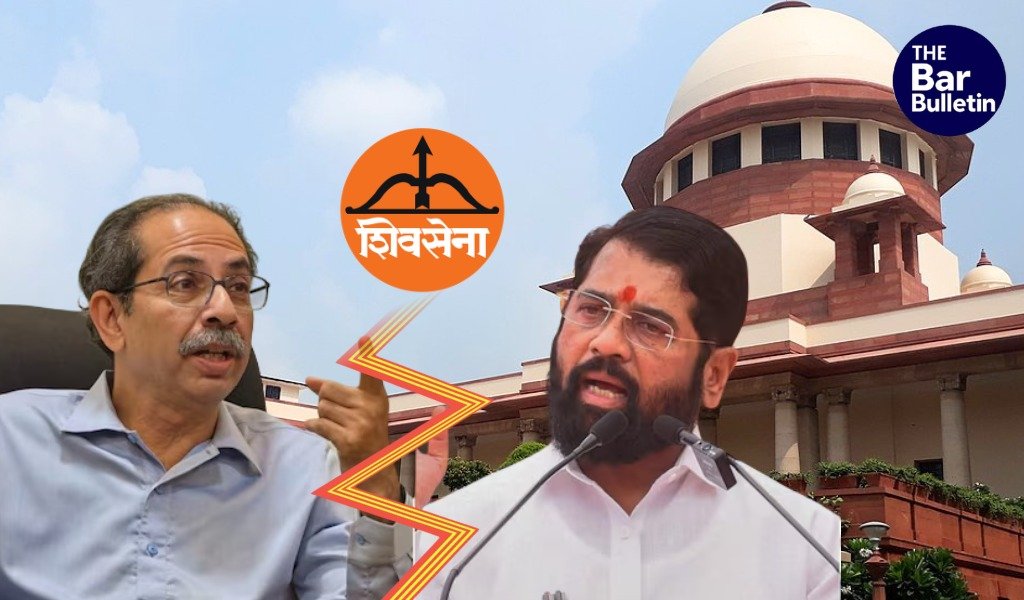

The Supreme Court on Thursday heard a batch of petitions arising from the Shiv Sena split, including challenges relating to the disqualification of MLAs and the Election Commission’s decision recognising the Eknath Shinde faction as the real Shiv Sena and allotting it the party’s “bow and arrow” symbol.
The petition filed by Sunil Prabhu (Chief Whip of the Uddhav Thackeray faction) challenges the January 10, 2024 order passed by Maharashtra Assembly Speaker Rahul Narwekar. The Speaker had refused to disqualify Eknath Shinde and his supporting MLAs under the Tenth Schedule (Anti-Defection Law) and recognised them as the “real” Shiv Sena in the assembly. The case was heard by Chief Justice Surya Kant, Justice Joymalya Bagchi and Justice V Mohana.
Appearing for the Uddhav Thackeray faction, Senior Advocate Kapil Sibal opened his submissions by describing the case as one that goes to the heart of India’s constitutional democracy. He told the Bench that the controversy raised two distinct issues:
● the disqualification of MLAs under the Tenth Schedule; and
● the legality of the Election Commission’s decision on the party symbol.
Giving what he described as a “bird’s eye view” of the dispute, Mr Sibal traced the events beginning with Uddhav Thackeray’s election as Shiv Sena Paksh Pramukh in 2013, the organisational restructuring in 2018, the 2019 Assembly elections, and the subsequent political developments leading to the split. He submitted that after cross-voting during an MLC election, a group of MLAs led by Eknath Shinde left Maharashtra for Surat and later Guwahati, where they passed resolutions removing Sunil Prabhu as the party whip, appointing Bharat Gogawale in his place, and declaring themselves to be the leadership of the Shiv Sena legislative party before informing the Speaker and Governor.
According to Mr Sibal, the Governor thereafter called for a floor test despite the dispute concerning the authority of the rebel legislators to act on behalf of the political party. Framing the principal constitutional issue, Mr Sibal submitted:
“
“One of the fundamental questions that arises in this case is this: Can members of the legislative party proclaim themselves to have the powers of the political party under the Constitution, remove the whip in the legislature, appoint themselves, go to the Governor and proclaim that they are the party? Whether that falls foul of the law or not, whether they can be disqualified on this ground alone… This has serious consequences on the very concept of representative democracy. It has serious consequences on the future of our polity and, with the greatest respect, Your Lordships must decide this matter because this is happening on a daily basis.”
Mr Sibal argued that the conduct of the rebel legislators amounted to voluntarily giving up the membership of the political party, attracting disqualification under the Tenth Schedule. He submitted that if legislators could simply assume control over the political party after getting elected on its symbol, it would fundamentally alter the constitutional scheme governing defections.
Referring to the delay in adjudication, Mr Sibal observed that the petitions had been pending since 2023 and, in the meantime, fresh elections had been held. He contended that had the disqualification issues been decided earlier, the political consequences would have been significantly different.
Mr Sibal warned that permitting legislators to abandon the party on whose symbol they were elected and later claim to represent another political formation would strike at the foundation of representative democracy.
“
“Somebody gets elected from one party, joins another, and then claims to represent a party on whose symbol he never fought the election. If this is upheld, this is constitutional harakiri. This is the most undemocratic step that, with the greatest respect, no court will countenance. The foundation of democracy is representative government; you represent the political party on whose symbol you were elected. You can’t represent another party in Parliament, not having fought on that symbol, and then claim that you are the party.”
Turning to the challenge against the Election Commission’s order, Mr Sibal submitted that after the formation of the Shinde government, the rebel faction approached the Commission claiming to be the real Shiv Sena. He argued that the Commission declined to examine the 2018 amended party constitution on the ground that it was not available on its record, and instead proceeded on the basis of the 1999 constitution while recognising the majority in the legislative wing.
He argued that this approach was contrary to the Constitution Bench judgment in Subhash Desai v. Principal Secretary, Governor of Maharashtra, (2023) 8 SCC 781, which recognised the distinction between a political party and its legislative party. According to Mr Sibal, once the Constitution Bench had held that legislators could not remove the party whip or claim the powers of the political party, the Election Commission could not determine the identity of the political party solely on the basis of legislative majority.
Mr Sibal further submitted that the Election Commission was aware of the 2013 and 2018 organisational elections and had received communications reflecting the party’s amended leadership structure. He referred to documents showing that Uddhav Thackeray was elected Paksh Pramukh in 2013 and again in 2018, and that Eknath Shinde himself had been nominated as a Shiv Sena leader under that very organisational structure.
He also criticised the Speaker’s decision in the disqualification proceedings, contending that while the Speaker accepted the 2018 leadership structure, he nevertheless declined to recognise the amended constitution because the Election Commission stated it was not available on its records. Mr Sibal argued that where both factions accepted appointments made under the 2018 structure, the absence of the amended constitution from the Commission’s records could not become the basis for ignoring the organisational constitution of the political party.
The hearing remained part-heard and will continue before the Supreme Court on Tuesday.
Sunil Prabhu v. Eknath Shinde & Ors., SLP (C) Nos. 1644-1662 of 2024, along with connected matters including Uddhav Thackeray v. Eknathrao Sambhaji Shinde & Anr., SLP (C) No. 3997 of 2023