
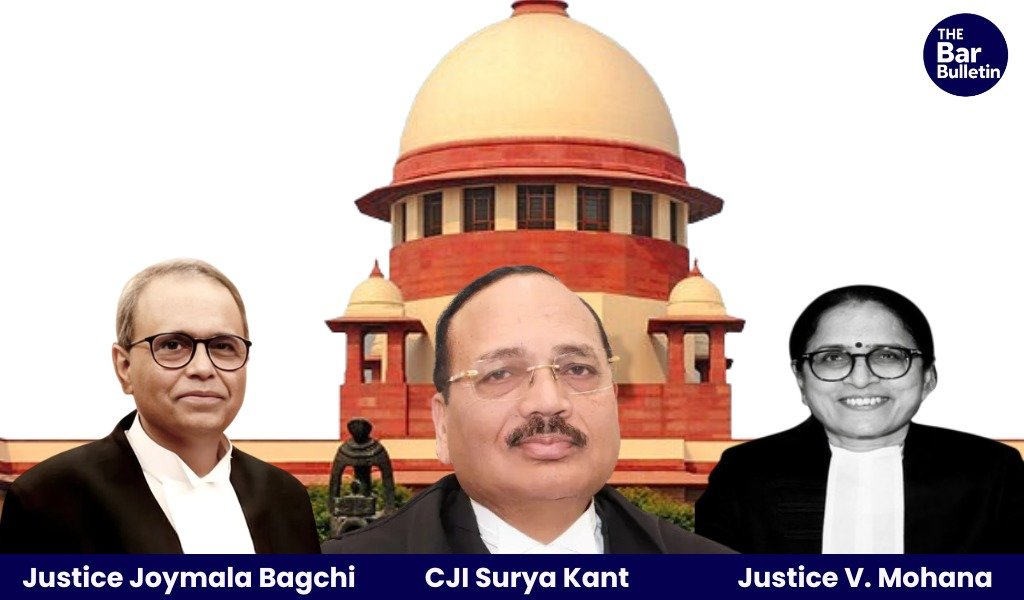

In a miscellaneous application in a suo moto writ petition before the Supreme Court in reference to an order dated 17-03-2025 by the Allahabad High Court, a Bench comprising Chief Justice of India Surya Kant, Justice Joymala Bagchi, and Justice V. Mohana accepted a publication to develop a sensitive and victim-centric approach amongst the members of the judiciary while directing all authorities to serve the same as a mandatory guiding resource in matters involving sexual offences and other cases concerning vulnerable persons.
The Court took cognizance of certain observations by a Single Judge of the Allahabad High Court. The controversy was brought to the Supreme Court’s attention by a letter dated 20-03-2025, from a forum known as ‘We the Women of India’. During the proceedings, the Supreme Court undertook a comprehensive examination of the correctness and propriety of the High Court’s observations and the Court found it difficult to concur with the High Court’s conclusions. Consequently, the Court allowed the Criminal Appeals, set aside the High Court’s order, and remitted the matter to the Court of the Special Judge (POCSO), Kasganj, for adjudication.
The Court deemed it appropriate to take notice of a broader systemic concern regarding the necessity for judicial decisions in cases involving sexual offences, specifically those involving vulnerable or minor victims and witnesses, to be informed by sensitivity, compassion, and empathy. It was emphasised that sustained institutional measures are necessary to inculcate and nurture a sensitive and victim-centric approach amongst members of the judiciary, while ensuring that court procedures are similarly aligned to uphold the dignity and rights of those who come before the justice system.
The Court considered it necessary to formulate appropriate guidelines informed by the views and recommendations of domain experts while remaining mindful of the various measures and initiatives undertaken in the past to strengthen the administration of justice in cases involving vulnerable persons. Hence, the Court requested Justice Aniruddha Bose, formerJudge of the Supreme Court and Director of the National Judicial Academy, Bhopal, to chair a Committee of Experts comprising four other domain specialists as members. The Committee was given the task of preparing a comprehensive report on ‘Developing Guidelines to Inculcate Sensitivity and Compassion into Judges and Judicial Processes in the Context of Sexual Offences and Other Vulnerable Cases’.
The Court recognised that one of the principal shortcomings of the earlier guidelines on the use of gender-neutral and non-stereotypical language in judicial writing was that they were framed with reference to a predominantly anglicised model of court functioning. It was stated that the present exercise was to ensure that the proposed guidelines are capable of meaningful implementation across the diverse linguistic and institutional landscape of the Indian justice delivery system. The Court stated that this exercise was also significant to improve and enhance the language generally employed in court proceedings, drafting of orders and judgments. The Court said that
“
“it is important to acknowledge that when our decisions ultimately have the effect of altering the course of a person’s life, it is imperative on us to ensure that such decisions are rendered in terms that are understandable to them.”
The Committee successfully submitted a publication which includes gender jurisprudence, targets victim-blaming or secondary trauma caused by police interrogation and cross-examination, outlines neutral alternative terminology, guides regional linguistic settings particularly in relation to transgender persons and persons of diverse sexual orientations, gender identities and expressions and sex characteristics (SOGIESC), concluding with a dedicated section on compassionate court practices.
The Court stated that owing to its lucid presentation, practical orientation, and ease of reference, the publication served as a valuable ready reckoner for judicial officers at every level. It was clarified that the use of appropriate, inclusive, and sensitive language is an evolving exercise, which could not be regarded as having attained finality.
Hence, it was said that the publication was to be treated as the commencement of a continuing institutional endeavour rather than its culmination. The Court said that the judiciary, and particularly this Court, must periodically revisit and refine these standards to ensure that judicial discourse is consistent with constitutional values, reflects sensitivity, and speaks in a harmonious voice.
The Court directed the Registry to upload it to the Supreme Court website and copies were ordered to be circulated for upload and implementation across all High Courts, the District Judiciary, Tribunals, State Judicial Academies, Law Departments, the National Legal Services Authority, and the Ministry of Women and Child Development. Regional translations of the handbook were to be circulated amongst relevant academicians, law universities, and law colleges.
Directors General of Police and Directors of Prosecution of all States were explicitly directed to instruct all police stations to abide by its contents when registering an FIR or filing a chargesheet. The Court directed the publication to serve as a mandatory guiding resource in matters of sexual offences and other cases involving vulnerable persons. All authorities were directed to ensure effective dissemination and implementation of the publication.
Before disposing of the matter, the Court instructed the Registry to seek administrative guidance from the Chief Justice of India regarding whether to register fresh suo motu proceedings concerning a conflicting Patna High Court judgment.
