


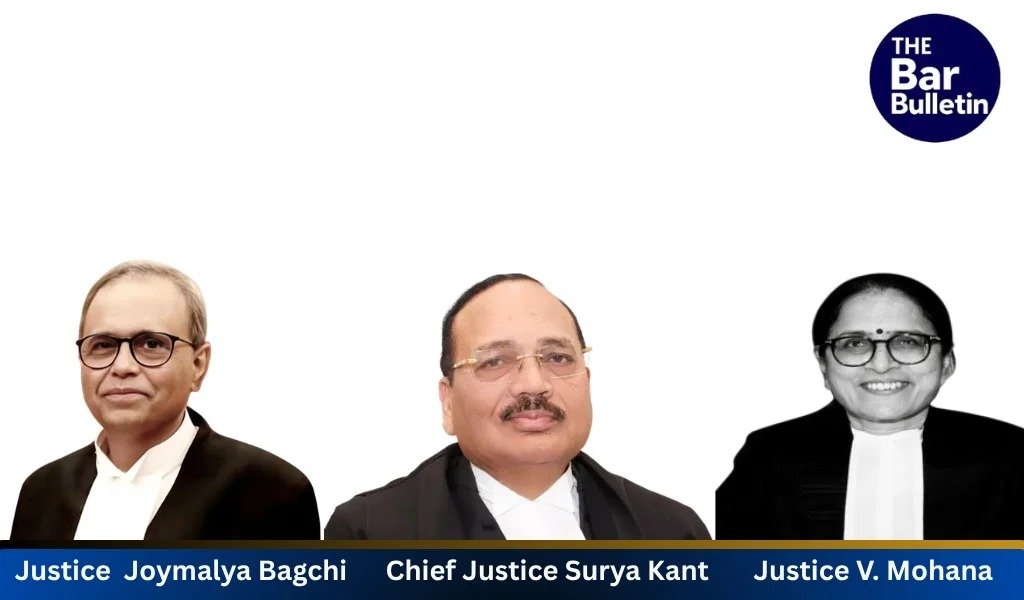
The Supreme Court on Monday reserved its order on a plea filed by Shri Saryu Nagar Vikas Samiti challenging the acquisition of multi-crop agricultural land for the third phase of a development scheme in Ayodhya. A bench of Chief Justice of India Surya Kant, Justice Joymalya Bagchi and Justice V Mohana heard the matter.
The petitioner challenged the acquisition under the Uttar Pradesh Awas Evam Vikas Parishad Adhiniyam, 1965, arguing that the State could not bypass the substantive safeguards under the Right to Fair Compensation and Transparency in Land Acquisition, Rehabilitation and Resettlement Act, 2013, merely by extending compensation and rehabilitation benefits under the latter legislation.
Senior Advocate Gopal Sankaranarayanan submitted that the Allahabad High Court had limited the petitioner’s rights under the 2013 Act to monetary compensation, rehabilitation and resettlement, whereas the legislation provided a broader set of protections governing the acquisition process itself. He argued that the third scheme was initiated well after the 2013 Act came into force and the State could not rely on the earlier Uttar Pradesh enactment to disregard those safeguards.

Referring to Section 2 of the 2013 Act, he submitted that its provisions concerning land acquisition, compensation, rehabilitation and resettlement applied when the government acquired land for its own use, hold or control, including for public purposes. He also referred to the statutory framework governing laws exempted from the 2013 Act, arguing that the State had not established a legal basis for excluding the acquisition from its safeguards. Sankaranarayanan argued that the State could not rely on the Uttar Pradesh Awas Evam Vikas Parishad Adhiniyam, 1965, to avoid following the safeguards under the 2013 Land Acquisition Act.
Justice Joymalya Bagchi then asked the State whether it believed that only compensation and rehabilitation benefits under the 2013 Act applied, while the other safeguards could be ignored.
Additional Solicitor General Aishwarya Bhati submitted the State was following the Uttar Pradesh law and providing landowners all the benefits available under the 2013 Act. She added that the acquisition was part of a larger development plan for Ayodhya, not merely a housing scheme, and argued that the project should not be stalled.

On the alleged non-utilisation of land acquired under earlier development schemes, Mr Sankaranarayanan submitted that the three schemes together covered approximately 1,407 acres, but that the petitioner was challenging only the third scheme. He argued that only around 70 acres had been utilised under the first two schemes, leaving a substantial area unutilised.
Invoking Section 8(1)(d) of the 2013 Act, he contended that the provision required the government to ensure that previously acquired land in the area had not remained unutilised before proceeding with further acquisition. He argued that this safeguard had not been addressed by the High Court and that the State had not placed material before the Supreme Court demonstrating how the land acquired under the earlier schemes had been used.
Mr Sankaranarayanan also relied on Section 10 of the 2013 Act, which restricts the acquisition of multi-crop irrigated land subject to statutory exceptions. He submitted that the State had not invoked the provision or shown that an applicable exception permitted the acquisition.
The petitioner further questioned the proposed use of the land, pointing to material referring to nine hotels and commercial facilities in a scheme presented as one for residential housing. He argued that agricultural land belonging to farmers was being acquired for a project whose full scope had not been adequately assessed.
“
“you’re going to take lands of 250 farmers who are having multi-crops there, and the idea is that at some point you’re going to have nine hotels. This is what has been happening. I’m sorry to say, over the last 20 years, we have had courts step in again and again and again about the fact that UP will take farmers’ land, convert it, re-fix it, and centre builders come in, board them, and they take it over, and they convert it into hotels, commercial plots, etc. That is not what the scheme is supposed to be. Apparently, it’s for residential housing. Where are nine hotels and all?
He also questioned why the social impact assessment process, which the petitioner said had already been initiated, was discontinued. He urged the Court to require its completion before the State proceeded with the third scheme, arguing that the assessment was particularly important given the impact of the acquisition on farmers and agricultural land. He submitted that approximately 1,300 acres acquired under the first two schemes remained unutilised and that the State had not shown how the land had been used. He further argued that the 2013 Act was being ignored despite providing safeguards to farmers, with compensation alone being offered in place of those protections. He clarified that his challenge was not about future acquisitions but the ongoing third scheme, which, he said, should remain on hold until the statutory provisions were applied.
Justice Bagchi observed that a social impact assessment could not be brushed aside lightly, while cautioning that the requirement could not become a millstone around the neck of the State. It stressed the need to weigh the statutory process against public interest, particularly where development projects were already underway. Justice Bagchi remarked:
“
“As much as we absolutely all hold that the social impact assessment is something which should not be brushed aside lightly, this can’t be put as a millstone around the neck of the state.”
Ms Bhati, meanwhile, submitted that the State was providing the benefits available under the 2013 Act, including enhanced compensation rates and solatium. She argued that the wider development plan included multiple components and that the dispute had become academic in view of the High Court’s direction concerning benefits for affected landowners.
She argued that the project was part of a broader development plan for Ayodhya and not merely a housing scheme, and cautioned that the development could not be stalled on the grounds raised by the petitioner. Addressing the criticism over the proposed hotels, she asked how a major pilgrimage destination like Ayodhya could be developed without hotels. Mr Sankaranarayanan countered that development could not justify acquiring multi-crop agricultural land, prompting Ms Bhati to submit that the State was not depriving farmers of their livelihoods.
The petitioner clarified that his challenge was not a general request for changes to future acquisitions, but a challenge to the third scheme currently in dispute. He argued that the State should not proceed until the relevant safeguards under the 2013 Act had been applied.
The Supreme Court reserved its order after hearing the parties.