
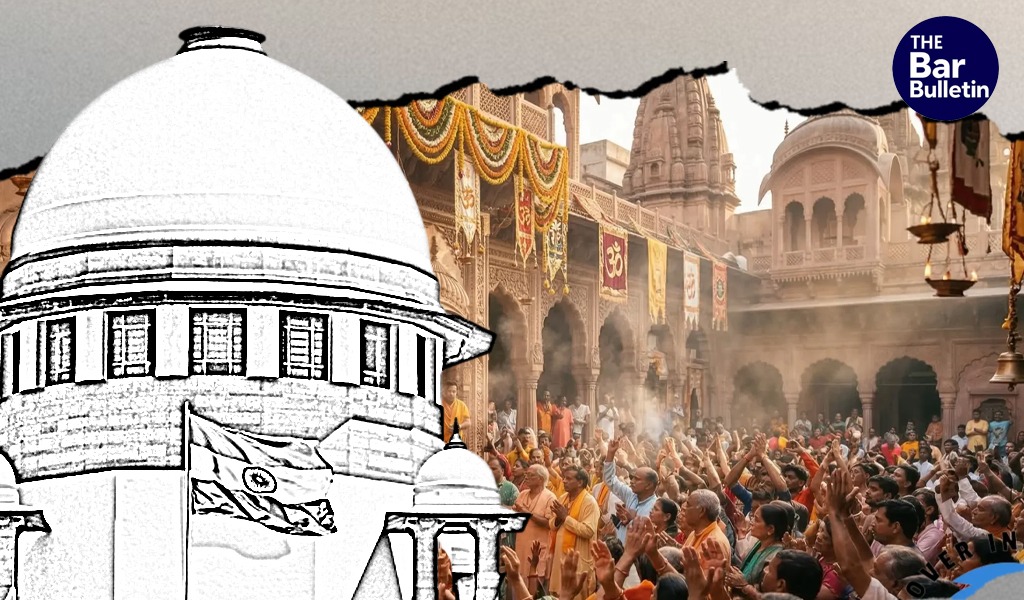
The Supreme Court on Tuesday asked the committee administering the Bankey Bihari Ji Maharaj Temple in Vrindavan to consider suggestions from representatives of the two Goswami groups (Shayan Bhog & Raj Bhog) regarding restoration of traditional religious practices and improvement in the day-to-day functioning of the temple, while also impressing upon the Uttar Pradesh government to prepare a broader development plan for the area surrounding the shrine.
The Bench of Chief Justice Surya Kant and Justice Joymalya Bagchi directed that two members each from the Shayan Bhog and Raj Bhog Goswami sects be included to assist the court-appointed committee. Recording its directions, the Court observed:
“With a view to ensure that the suggestions with respect to allowing the traditional religious practices to the extent possible, without any exploitation of visitors and other day to day rituals… all of them shall jointly give suggestions for improvement of traditional and religious practices and the day-to-day functioning of the temple. We have no reason to doubt that such suggestions shall be given due consideration by the committee constituted by this Court.”
The Court further stressed the need for scientific crowd management and modern infrastructure around the temple, noting the extremely narrow lanes leading to the shrine and the massive daily influx of devotees. The Bench observed that “crowd management is not going to happen with conventional ideas…Modern systems and phased entry mechanisms would be required to prevent congestion and stampede-like situations.”
The Bench also urged the State to explore a larger development model on the lines of Kashi Vishwanath and Vaishno Devi, including widening roads, creating medical and sanitation facilities, shelters, waiting areas and emergency infrastructure for devotees. “A development plan for the entire area is required,” the Court indicated while asking the State and the committee to place their proposals before it.
Arguments of the Parties
Senior Advocate Shyam Divan, appearing for the Management Committee of Thakur Shree Bankey Bihari Ji Maharaj Temple, made extensive submissions before the Supreme Court concerning the functioning of the court-appointed High Powered Committee (HPC), alleged interference with longstanding temple rituals, representation of the Goswami community, expenditure from temple funds, and factual corrections sought in the Court’s earlier August 8, 2025 judgment.
Mr Divan began by informing the Court that two sets of issues arose in the matter
- one from the writ petition challenging the ordinance; and
- another from a miscellaneous application seeking corrections in portions of the Court’s earlier judgment which, according to the petitioners, contained factual reconstructions unsupported by pleadings.
On representation in the High Powered Committee, Mr Divan argued that the present Goswami representatives on the committee did not enjoy the confidence of the larger Goswami community. He submitted that before the Supreme Court’s earlier order, a general body meeting had been held in June 2025 in which representatives were elected by the Goswami community. He stated that 208 out of 280 Goswamis from the Shayan Bhog group and 47 out of 65 Goswamis from the Raj Bhog group had participated in the voting process.
According to Mr Divan, despite repeated communications and affidavits showing majority support for the elected representatives, the committee instead conducted interviews of 11 applicants and selected four representatives, only one of whom had majority support. He contended that this had created a huge and deleterious impact and caused a communication gap between the committee and the Goswami community. He urged the Court either to accept the representatives elected in June 2025, direct fresh elections under the 1939 scheme, or expand the Goswami representation on the committee by adding three more elected representatives.
Interference with Temple Ritual: Sr Adv Shyam Divan
Mr Divan then turned to a ‘sensitive issue’ of interference with internal rituals of the temple. He objected to the High Powered Committee’s decision to change traditional darshan and aarti timings, followed “since time immemorial.” He argued that the deity at Bankey Bihari Temple is treated as a living child and therefore rituals relating to waking, resting, bhog seva and aartis are deeply embedded in centuries-old religious practices and ought not to be altered merely for administrative convenience.
He specifically pointed to changes made by the committee under an order dated September 19, 2025, where darshan timings had allegedly been advanced from 7:45 AM to 7:00 AM and associated rituals such as Sringara Aarti were similarly shifted. Divan submitted that such changes disrupted the established sequence of temple rituals.
On the issue of “Dhehri Puja”, Mr Divan argued that the ritual had traditionally been performed in the Jagmohan area of the temple whenever the main temple doors were closed. He submitted that the committee had barricaded the entire Jagmohan area and prohibited the ritual from being conducted at its traditional location. According to him, this interfered with the Guru-Shishya Parampara associated with the ritual.
Mr Divan further submitted that the ritual did not interfere with crowd management because it was performed only when the temple remained closed to the general public and involved not more than 50 participants from Guru-Shishya families. He stressed that the ritual carried deep religious significance because the threshold (“Dhehri”) of the entrance was treated as the feet of the deity where offerings were made.
Commercialisation of Sacred Place: Sr Adv Shyam Divan
Another grievance raised by Mr Divan concerned “Phool Bangla Seva”, a ritual performed during the summer months. He objected to the charge of ₹1 lakh to ₹1.51 lakh for performing the seva, arguing that historically only nominal electricity charges had been levied. He described the increased charges as an “excessive burden” on Goswamis and their disciples and argued that such financial demands amounted to “commercialisation of a sacred religious practice” and imposed unreasonable restrictions on rights under Articles 25 and 26 of the Constitution.
Divan also challenged a February 17, 2026 decision directing that the deity be brought daily into the Jagmohan area for devotees’ convenience. He argued that under longstanding customs, the deity emerged from the sanctum only on special occasions such as Holi, Sharad Purnima and Janmashtami, and daily exposure would violate temple traditions.
He additionally objected to the installation of “very bright halogen lights” and digital display systems facing directly toward the deity, arguing that devotees believed the deity to be living and that such lighting arrangements were religiously inappropriate.
Mr Divan also questioned the expenditure incurred by the High Powered Committee from temple funds. He submitted that while the Supreme Court had earlier permitted honorariums and secretarial support for committee members to be paid from temple funds, the committee was allegedly incurring expenditure beyond those directions, including travel expenses, house rent, structural surveys, and acquisition-related expenses. He informed the Court that approximately ₹25 crore may have been spent from temple funds in eight months, though exact figures were unavailable because RTI queries had allegedly not been answered.
On crowd management, Mr Divan submitted that the committee’s barricading arrangements had worsened congestion rather than solved it. Referring to photographs placed before the Court, he warned that the huge rush of devotees could create dangerous situations and proposed alternative measures such as online registration systems similar to those used in other major temples.
Wrong Facts Recorded by the Court: Sr Adv Shyam Divan
On the miscellaneous application seeking clarification and correction of factual observations in the Supreme Court’s August 8, 2025 judgment, Mr Divan argued that certain historical and factual findings had entered the judgment despite there being no pleadings or evidentiary basis for them in the proceedings. For instance, he challenged the observation that the temple had been constructed in 1864 on land gifted by Raja Ratan Singh. Mr Divan submitted that historical records instead showed that Mughal Emperor Akbar had granted land to Swami Haridas Ji due to his spiritual influence and devotion toward the deity.
He also disputed observations in the earlier judgment suggesting longstanding factional disputes and administrative deadlock between the Rajbhog and Shayanbhog groups. Mr Divan argued that earlier litigation arose only from disputes concerning one nomination in the management committee and not from any broad factional conflict.
“There were no pleadings to that effect. There were no proceedings or findings in any judicial order alleging any financial irregularity by the Goswamis in relation to the temple administration. The writ petition was filed challenging the constitutional validity of the ordinance and the administrative deadlock between the two groups was not in question, neither in the writ petition nor any counter affidavit was filed in the matter. There is no material on the record which reflects ineffective and inefficient ad-hoc arrangement of the temple management. There is no material on the record which reflects that there is administrative deadlock in the temple.”
Further, Mr Divan challenged observations in the judgment indicating ineffective administration, infighting, and failure by Goswamis to provide facilities to devotees despite substantial donations. He argued that there were no pleadings, counter-affidavits or judicial findings alleging financial irregularities or administrative breakdown by the Goswamis.
Concluding his submissions, Mr Divan urged the Court to clarify that while the High Powered Committee may continue handling secular and administrative matters on a temporary basis, it should not interfere with religious rituals and practices traditionally followed in the temple.
Devotion is not a Revenue Model: Advocate Sankalp Goswami
Advocate Sankalp Goswami, appearing on behalf of the deity in the Bankey Bihari Temple matter, urged the Supreme Court to protect the temple’s centuries-old rituals and objected to changes in darshan timings, interference with traditional practices, and alleged commercialisation of live-streaming arrangements by the court-appointed committee.
Addressing the Bench, Mr Goswami said the temple followed a unique denominational tradition centred around the “Nitya Leela” of the deity, who is worshipped as a living divine couple. Opposing revised darshan timings, Mr Goswami argued that,
“unlike other Vaishnav temples, Bankey Bihari Temple intentionally does not hold an early morning Mangala Aarti so the deity can rest after nightly divine rituals. The deity also has a right to sleep. He is a delicate deity. The darshan timing will force the deity to stand up. It will cause interference in his Leela. It will displeasure the deity.”
He argued against commercial exploitation through live-streaming screens and QR-code based donations. Referring to advertisements allegedly displayed during livestreams, he submitted: “A deity’s darshan cannot be converted into a commercial screen. Faith is not inventory. Devotion is not a revenue model.”
He further alleged that despite RTI requests, details relating to QR-code donations, bank statements, contracts and advertisement permissions had not been disclosed, and urged the Court to direct production of records and stay the live-streaming arrangement until transparency was ensured.
Change in Darshan Timing is a Crowd Management Measure: ASG KM Nataraj
Additional Solicitor General K.M. Nataraj, appearing for the government, defended the functioning of the court-appointed committee, stating that changes in darshan timings and certain ritual arrangements were introduced solely for crowd management and devotee safety at the heavily congested Vrindavan temple.
Explaining the revised darshan schedule, Mr Nataraj submitted: “The timings has been now rescheduled… only for the purpose of enabling more devotees to visit and for the purpose of crowd management.” Referring to the narrow temple premises and heavy footfall, he told the Court that the temple was built over hardly about 3 cents of land and lakhs of devotees from across North India visited the shrine regularly.
On the issue of “Dhehri Puja”, the ASG submitted that the ritual itself had not been stopped and only its location had been adjusted to prevent overcrowding and stampede-like situations. “Dehri Puja is still going on. This is unimpeded; Puja can’t be affected. This is a religious function. We can’t touch,” he submitted.
Mr Nataraj also supported broader infrastructure development around the temple, including widening access roads, acquiring surrounding properties, medical facilities, sanitation infrastructure and waiting areas for devotees.
Develop Bankey Bihari Like Kashi Vishwanath Corridor: Adv Ashwini Upadhyay
Advocate Ashwini Upadhyay, appearing as an intervenor-devotee, described Bankey Bihari Temple as the “Tirupati of North India”, as devotees travel hundreds of kilometres from Rajasthan, Haryana, Uttarakhand, Jharkhand and other States, often in tractors and trolleys, but due to inefficiencies, they face overcrowding and inadequate facilities. Drawing comparisons with the Kashi Vishwanath Corridor and Vaishno Devi shrine models, Upadhyay argued that the same court be done in Bankey Bihari.
Appearances
For Petitioner- Mr. Shyam Divan, Sr. Adv. Ms. Tanvi Dubey, AOR Mr. Yash Dubey, Adv. Mr. Rongon Choudhury, Adv. Mr. Mekala Ganesh Kumar Reddy, Adv.
For Respondent- Mr. KM Nataraj, A.S.G. Mr. Sharan Dev Singh Thakur, Sr. Adv. Mr. Sharan Dev Singh Thakur, Sr. A.A.G. Ms. Ruchira Goel, AOR Ms. Indira Bhakar, Adv. Ms. Ritika Rao, Adv. Mr. Sharanya, Adv. Ms. Rishika Rishabh, Adv. Mr. Kailash Prashad Pandey, AOR Mr. Hitesh Kumar Sharma, Adv. Mr. Amit Kumar Chawla, Adv. Mr. Akhileshwar Jha, Adv. Mr. Mahi Pal Singh, Adv. Mr. Varun Varma, Adv. Mr. Sativk Sharma, Adv. Mr. Anupam Kumar, Adv. Mr. D.P. Singh, Adv. Mr. Narendra Kumar Goswami, Adv. Ms. Shivani, Adv. Ms. Shilpi Chowdhary, AOR Mr. Amarkant Patel, Adv. Mr. Shivansh Bharatkumar Pandya, AOR