
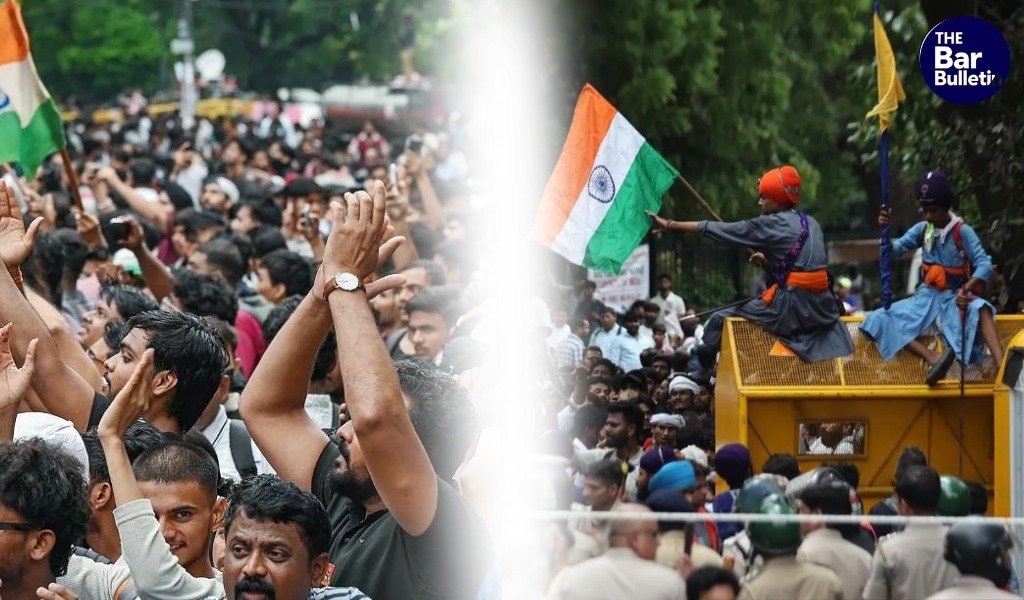
The Supreme Court on Friday declined to entertain an urgent plea concerning the CJP Tiranga protest at Connaught Place in Delhi, observing that the Delhi High Court has already dealt with the issue. The Bench, however, indicated that it could examine the proportionality of restrictions imposed by the authorities and consider compensation if warranted.
A Bench of Chief Justice of India Surya Kant and Justice Joymalya Bagchi was hearing a mentioning by Advocate Jai Anant Dehadrai, who raised concerns over the proposed “Lehra Do Tiranga” protest called by the Cockroach Janta Party (CJP) at Connaught Place on October 16.
Mr Dehadrai submitted that the gathering could severely disrupt business in central Delhi, particularly during the festive season. He told the Court that traders could suffer losses of ₹200–250 crore per day and pointed out that the New Delhi Municipal Council (NDMC) had issued a notice the previous night directing the closure of the area.
Justice Bagchi observed that the issues raised were interconnected.
“
“Someone wants to protest; someone wants to sell mungfali; someone wants to maintain law and order; all are related,” Justice Bagchi remarked.
Dehadrai argued that the festive period, including Karwa Chauth, Dussehra, Diwali and Dhanteras, made the situation particularly difficult for traders and small businesses dependent on daily earnings.
Chief Justice Surya Kant expressed concern for small shopkeepers, street vendors and stall owners who could face financial hardship because of disruptions during the festive season.
“
“We hope better sense will prevail over everyone. It is season of festivities, we know all small shopkeepers, rediwala, and stall people. We know the hardship, difficulty and the crisis the entire family will face,” the CJI observed.
The Bench said it would take up the matter on October 26. Justice Bagchi indicated that if the NDMC’s order was found to be disproportionate, the Supreme Court could consider relief under its public law jurisdiction, including compensation.
The development comes after the Delhi High Court declined to restrain the CJP and its founder, Abhijeet Dipke, from holding the proposed protest at Central Park in Connaught Place on October 16. The High Court recorded the Delhi Police’s assurance that necessary steps would be taken to regulate the gathering and maintain public order.
Meanwhile, the NDMC announced that Central Park would remain closed to the public on October 16 and 17, citing administrative reasons. The proposed march was called amid protests demanding the resignation of Chief Election Commissioner Gyanesh Kumar over issues relating to the Special Intensive Revision of electoral rolls.