
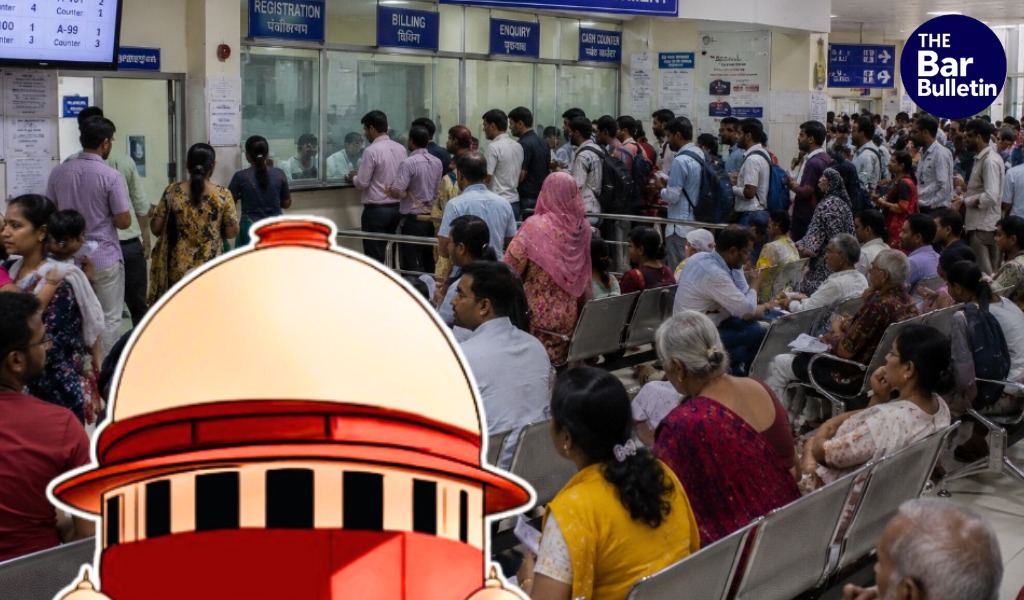
The Supreme Court on Wednesday expressed concern over continued non-compliance by several private hospitals in Delhi with directions requiring free treatment for economically weaker section (EWS) patients in hospitals built on concessional public land.
The Bench of Justice Prashant Kumar Mishra and Justice N.V. Anjaria considered a detailed report submitted by the amici curiae regarding compliance by over 450 hospitals with the Court’s earlier directions relating to free OPD and IPD treatment for EWS patients.
The report noted that even current compliance figures appeared “inflated” because averages improved only after recent Supreme Court proceedings. The amici pointed out a “huge gap” between the prescribed and actual percentages for free treatment.
During the hearing, the Court observed that the focus now was not merely identifying deficiencies but determining “what to proceed further” and whether hospitals should be given time to adopt corrective measures.
The amici proposed several measures, including the installation of CCTV cameras at hospital entrances and patient assistance points to monitor whether EWS patients were being treated fairly and not discouraged from seeking treatment. The Court also took note of submissions highlighting practical difficulties faced by poor patients.
“Nobody would like to take a day off and go to the hospital unnecessarily. So, he has gone there, do not dissuade him, do not discourage him, give him a conducive atmosphere,” the Court stated.
The Bench directed that a joint meeting be convened involving major hospitals, Delhi government officials and amici curiae to evolve a workable Standard Operating Procedure (SOP).
“You conduct a meeting of all the CEOs or MDs of all major hospitals with the Amici and the concerned Secretary of the Delhi Government. You hold a joint meeting and prepare a kind of guideline or SOP or modalities.”
“The idea is that instead of forcing something on you, you prepare some modality for yourself and then adhere to it. Because then it will come as your undertaking. And if you fail on that, then no one can save you. Since it is coming from your end, that we will do this, we will do this. If you fail thereafter, because I am putting the ball in your court.”
The Bench further cautioned hospitals that if deficiencies continued despite opportunities for improvement, stricter action could follow.
“If at the end of it also they are not following the orders of the court, then we will take some strict view of them,” the Court said.
The Court also remarked that persistent default by those who are allotted land at concessional rates could even raise questions about requiring them to pay the prevailing market value for such land.
The Court appreciated the extensive work undertaken by the amici curiae, including geo-mapping of hospitals and nearby jhuggi clusters across Delhi to assess accessibility of EWS treatment facilities.
The Bench directed Dr Kusum Arora, Superintendent, Nursing Home and EWS in-charge, GNCTD, in consultation with amici, to convene a meeting with the noticee hospitals at the Delhi Secretariat within 15 days for preparation of an SOP and compliance framework.
The matter has been listed for further hearing on July 29.
Background of the case
The matter arises out of Union of India v. Moolchand Khairati Ram Trust & Ors., (2018) 8 SCC 321, concerning charitable hospitals in Delhi that had received government land at highly concessional rates for public welfare purposes. Moolchand Hospital, run by the Trust, was allotted around nine acres of land by the Government of India in the 1960s at subsidised rates for establishing and operating a charitable hospital.
Subsequently, following the PIL Social Jurist v. GNCTD filed in 2002 regarding private hospitals built on concessional public land, directions were issued requiring such hospitals to provide free treatment to economically weaker sections, including free OPD and IPD facilities. The government thereafter issued communications and policy directions enforcing these obligations.
The Trust challenged these directions, contending that the original lease deed and allotment terms did not specifically mandate free treatment quotas and that such obligations could not be imposed decades later through executive instructions. The Delhi High Court accepted this contention. However, the Supreme Court, in Union of India v. Moolchand Khairati Ram Trust & Ors., (2018) 8 SCC 321, reversed the High Court’s judgment and held that institutions receiving concessional public land cannot avoid their larger public and charitable obligations. The Court observed that state largesse carries reciprocal duties and that hospitals benefiting from subsidised public resources cannot function purely as commercial entities while ignoring obligations toward poorer sections of society.
The present contempt application arises from issues relating to the implementation and continued compliance with the directions issued in the main judgment.
Appearances:
Petitioner: Mr. Vikramjit Banerjee, A.S.G. Ms. Swati Ghildiyal, AOR Mr. Nimesh Bhatt, Adv. Mr. Nring Chamwibo Zeliang, Adv. Mr. Shrisha Chandra, Adv. Mr. Hritik Pathak, Adv.
Respondent: Dr. Lalit Bhasin, Adv. Ms. Nina Gupta, Adv. Ms. Mansi Bajaj, Adv. Ms. Radhika Gupta, AOR Mr. Aditya Bhasin, Adv. Mr. Nitin Mishra, AOR Mr. Ishaan Sharma, Adv. Ms. Mitali Gupta, Adv. Mr. Neeraj Kishan Kaul, Sr. Adv. Mr. Rajiv Shakdhar, Sr. Adv. Mr. Mahesh Agarwal, Adv. Mr. Manu Krishnan, Adv. Ms. Chanan Parwani, Adv. Mr. E. C. Agrawala, AOR Mr. Saket Sikri, Adv. Ms. Ekta K Sikri, Adv. Mr. Vikalp Mudgal, AOR Mr. M H Zahidi, Adv. Mr. Priyansh Choudhry, Adv. Ms. Ekta Choudhary, AOR Mr. Ashok Chhabra, Adv. Mr. Mohit D. Ram, AOR Ms. Nayan Gupta, Adv. Mr. Arnav Chaudhary, Adv. Mr. Anil Kumar, AOR Mr. Prateek Walia, Adv. Mr. T Jayaraman, Adv. Ms. Sangeeta, Adv. Mr. Deepak Aggarwal, Adv. Mr. Jaideep Singh Randhawa, Adv. Mr. Ashish Pandey, AOR Mr. Namit Suri, AOR Mr. Kapil Midha, Adv. Ms. Pepakayala Geetanjali, Adv. Mr. Garv Singh, Adv. Ms. Vartika Gautam, Adv. Mr. Preetpal Singh, Adv. Mr. Nitin Garg, Adv. Mr. Pramod Kant Saxena, Adv. Mr. Girdhari Lal Gupta, Adv. Mr. Ravi Kumar Tomar, AOR Mr. Sridhar Potaraju, Sr. Adv. Ms. Ritwika Nanda, Adv. Ms. Petal Chandhok, Adv. Mr. Veer Singh, Adv. M/s Trust Legal, AOR Ms. Pragya Parijat Singh, AOR Mr. Kartik Dabas, Adv. Ms. Priyanka Sachdeva, Adv. Mr. Lakshay Saini, Adv. Ms. Jayita Verma, Adv. Mr. Rakesh Malhotra, Adv. Mr. Kushal Malhotra, Adv. Mr. Bharat Malhotra, Adv. Ms. Savita Singh, AOR Mr. Jacob Benny, Adv. Mr. Mohnish Nirwan, Adv. Ms. Ritika Gaur, Adv. Mr. Ashish Kumar Mishra, Adv. Mr. Umesh Dubey, AOR Mr. Raghenth Basant, Sr. Adv. Ms. Aanchal Tikmani, AOR Ms. Kaushitaki Sharma, Adv. Mr. Mujadid Gilani, Adv. Mr. Gaurav Sarin, Sr. Adv. Ms. Supriya Juneja, AOR Mr. Aditya Singla, Adv. Mr. Harish Kumar, Adv. Mr. Mrigank Prabhakar, AOR Mr. Tarang Agarwal, Adv. Mr. Mrigank Kumar, Adv. Ms. Astha Singh, Adv. Ms. Sakshi Banga, Adv. Mr. Rajeev Sharma, Sr. Adv. Mr. Uddyam Mukherjee, AOR Ms. Shruti Sharma, Adv. Ms. Shreya Sharma, Adv. Mr. Swapnil Pattanayak, Adv. Mr. Nishant Kandpal, Adv. Mr. Agnibha Chatterjee, Adv. Ms. Kratika Kushwaha, Adv. Ms. Chitrangda Rastravara, AOR Mr. Anirudh Singh, Adv. Mr. Abhijeet Singh, Adv. Mr. Aishwary Mishra, Adv. Mr. Dhananjai Shekhwat, Adv. Mr. Yuvraj Singh, Adv. Ms. Pearl Pundir, Adv. Mr. Dashrath Singh, Adv. Mr. Anoop Prakash Awasthi, AOR Mr. Shubham Dubey, Adv. Mr. Rushikanta Dash, Adv. Ms. Jasleen Kaur, Adv. Mr. Sandeep Agarwal, Sr. Adv. Mr. Rajesh Pathak, Adv. Mr. Kumar Ajit Singh, Adv. Ms. Tanya Chanda, Adv. Ms. Manjeet Kirpal, AOR Mr. Vikas Mehta, AOR Mr. Manish Aggarwal, Adv. Mr. Vaishak Omanakuttan, Adv. Mr. Bipul Kumar Mishra, Adv. Ms. Ankita Dwivedi, Adv. Mr. Piyush Kant Roy, AOR Ms. Bhukya Reshma Bai, Adv. Ms. Ruchika Rathi, AOR Mr. Abhishek Malhotra, Sr. Adv. Mr. Mayank Rai, Adv. Mr. Kartikay Dutta, Adv. Ms. Anukriti Trivedi, Adv. Mr. Anil Bhat, Adv. Ms. Preeti Gupta, AOR Mr. Vivek P Gupta, Adv. Mr. Balwant Chaubey, Adv. Mr. Gopal Sankaranarayanan, Sr. Adv. Mr. Manu Nair, Adv. Mr. Manik Singh, Adv. Mr. Saurabh Gupta, Adv. Ms. Samridhi Shukla, Adv. Mr. Shourya Dasgupta, Adv. Mr. S. S. Shroff, AOR Mr. Rajiv Bahl, Adv. Mr. Arun K. Sinha, AOR Mr. Rakesh Singh, Adv. Mr. Sumit Sinha, Adv. Mr. Neeraj Yadav, Adv. Mr. Digvijay Yadav, Adv. Mr. Davesh Bhatia, AOR Mr. Anuj Tiwari, AOR Mr. Sumit Dubey, Adv. Mr. Saurabh Kumar Mishra, Adv. Mr. Sameer Mishra, Adv. Ms. Shalini Basu, Adv. Mr. Vaibhav Vats, Adv. Mr. Shivendra Nath Mishra, Adv. Mr. Girijapati Kaushal, Adv. Mr. Parag Tripathi, Sr. Adv. Mr. Sameer Rohatgi, Adv. Ms. Anuradha Dutt, Adv. Mr. Anish Kapur, Adv. Mr. Haaris Fazili, Adv. Ms. Nikhita Suri, Adv. Ms. Prachi Pandey, Adv. Mr. Raghav Dutt, Adv. Ms. B. Vijayalakshmi Menon, AOR Mr. Ribhav Pande, Adv. Mr. Aayush Shukla, Adv. Mr. Yadav Narender Singh, AOR Mr. Amitt Mehtta, Adv. Ms. Shruti Munjal, AOR Mr. Vikramaditya Singh, AOR Mr. Manoj Chouhan, Adv. Mr. Ujjwal Singh Parmar, Adv. Ms. Neha Raj Singh, Adv. Ms. Yashika Gupta, Adv. Mr. Shivendra Singh, AOR Ms. Prakriti Rastogi, Adv. Ms. Aryama Singh Rajput, Adv.