
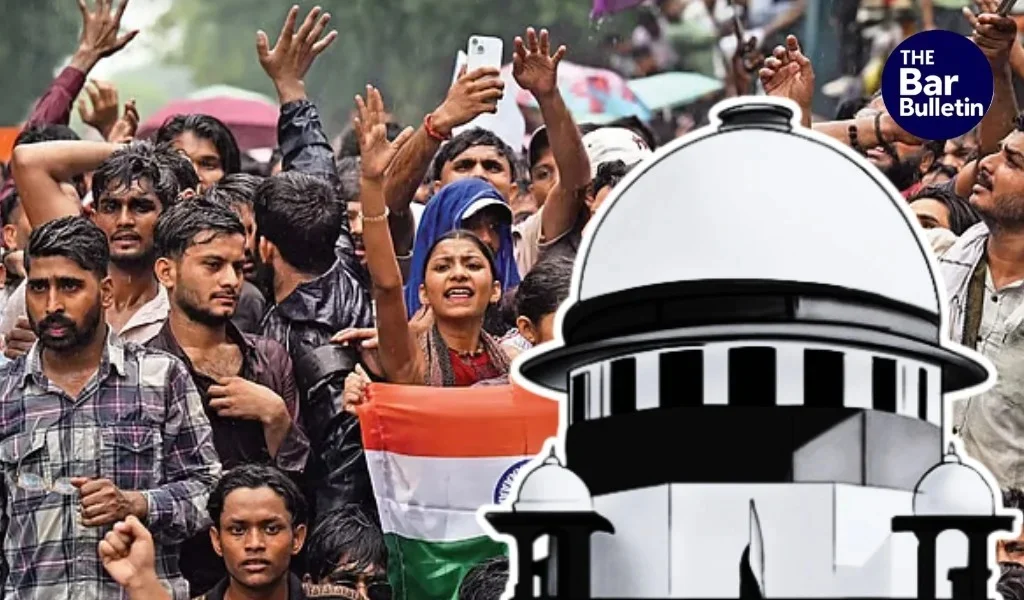
The Supreme Court on Sunday heard urgent petitions alleging police action against protesters and lawyers, restrictions on public transport and movement in Delhi, and non-compliance with its earlier directions concerning the proposed protest at Jantar Mantar.
A Bench of Justice Joymalya Bagchi and Justice V. Mohana heard submissions from Senior Advocates Kapil Sibal, Gopal Sankaranarayanan, Menaka Guruswamy, Sanjay Hegde, Shadan Farasat and others. Solicitor General Tushar Mehta, assisted by Additional Solicitor General Raju, appeared for the respondents.
Senior Advocate Gopal Sankaranarayanan raised concerns over barricades, restricted Metro access and lawyers allegedly being prevented from reaching the Supreme Court. Senior Advocate Sanjay Hegde emphasised the importance of access to lawyers, submitting, “Access to justice is also access to lawyers,” and alleged that advocates had been detained and manhandled. Senior Advocate Menaka Guruswamy raised concerns over reported detentions and restrictions on movement, while Senior Advocate Shadan Farasat described the alleged police action as “remarkably suppressive”.
Counsel also questioned the reported imposition of Section 163 of the Bharatiya Nagarik Suraksha Sanhita (BNSS) in and around the Supreme Court premises, submitting that restrictions should not impede lawyers and citizens from physically accessing courts.
Solicitor General Tushar Mehta disputed the allegations concerning Metro operations, submitting that all 4,157 scheduled train trips had operated on October 10, although entry and exit had been restricted at 45 of the Metro’s 303 stations. He assured the Court that all Metro stations had been open since 10 PM the previous night, train services were operating normally and internet connectivity had been restored.
He further assured the Court that lawyers, journalists and other professionals would not be obstructed in discharging their professional duties. On the issue of Section 163 BNSS in and around the Supreme Court premises, he sought time to obtain instructions.
Supreme Court’s directions
Taking note of the submissions and assurances, the Court issued interim directions concerning public transport, internet connectivity, free movement and access to courts.
1. Metro, railway and internet services: The Court directed that Metro, railway and internet services shall function normally unless restrictions are required to be imposed in accordance with law, keeping in mind considerations of public order under Article 19(2) of the Constitution.
2. Free movement of people and traffic: The Court directed that the movement of people and traffic in Delhi shall be permitted, subject to traffic regulations.
3. Review of barricades: The requirement for imposing barricades shall be reviewed immediately, keeping in mind law-and-order considerations and prevailing traffic conditions.
4. Detention in accordance with law: The Court clarified that detention must be in accordance with the procedure established by law, particularly in relation to assemblies of people.
5. Access to courts and professional duties: The Court took note of the Solicitor General’s assurance that lawyers, journalists and other professionals would not be obstructed in discharging their professional duties. The proceedings also addressed the need to ensure physical access to the Supreme Court, the High Court and other courts of law so that access to justice was not impeded.
During the hearing, Justice Bagchi observed that the Court did not wish to add to the “cauldron of suspicion and concern” while discussing restrictions around sensitive government installations. He also urged those present to maintain peace and not instigate others.
The Court directed that the petitions and applications referred to during the hearing be tagged with the main matters listed for Tuesday. Oral matters mentioned before the Bench were directed to be placed before the Registry during the course of the day.