
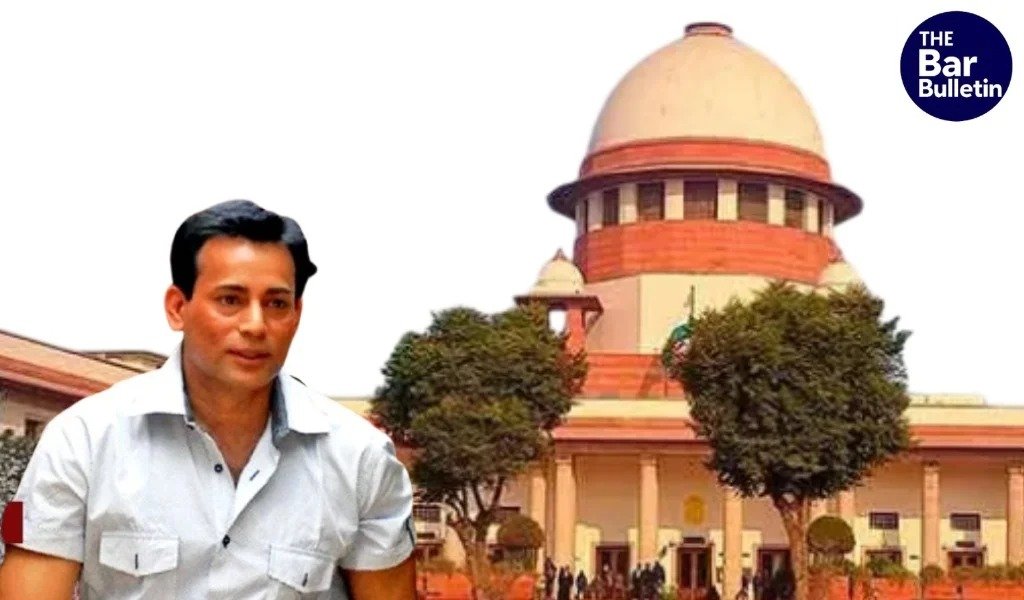

The Supreme Court on Thursday dismissed gangster and 1993 Mumbai serial blasts convict Abu Salem’s plea seeking premature release, rejecting his claim that the remission earned during imprisonment should be counted towards the 25-year period fixed in connection with India’s extradition assurance to Portugal. The plea arose from Salem’s challenge to the Bombay High Court’s refusal to order his release. The judgement was pronounced by Justice Vikram Nath and Justice Sandeep Mehta.
Salem had argued that his undertrial custody, post-conviction incarceration and nearly three years of earned remission together meant that he had completed the 25-year period and was therefore entitled to release. His counsel had specifically argued before the Supreme Court that jail-earned remission for good conduct was different from remission under Section 432 CrPC and should be included while calculating the period of imprisonment.
The Bombay High Court had rejected this contention in April 2026, holding that the 25-year period flowing from the sovereign assurance to Portugal could not be reduced by ordinary prison remissions. It noted that Salem was first arrested in India on November 11, 2005 and that the 25-year period would therefore expire in November 2030. The High Court held that any question of remission or reduction below that period could arise only in accordance with the statutory process contemplated by the Supreme Court’s earlier judgment.
The issue stems from the December 17, 2002 sovereign assurance given by India to Portugal when Salem’s extradition was sought. India had assured that he would not be sentenced to death or imprisoned for more than 25 years. In its July 2022 judgment concerning Salem, the Supreme Court had relied on this assurance and directed the government to undertake the remission exercise around the completion of the 25-year period.
Salem was extradited to India from Portugal in 2005 and was subsequently convicted in two cases. He was sentenced to life imprisonment in 2015 for the murder of businessman Pradeep Jain and again in 2017 in the 1993 Bombay blasts case; the sentences were ordered to run concurrently. The 1993 blasts, carried out on March 12, 1993, killed 257 people and injured more than 700.