

The Supreme Court on Tuesday heard a plea concerning the 2019 selection process for appointment of members of the Income Tax Appellate Tribunal (ITAT), with the petitioners alleging that candidates recommended by the Search-cum-Selection Committee were arbitrarily overlooked in favour of candidates from the wait list.
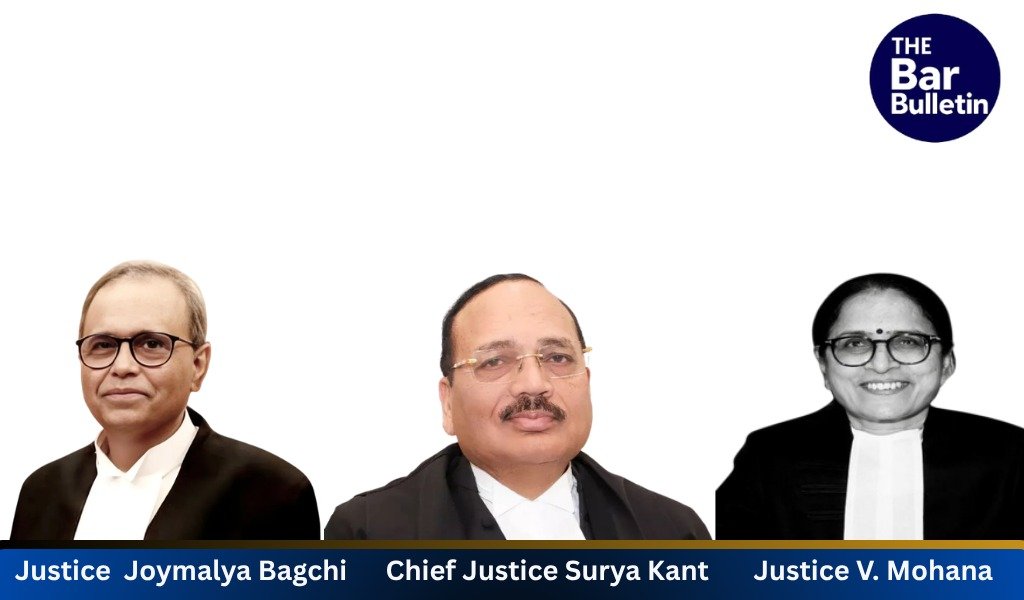
The matter was heard by the bench of Chief Justice Surya Kant, Justice Joymalya Bagchi and Justice V Mohana.
The matter arises from the selection process initiated pursuant to an advertisement issued in 2018 for 37 ITAT posts. A Search-cum-Selection Committee headed by Justice A.M. Khanwilkar subsequently evaluated the eligible candidates and recommended 41 candidates—28 in the main list and 13 in the wait list.
According to the submissions made before the Court, when the recommendations were placed before the Appointments Committee of the Cabinet (ACC), 22 candidates were recommended. The petitioners’ grievance was that the ACC ignored six candidates from the main list and instead selected candidates from the wait list, despite the main-list candidates having higher merit. The issue had earlier been brought to the Court’s attention, including through the assistance of amicus curiae.
The petitioners submitted that the 2018 selection was governed by the pre-amendment statutory regime and relied on previous orders of the Supreme Court directing that the selection be finalised in accordance with the procedure existing before the amendment. It was argued that the earlier selection process therefore continued to have relevance for candidates who had not yet been appointed.
The petitioners also pointed to three vacancies which, according to the Government’s affidavit, were presently available. They submitted that if their candidates were found entitled to appointment, room could be made for them.
AG Opposes Continuation of Old Appointment Regime
The Attorney General submitted that a new law governing tribunal appointments had since come into force, and therefore the earlier statutory dispensation could not simply be continued for making fresh appointments. He submitted
“
“The new Act has come. It takes care of every appointment. You can’t go back to a dispensation prior to the new Act and make some appointment there, make new appointment, a new law. We cannot do that. Even if they get into that process, but the new law will say certain terms of appointment. You are not even a selected candidate. It will create endless problems.”
However, the petitioners maintained that the earlier orders had protected the 2018 selection and that their grievance concerned the fairness of the selection process, rather than an attempt to create an entirely new selection under the old regime.
AG submitted that the earlier judgment had protected the position of persons who had already been appointed, but questioned whether it had directed that a selection which remained pending would automatically be carried forward.
“
“It did not say a pending selection will be carried forward. You have pending selection, nothing happened under the pending selection process. It is not about the vacancies being carried forward, it is about the appointment to that selection whether they are fairly made, that was the point.”
Court Questions Procedure For Challenging Appointments
The Bench also raised a procedural concern over the petitioners’ attempt to challenge the alleged supersession of candidates through the present miscellaneous application. It questioned whether the claim could be adjudicated in an MA and whether such adjudication could take place without hearing candidates who had already been appointed.
“
“For testing or going into the issue of the merits of your claim… A, whether this claim can be adjudicated by way of an M.A. … Secondly, can it be done in the absence of a person who has already been appointed?”
Counsel for the petitioners agreed to implead the persons who had already been appointed. The petitioners also maintained that the Government’s affidavits supported their allegation that six candidates had been superseded without any adverse material being disclosed against them.
The matter would be listed for further hearings.