
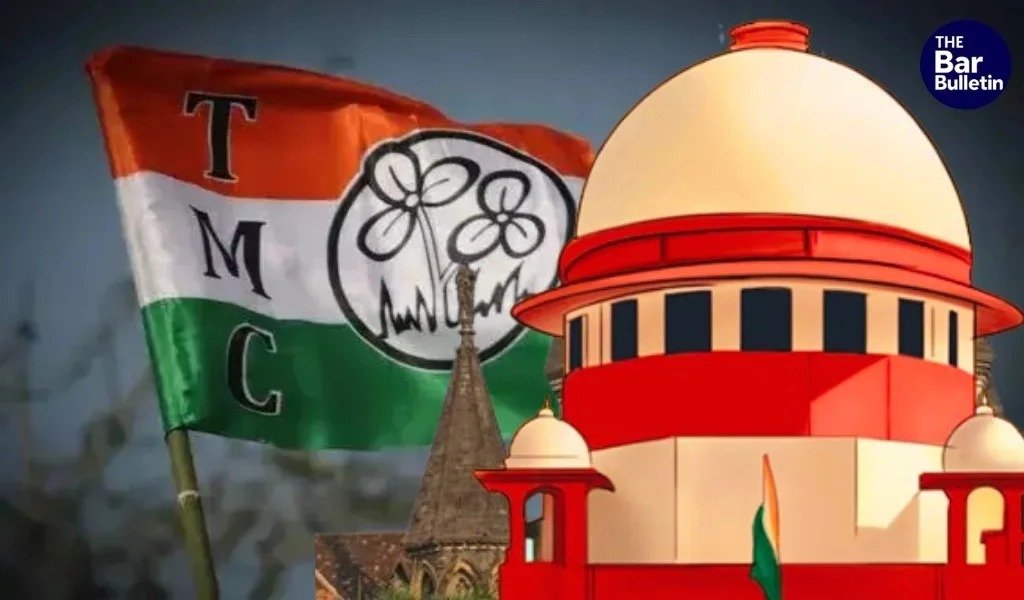

The Supreme Court on Thursday declined to interfere with the Calcutta High Court’s refusal to grant interim relief to the All India Trinamool Congress (AITC) in its plea challenging the freezing of four bank accounts maintained with Indian Bank by the West Bengal Police. The Bench of Justice M.M. Sundresh and Justice P.B. Varale requested the High Court to expedite the hearing of the pending matter.
The case concerns four Indian Bank accounts of the party that were debit-frozen following a criminal investigation initiated by the West Bengal Police on the basis of a complaint filed by West Bengal MLA Biswanath Das. The party had approached the Supreme Court after the Calcutta High Court, on August 27, declined to grant further interim relief permitting operation of the accounts.
Senior Advocate Abhishek Manu Singhvi, appearing for the AITC faction led by Mamata Banerjee, argued that freezing the accounts had severely affected the party’s functioning. He submitted that the party’s audited accounts reflected minimum monthly expenditure of ₹12.15 crore for day-to-day operations, excluding political expenses.
“
“If the police force of a state where the ruling party is opposed to me… send the police and they freeze all accounts, that’s the best way of stopping political activities.”
Singhvi also argued that the High Court had conflated the present four Indian Bank accounts with an earlier set of three HDFC Bank accounts, which were the subject of separate proceedings. He submitted that the HDFC accounts were already being operated under the supervision of a court-appointed Special Officer, while the present case concerned the Indian Bank accounts.
Singhvi further submitted that the party required ₹12.15 crore every month merely to sustain its basic functioning and that the figure did not include expenses relating to by-elections, legal fees or other political activities.
Solicitor General Tushar Mehta, opposing the plea, submitted that the present matter arose from a different FIR and involved a factional dispute concerning which group represented the Trinamool Congress. He referred to allegations that a person associated with the party faction had deposited ₹35 crore in cash into the accounts and submitted that the investigation concerned allegations relating to conversion of government land into private land and its subsequent sale.
Singhvi disputed the relevance of these allegations to the present proceedings, submitting that the issues being referred to were not connected with the FIR under consideration and were being raised only to prejudice the Court.
The Bench noted that the earlier Supreme Court proceedings concerned a different set of accounts. It also took note of the ongoing dispute regarding the party and the Election Commission of India’s interim order concerning the party’s name and symbol. The larger question concerning entitlement to the funds in the accounts therefore remains pending adjudication.
The Supreme Court ultimately declined to exercise its jurisdiction under Article 136 of the Constitution, without entering into the merits of the dispute.
“
“We refrain from going into the merits. We are not inclined to exercise our jurisdiction under Article 136. We request High Court to expedite hearing.”