
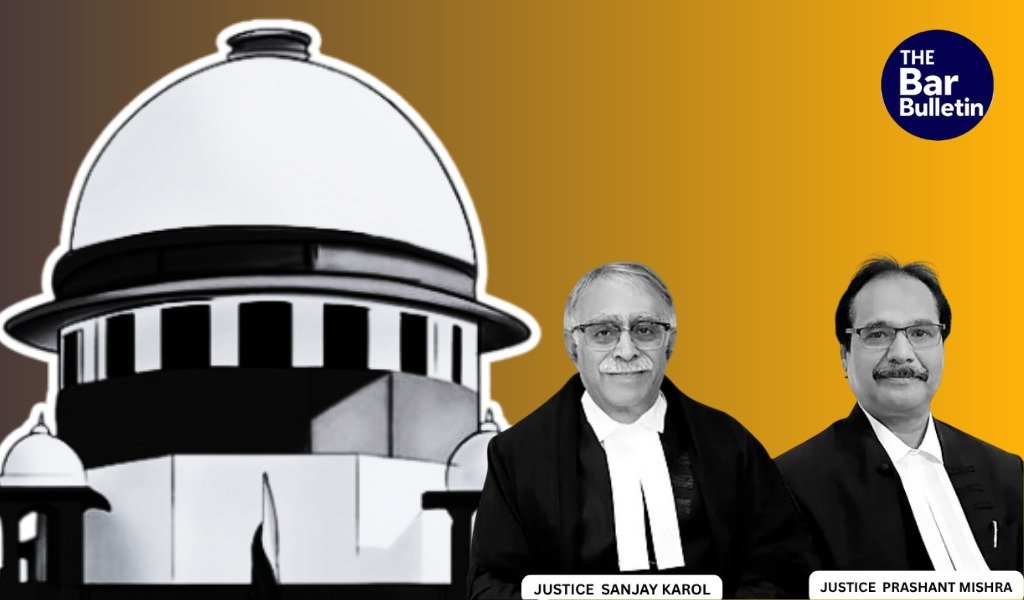

In a sweeping public interest ruling, the Supreme Court has directed IRDA, MoRTH, and all insurance companies to implement technology-driven enforcement against uninsured vehicles, introduces a uniform four-layer insurance policy framework with mandatory customer option forms, enhances third-party insurance tenure to four years for cars and six years for two-wheelers, and orders pilot projects linking fuel dispensing and toll payments. with valid insurance status
The Supreme Court has held that in matters concerning motor accident claims, Courts should not adopt a hyper-technical approach. Relying on the IRDA circular dated 16 November 2009, the Court confirmed that insurance companies are liable to compensate for any occupant in the vehicle under a comprehensive or package policy. The Court found no reason to disagree with the High Court’s reasoning that the comprehensive policy in question covered the owner of the vehicle who was travelling in the car as a passenger, and accordingly dismissed the insurance company’s appeal, upholding the compensation award of Rs. 10 lakhs with 7.5% interest per annum.
The Court further held that the integration of enforcement systems with technology is the need of the hour, that there exists a stark gap between the statutory mandate under Section 146 of the Motor Vehicles Act and ground-level enforcement, and that the constitutional right to life under Article 21 encompasses the right to safe travel, warranting comprehensive systemic directions in public interest.
A Two-Judge Bench comprising Justice Sanjay Karol and Justice Prashant Kumar Mishra has issued specific directions concerning (i) four-layer insurance policy structure mandated for private vehicles; (ii) technology-driven enforcement through ANPR cameras and hand-held devices; (iii) third-party insurance tenure enhanced by one year; and pilot projects linking fuel and tolling with insurance status.
Key directions:
1. The Court directed implementation of a structured four-layer framework comprising a mandatory Third Party Only policy as the base cover, an optional legal liability cover for occupants and pillion riders, an optional personal accident cover for owner-driver and occupants, and an optional own damage cover. Every customer must be issued a customer option form at the time of purchase, allowing them to opt in via check box to each add-on. The IRDA is to formulate uniform policy wordings for the optional covers in consultation with the General Insurance Council and insurance companies, while insurers retain freedom to innovate coverage and pricing on own damage covers in line with market forces.
2. The Court directed that ANPR cameras already deployed on highways and roads be integrated with the Insurance Information Bureau database and the VAHAN portal for automatic issuance of e-challans to uninsured vehicles. Additionally, State Police are to be equipped with hand-held devices or downloadable apps linked to the same databases for real-time verification of insurance status and on-the-spot challans. The Court noted that currently there is no uniform mechanism with State Police to verify insurance status on the ground.
3. Despite the IRDA and General Insurance Council recommending against any enhancement, the Court directed that henceforth third-party insurance for four years for new cars and six years for new two-wheelers be mandatorily purchased at the time of registration, enhancing the earlier requirement of three years and five years respectively. The Court observed that despite eight years having passed since the earlier direction, a large number of vehicles remain uninsured.
4. The Court directed the IRDA and MoRTH to evolve pilot projects whereby fuel for vehicles would be linked with valid insurance status, meaning uninsured vehicles would be refused fuel at petrol pumps until valid insurance is obtained. The Ministry of Petroleum and Natural Gas has in principle no objection. Separately, the MoRTH is to implement barrier-less tolling pilot projects on certain corridors using ANPR cameras and FASTag for automatic detection, given the impact of long toll queues on road accidents.
5. The Court directed State Police to promptly file Detailed Accident Reports along with all relevant documents before the concerned MACT in pending cases relating to accidents prior to 31 March 2022, and to assist with prompt service and production of witnesses. These directions are to be forwarded through the registry to the Secretary of High Court Legal Services Authorities of all High Courts for onward transmission to State Police.
Briefly, the present appeal arises from a motor accident claim dating back to July 1996, when the deceased, Mr. T. Ramu, while travelling from Tirupathi to his village Venkanur in his Maruti 800 vehicle, met with an accident and an unknown lorry driven in a rash and negligent manner struck the deceased’s car from behind, resulting in fatal injuries during treatment. The claimant-respondents, being the legal representatives of the deceased, filed a compensation application before the Motor Accident Claims Tribunal (MACT), under Section 166 of the Motor Vehicles Act, 1988 (later amended to Section 163-A), claiming Rs. 10 lakhs on the ground that the deceased was a seafood businessman earning at least Rs. 1 lakh per annum and was the sole breadwinner of the family. The appellant, National Insurance Company Ltd., was the insurer of the Maruti 800 car in which the deceased was travelling.
The Tribunal dismissed the claim, holding that the claimant-respondents were not entitled to any compensation. The Tribunal relied on the testimony of the Assistant Manager of the appellant insurance company and observed that no extra premium was paid to cover the personal risk of the owner of the vehicle. Aggrieved by the Tribunal’s order, the claimant-respondents preferred an appeal before the High Court of Telangana, which awarded compensation of Rs. 10 lakhs along with 7.5% interest per annum. The High Court observed that the policy in question was a comprehensive policy that would cover the owner of the vehicle as well, who was travelling in the car as a passenger. In the absence of any evidence regarding the monthly income of the deceased, the Court assessed his monthly income at Rs. 4,500/- on a notional basis.
