
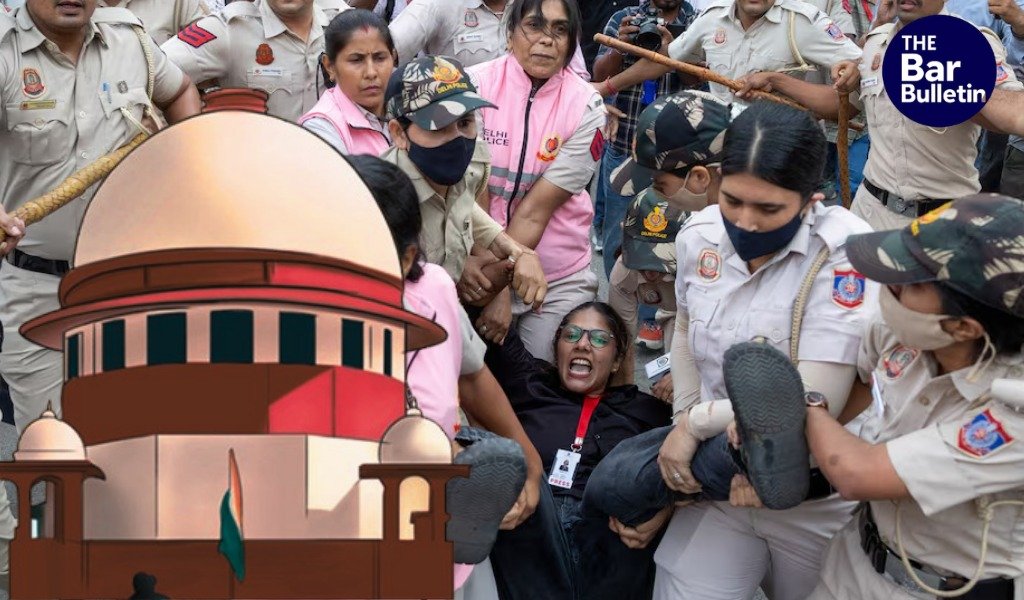

The Supreme Court on Thursday issued notice on a contempt petition filed by the Free Speech Collective alleging wilful disobedience of its October 11 order directing that journalists, lawyers and other professionals should not be obstructed while performing their professional duties during protests in Delhi.
A Bench of Chief Justice of India Surya Kant and Justice Joymalya Bagchi issued notice in the matter, which alleges that the Delhi Police detained and forcibly removed journalists covering protests demanding the resignation of Chief Election Commissioner Gyanesh Kumar, despite the Court’s specific directions protecting their right to work without obstruction.
The petitioner has invoked Article 129 of the Constitution, read with Section 12 of the Contempt of Courts Act, 1971, alleging non-compliance with paragraph 16(f) of the Supreme Court’s October 11 order, which stated:
“
“Lawyers, journalists and other professionals shall not be hindered in discharge of their professional duties in any manner whatsoever.”
The petition alleges that journalists covering the protests were detained, forcibly removed and prevented from reporting at locations including R.K. Ashram Marg and Connaught Place. It relies on media reports, social media posts and video recordings to substantiate the allegations.
The petitioner has sought identification of the police personnel allegedly responsible for the detentions and obstruction, disclosure of how the Supreme Court’s directions were communicated to officers deployed at protest sites, and preservation of relevant records and evidence.
It has also sought appropriate proceedings against those allegedly responsible for wilful disobedience of the Court’s order.
In another petition filed by Delhi Union of Journalism, it was submitted that electronic devices belonging to journalists had allegedly been seized by the police during protests, prompting a request for their immediate release.
Senior Advocate CU Singh, appearing for the petitioners, submitted that the devices were essential to journalists’ professional work and livelihood, as they contained their reporting material and other work-related content. He urged the Court to direct the release of the devices, contending that the police had no authority to seize journalists’ electronic equipment in the circumstances alleged.
Solicitor General Tushar Mehta, however, disputed the allegations, submitting that, according to his instructions, no devices had been seized.
The Bench noted the competing submissions and observed that if any devices had in fact been seized, they would have to be returned. The Court subsequently issued notice on the petition and called upon the Union Government to substantiate its position in its counter-affidavit.
With regard to the petition, the Bench clarified that it had taken note of the Solicitor General’s submission that no devices had been seized and had asked the authorities to establish the same in their response.