
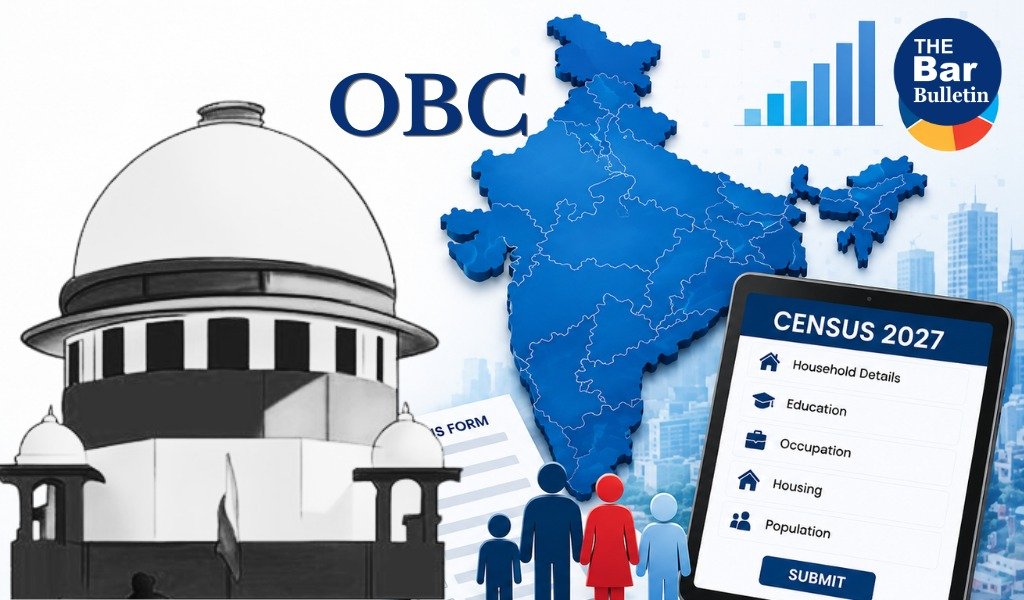

The Supreme Court on Wednesday disposed of a petition filed by the OBC Federation of India seeking a direction to the Union Government and census authorities to introduce a drop-down menu of recognised Other Backward Classes (OBC) castes in the digital tools for the upcoming Census 2027, observing that the issue essentially concerns a policy decision that can be addressed by the policymakers.
A bench of Chief Justice Surya Kant, Justice Joymalya Bagchi and Justice V Mohana disposed of the writ petition without expressing any opinion on the merits, while granting liberty to the petitioner association to approach the Director General and Census Commissioner of India, or forward a copy of the petition to the authority as a representation, so that the concerns raised could be considered.
The petition challenged the format of the population enumeration schedule notified on August 14, 2026. The petitioner contended that Column 10, which concerns caste, provides for a separate entry for converted Scheduled Castes but leaves an open-text field for persons belonging to communities other than Scheduled Castes and Scheduled Tribes to describe their caste in their own words.
During the hearing, the petitioner argued that the open-text format could lead to inconsistencies in caste data and repeat the shortcomings associated with the Socio-Economic and Caste Census of 2011. It urged the Court to direct the authorities to provide a drop-down menu containing the regularised list of OBC castes, enabling respondents to select their caste from the available options.
The petitioner also relied on Article 342A of the Constitution, which deals with the identification of socially and educationally backward classes, and argued that the constitutional recognition of such classes required their proper identification during the census exercise.
The bench, however, observed that the level of detail at which a census is conducted falls within the policy domain of the census authorities. It indicated that the issue could be raised before the competent authority for consideration. The Court observed:
“
“The issue highlighted in our country essentially pertains to a policy decision which can be effectively addressed by the policymakers. We therefore, without expressing any opinion on the merits, dispose of this petition with liberty to the petitioner association to approach the Director General and Census Commissioner of India, or to whom a copy of this petition may be forwarded as a representation, so as to enable that authority to look into the issue highlighted on behalf of the petitioner.”
The petitioner’s counsel pressed the urgency of the matter, stating that the second stage of the census exercise was approaching and a simple change to the digital form could address the concern. Counsel argued that the absence of a drop-down menu would require individuals to enter their caste details manually, potentially resulting in inconsistencies in the collected data. The counsel submitted:
“
“Article 342A of the Constitution identifies three lists of communities. If there is a drop-down menu given, then it will be all fair. At a granular level, how the census will be done is a policy decision of the census authority, but there is a constitutional obligation, specifically once the SCBC has been identified as a separate species defined by the Constitution in Article 342A. Also, my Lord, ₹11,000 crores versus a drop-down menu. ₹11,000 crores has been spent on this. If a drop-down menu is introduced, that will resolve all.”
The petitioner thus sought to distinguish its plea from a challenge to the overall census policy, arguing that the requested change was a practical measure to ensure more consistent caste enumeration.
The Court did not issue a direction requiring the introduction of a drop-down menu or rule on the constitutional merits of the plea. Instead, it left the petitioner at liberty to place its concerns before the census authorities for consideration. The petition was accordingly disposed of without an adjudication on the merits.