
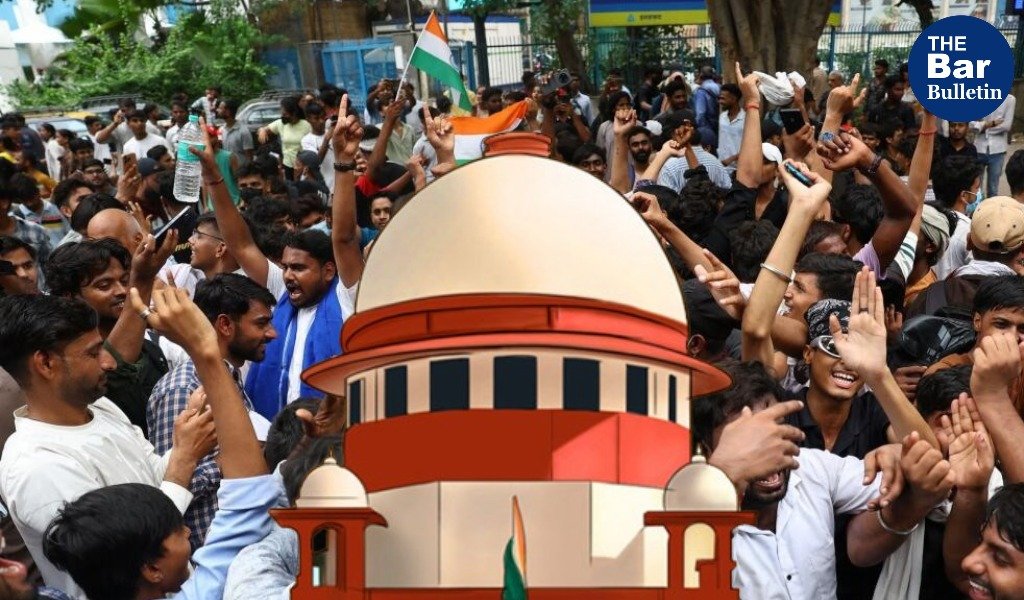

The Supreme Court on Thursday directed the High-Powered Enquiry Committee (HPEC), constituted to examine allegations of police excesses during the July 2026 student protests at Jantar Mantar, to submit its first fact-finding report within one month. CJI observed:
“the committee need not wait indefinitely. Whatever material has come, based upon that, whosoever is required to give their response, they should call for that response, and submit…First report can be on one issue, second interim report can be on the second issue. There may be one interim report on two issues. But we would like to know, now the committee should start giving the fact-finding reports. And those fact-finding reports, unless we find that there is something really extraordinary requiring to maintain confidentiality, the rest of the relevant contents we would like to share with you all.”
A Bench of Chief Justice of India Surya Kant and Justice Joymalya Bagchi also clarified that the committee must examine material submitted by petitioners on behalf of victims, including petitions, affidavits and video recordings. The matter has been listed for further hearing on December 2, 2026.
The Court took note of the HPEC’s action-taken report dated October 31, 2026, which stated that despite launching a complaint portal and providing dedicated email and other submission channels, only a few complaints had been received through the portal, with none received by email, post or physical delivery.
Reading out the report, CJI Surya Kant said that the committee had held a sitting at its office and issued notices to protesters who had filed complaints. However, only one complainant appeared on October 29 and submitted an affidavit. Some police personnel had also appeared before the committee. The CJI said:
“
“The committee will now commence examination of the complaints and proceed towards fact-finding.”
The Bench further directed the committee to proceed on the basis of material already received, call for responses from persons concerned and submit its first report within one month. It observed that the committee need not wait indefinitely for more complaints.
“
“We would like the committee to start submitting its fact-finding reports. Unless there is something extraordinary requiring confidentiality, we would ordinarily like the relevant contents of those reports to be shared,” the Court said.
Disclosure of HPEC Report
Solicitor General Tushar Mehta opposed making the HPEC’s action-taken report available to the parties at this stage, submitting that it was a confidential report prepared by a committee constituted by the Supreme Court itself and that its sanctity should be maintained. He cautioned that if the report were circulated, its contents could become a subject of debate on television channels. He also pointed out that the report had been submitted in a sealed cover and was presently before the Court and the committee.
Senior Advocate N. Hariharan, however, submitted that the petitioners could not effectively assist the Court without knowing what the report contained. He argued that unless they were made aware of the material and the committee’s observations, they would not be in a position to respond or point out any factual discrepancies. He further submitted that the petitioners had already placed detailed allegations and supporting material before the Court.
The CJI observed that the report was not one submitted by an adverse party or a government agency, but by an independent committee constituted by the Court. The Bench said it would first examine the report and identify the specific issues on which responses from the parties would be required.
The CJI indicated that the Court would share the gist of the report with the parties so that they could either controvert its contents or take appropriate remedial steps. He also clarified that the Court would consider a way to provide the parties with relevant information without compromising the confidentiality of the committee’s proceedings.
Petitioners permitted to forward petitions, affidavits and videos to HPEC
Senior Advocate N. Hariharan, appearing for petitioners, questioned the progress made by the committee since its constitution in August. He submitted that the principal issue concerned alleged police brutalities during the protests and no departmental inquiry or criminal case had been initiated in relation to the incidents. He said:
“
“Our petition concerns the brutalities allegedly committed during the protests. That is the principal issue requiring consideration. We do not know whether any departmental inquiry has been initiated or whether any case has been registered concerning what happened.”
Mr Hariharan also sought access to the committee’s report, submitting that the petitioners would be unable to assist the Court without knowing its contents.
Advocate Vrinda Grover submitted that the petitioners had already made representations before the complaint portal was launched and had subsequently submitted material through the prescribed portal as well. She also pointed out that no FIR had been registered in relation to the alleged incidents of police violence.
Senior Advocate Gopal Sankaranarayanan submitted that the petitions already before the Supreme Court contained detailed allegations and supporting material, which could be forwarded directly to the committee instead of requiring every affected person to approach it individually. He also expressed concern that the committee appeared to be considering only complaints submitted directly by victims, while material placed before the Supreme Court by petitioners was not being examined.
Sankaranarayanan also referred to the Supreme Court’s earlier order clarifying that constitution of the HPEC would not prevent police authorities from taking administrative or disciplinary action against personnel found to have violated service rules. He sought a status report on action taken against the officers allegedly involved in the incidents.
Justice Bagchi clarified that the committee’s constitution did not prevent police authorities or their superiors from taking independent action if they found any transgression by personnel deployed at the protest site. Solicitor General Mehta cautioned against demoralising police personnel for using reasonable force to control an unlawful assembly, submitting that demands for suspension or transfer should not be made prematurely. He said the authorities would act if the committee reached a conclusion warranting such action.
The Solicitor General also submitted that PIL petitioners might not have personal knowledge of the incidents and the committee should distinguish between direct victim accounts and third-party material.
The Bench, however, clarified that material submitted by petitioners on behalf of victims must also be considered by the HPEC. It permitted counsel to forward soft copies of their petitions and supporting material, including video clips, to the committee. The Court stated:
“
“We clarify that materials/information forwarded by the parties on behalf of victims will also be examined and considered by the Committee.”
The CJI also urged petitioners to encourage victims to approach the committee and submit their accounts. He said that where petitioners were acting on behalf of victims, they could request the committee to summon the concerned persons.
The Bench noted that the HPEC portal allows complaints to be submitted confidentially and anonymously, without disclosing the complainant’s name, phone number, address or Aadhaar details. Separate submission channels have also been provided for affected protesters and police personnel.
The CJI urged the parties to encourage complainants to come forward, observing that there appeared to be a gap between the material petitioners claimed to have submitted and what had actually reached the committee.