
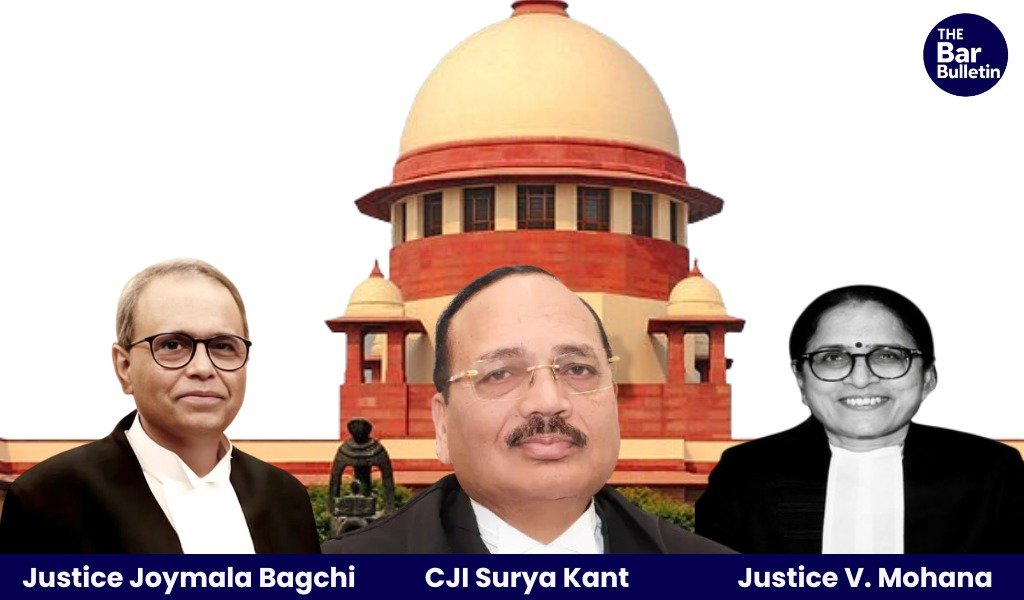

The Supreme Court on Friday has raised concerns over the failure of direct recruitment to the District Judiciary, observing that the problem may lie with the recruitment structure adopted by High Courts. The has asked the Gujarat High Court to introspect into the reasons behind zero selections against 113 District Judge vacancies and formulate proposals to address the gaps in the 25% direct recruitment quota.
The Court also sought data on previous recruitment exercises, including candidates’ performance in the written examinations and viva voce, to examine the reasons for the failure to attract and select candidates through direct recruitment.
A Bench of Chief Justice Surya Kant, Justice Joymalya Bagchi and Justice V. Mohana was hearing a petition filed by Mansi Jain and Vishal Baljit Singh challenging the Gujarat High Court’s District Judge recruitment process under the 25% direct recruitment quota. Advocate Prashant Bhushan appeared for the petitioners, while Senior Advocate Vijay Hansaria appeared for the respondent.
The Bench expressed concern that the Gujarat High Court had advertised 113 posts but had not made any appointments through direct recruitment. It noted that no direct recruitment had taken place in the High Court for nearly a decade and questioned the reasons behind the continuing vacancies. The Court observed that High Courts needed to examine whether the problem arose from a lack of suitable candidates or from the recruitment framework itself. The Bench emphasised the need to bring fresh talent into the judicial cadre and said that the absence of direct recruits was a matter requiring serious consideration. Justice Bagchi said:
“
“the judges and the High Court in general, High Courts in general need to introspect. What is the problem? Is it the problem with the candidate or it’s a problem with the structure that we have created in recruitment, which is standing in the way of infusing of fresh blood? We want the High Court to introspect as to what is the stumbling block where direct recruits are not being [appointed]. We are looking for fresh blood in the cadre. We are looking for fresh blood in the system.”
Mr Bhushan submitted that the recruitment process needed closer scrutiny, pointing to the assessment of candidates at the written examination and interview stages. He referred to 2025 selection in which only two candidates (petitioners) were called for the interview and both were awarded 20% marks. He also questioned the marks awarded during character verification, submitting that favourable reports from the candidates’ parent High Courts had not translated into better scores.
The Bench also questioned whether the existing recruitment structure and evaluation criteria were making it difficult for advocates to enter the judicial service. The Court further remarked that the 25% direct recruitment quota could become illusory if the selection process did not result in actual appointments.
“
“we need to look into this. We need to look into the structure also. Otherwise this 25% is an illusion.”
The Bench asked the Gujarat High Court to examine the reasons for the lack of direct recruitment and formulate proposals to address the problem. It also sought details of previous recruitment exercises. During the hearing, the Court agreed to tag a connected petition challenging an earlier Gujarat District Judge recruitment exercise with the present matter.