
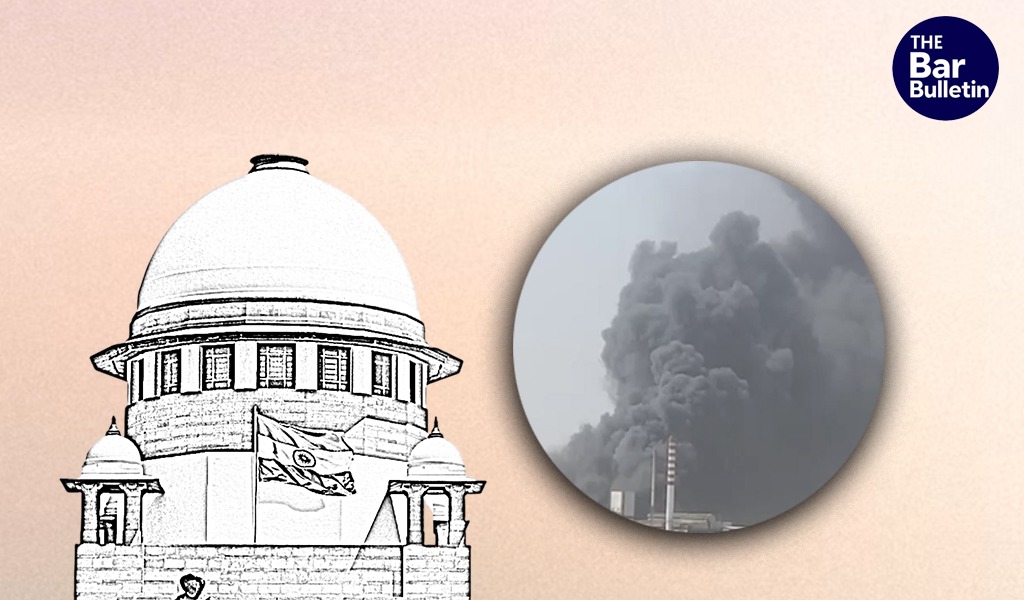

The Supreme Court on Tuesday declined to dilute the 5% turnover-based environmental compensation imposed on Bharat Rasayan Ltd. following the 2022 industrial accident at its Dahej pesticide plant in Gujarat that claimed eight lives and injured several others.
The case arose from an industrial accident on May 17, 2022, at the M/s Bharat Rasayan Limited (Unit-II) pesticide plant in Dahej, Gujarat, where a reactor defect allegedly triggered a blast and fire. The incident resulted in the death of 8 persons and injuries to 29 others, besides concerns regarding toxic emissions and chemical contamination. Applying the “polluter pays” principle, the National Green Tribunal (NGT), by order dated May 29, 2024, imposed environmental compensation of approximately ₹13.5 crore on the company. The NGT directed that the amount be utilised by the Gujarat Pollution Control Board (GPCB) for environmental restoration and improvement measures within a 10-kilometre radius of the plant.
The petitioner-company, Bharat Rasayan Ltd., did not dispute the occurrence of the industrial accident or the principle of liability, but challenged the NGT’s method of quantifying environmental compensation.
The company argued that the Gujarat Pollution Control Board had initially assessed environmental damage at ₹1.5 crore, which had already been deposited, but the NGT later enhanced the amount to ₹13.5 crore by applying 5% of the company’s gross turnover across all plants in India. It was further argued that the NGT merely noted that there had been a fire and use of water and therefore imposed compensation based on turnover, without any scientific assessment of actual damage caused.
“The Pollution Control Board had assessed temporarily ₹1.5 crore as an environmental damage on account of the fire in the plant… I deposited that amount NGT subsequently enhanced the compensation to around ₹13.5 crore by applying 5% of your gross turnover of your all plants in India, including Haryana” without determining what is the actual [environmental damage].
The Bench, however, made strong observations on industrial liability and environmental compliance.
“When there is an accident, there is an absolute liability. It’s not a question of apportionment of liability…That is annual turnover, five percent and that is exactly what has been calculated on that. Produce any authority which waters down this proposition.You are lucky that your clients are still outside. They should suffer a sentence of less than 10 years because of this.”
The Court further observed: “While we do not want to make any adverse observations against the Pollution Control Board for non-disclosure of the plan… we deem it appropriate to direct Member Secretary of the Board to place the same on record along with affidavit within four weeks.”
The matter remains pending before the Supreme Court.
During the hearing, the Bench stressed the principle of absolute liability in industrial accident cases, observing:
“When there is an accident, there is an absolute liability. It’s not a question of apportionment of liability.”
The Court also made strong oral remarks regarding the seriousness of the incident:
“You are lucky that your clients are still outside. They should suffer a sentence of less than 10 years because of this.”
At another stage, the Court remarked:
“You have managed to resolve him. If you can work it out that way, that’s much better.”
The Gujarat Pollution Control Board informed the Court that it had prepared a comprehensive and robust action plan for scientific utilisation of the ₹13.5 crore amount towards environmental restoration and improvement.
Recording the submission, the Supreme Court directed the Board to place the utilisation plan and approvals on record within four weeks.