
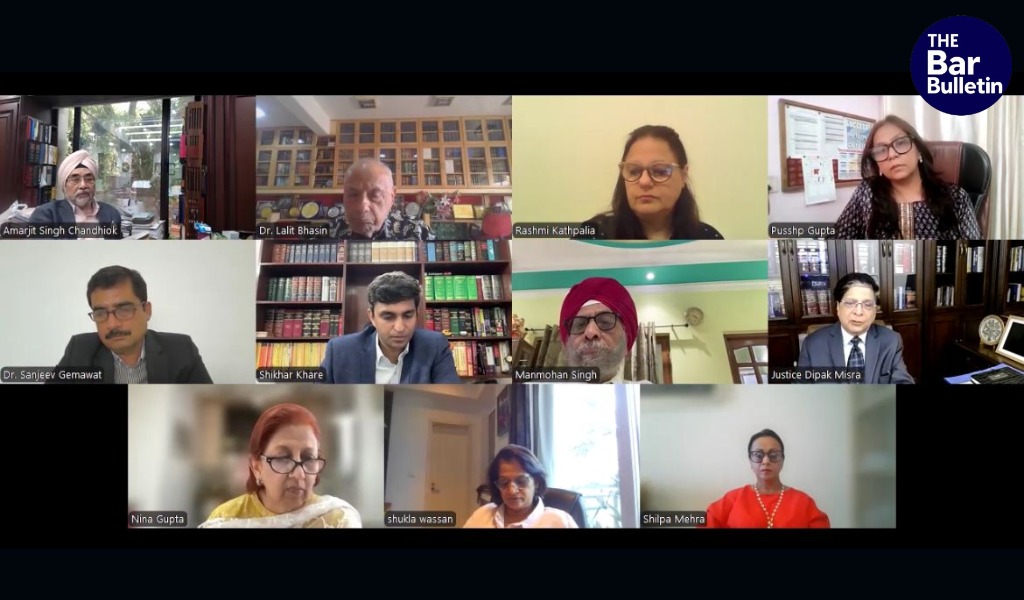
At a webinar organised by the Confederation of Indian Industry (CII) and Society of Indian Law Firms (SILF), former Chief Justice of India Dipak Misra, giving the inaugural speech described mediation as “the best mode” of dispute resolution because settlements are reached through discussion, negotiation and consent, leaving minimal scope for future challenge. He extensively spoke about the philosophical, psychological and behavioural dimensions of mediation, stressing that mediators must understand not only law but also human behaviour, ego, emotional resistance and social dynamics underlying disputes. Justice Misra stated:
“This is the best mode by which you can solve a dispute, because there is no challenge to it, as it is arrived at through discussion, negotiation and not challengeable and on consent.”
Justice Misra also shared several examples from his judicial experience where mediation successfully resolved commercial loan disputes, family property conflicts and high-value corporate disputes. He emphasised that mediation restores communication and relationships while preventing disputes from escalating into destructive litigation. Explaining the qualities required in a mediator, he later observed:
“A mediator must have an uncommon common sense.”
Dr. Lalit Bhasin, speaking at the webinar, emphasised that India urgently needs alternatives to prolonged litigation and ineffective dispute resolution mechanisms. Referring to the nearly six crore pending cases across courts, he stressed that mediation requires not merely legal reform but a fundamental change in societal and professional mindset. He urged lawyers and business communities to promote consensual settlement culture. Mr Bhasin remarked:
“A bad settlement is better than successful litigation.”
Senior advocate A.S. Chandhiok, said disputes are inevitable in society, but mediation offers parties the opportunity to resolve them quickly, economically and with greater satisfaction because the resolution comes from the parties themselves rather than an imposed judicial determination. He stressed that even arbitration was increasingly becoming expensive and time-consuming, making mediation more relevant for modern dispute resolution. Mr. Chandhiok observed:
“The keys to do a business is also to see how fast we can resolve the dispute.”
The Panelists for this discussion were Moderated by Ms. Rashmi Kathpalia, Advocate and Mediator:
The issues Kathpalia raised for the Panelists to address were centered on, how mediation serves as a superior alternative to traditional litigation by overcoming court backlogs to restore the fundamental right to a speedy resolution. How financially, litigation imposes heavy burdens, acting as a contingent liability on corporate balance sheets and draining individual life savings, whereas mediation could offer financial certainty that a judge’s hammer cannot guarantee. How Singapore Convention and India’s Mediation Act 2023 were ensuring cross-border enforceability, and whether mediated settlements could be enforced as court decree. She questioned how mediation balanced the power dynamic for small businesses against multinational corporations, and how the professionalisation of credible mediators could resolve fears of bias. How mediation can protect a smaller innovator’s trade secrets against large corporations. She also evoked responses from the Panel as to how unlike the win-lose nature of litigation, could mediation act as a vital tool to preserve critical relationships in long-term joint ventures or family businesses, and could it be made more accessible and efficient through Online Dispute Resolution.
Former Delhi High Court judge Justice Manmohan Singh focused extensively on mediation in intellectual property and patent disputes. He noted that patent and licensing litigation often becomes commercially meaningless because disputes continue for years while the effective commercial life of patents diminishes. Justice Singh recalled that during his tenure before the Intellectual Property Appellate Board, nearly 300 out of 800 pending patent appeals were resolved through mediation efforts. He observed:
“Mediation is necessary in the present scenario.”
Justice Singh further highlighted that mediation provides a flexible middle ground in patent disputes involving licensing periods, royalty arrangements and compulsory licensing issues. According to him, mediation allows parties to preserve business interests while avoiding prolonged technical litigation.
Cross-border mediator Shilpa Mehra from UAE, highlighted the growing significance of online dispute resolution (ODR) and international mediation frameworks. She said ODR removes geographical, financial and logistical barriers while making mediation accessible even to small businesses and individuals. Referring to the future of digital mediation systems, Mehra stated:
“Mediation is becoming financially and legally portable across borders.”
She also stressed that although India has signed the Singapore Convention, complete cross-border enforceability would become more effective after formal ratification and stronger domestic implementation mechanisms.
Senior mediator Ms. Pushp Gupta highlighted the central role of trust and communication in mediation. She said litigation often deepens hostility because lawyers and courts focus primarily on legal rights and liabilities, whereas mediation allows parties themselves to communicate their emotional, relational and commercial concerns. Stressing the importance of mediator competence and specialised institutional mediation, Gupta remarked:
“It’s better to live life in peace than in pieces. So choose mediation.”
Ms. Gupta also cautioned that mediators handling specialised commercial disputes must possess subject-specific legal understanding and ethical credibility, warning that a lack of competence could undermine trust in institutional mediation systems.
Dr. Sanjeev Gemawat, MD, Group GC at the Essar Group, gave the corporate perspective on mediation from the perspective of businesses and infrastructure projects. He said traditional litigation and arbitration had “miserably failed” in delivering timely and commercially efficient outcomes. According to him, mediation offers speed, predictability and financial certainty while reducing contingent liabilities and project delays. He observed:
“Settlement is your strength because it gives you predictability.”
Mr Gemawat further noted that disputes in the infrastructure and construction sector significantly affect economic growth and project execution timelines, making mediation increasingly important for India’s commercial ecosystem.
Advocate Shikhar Khare described mediation as a forward-looking process, unlike litigation, which he termed inherently backwards-looking because it focuses on assigning blame. According to him, mediation offers flexibility, confidentiality and practical solutions that traditional litigation often cannot provide. Khare observed:
“Litigation is backward looking. Mediation, on the other hand, is forward looking.”
Mr Khare also pointed to the emotional and psychological toll of prolonged litigation, referring to concepts similar to litigation-induced trauma and stress. He stressed that mediation can help preserve relationships and avoid unnecessary escalation of disputes.