
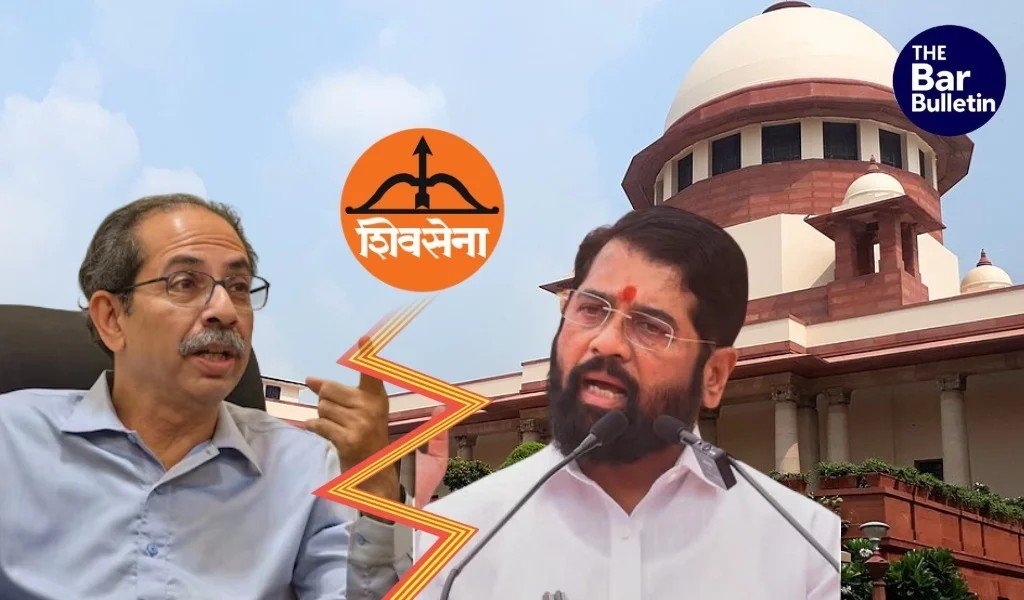
Senior Advocate Neeraj Kishan Kaul, appearing for the Eknath Shinde-led faction of the Shiv Sena, on Tuesday defended the Election Commission of India’s decision recognising the Shinde faction as the real Shiv Sena, arguing before the Supreme Court that the dispute could not be reduced to a question of numbers in the legislative party.
Mr Kaul was addressing a Bench comprising Chief Justice Surya Kant, Justice Joymalya Bagchi and Justice V. Mohana in the ongoing proceedings challenging the ECI’s decision under Paragraph 15 of the Election Symbols (Reservation and Allotment) Order, 1968. The ECI had recognised the Shinde faction as the faction representing the real Shiv Sena and allotted it the party name and the ‘bow and arrow’ symbol after examining the rival claims. The dispute before the Supreme Court concerns, among other issues, the manner in which the ECI assessed legislative and organisational support and examined the party’s constitution.
He submitted that the ECI was entitled to examine the competing claims to the political party as a whole. He disputed the argument that the Commission could assume jurisdiction only if a split had first occurred within the organisational wing of Shiv Sena.
Referring to Paragraph 15, Mr Kaul submitted that once rival groups emerge, each claiming to represent the recognised political party, the ECI can examine the circumstances and determine which group represents that party. A division in the legislative wing, he argued, can spread into the wider organisation, just as organisational differences can have repercussions in the legislature. The question, therefore, is the overall effect of the schism and not merely where the dispute first manifested itself.
This was particularly important to the Shinde faction because Mr Kaul submitted that its case before the ECI was never simply that it commanded a majority among MLAs. The faction’s case, he said, was that there was a deeper dispute within Shiv Sena, including discontent among the grassroots cadre, and that the competing groups were each claiming to represent the original political party.
“
“They are not inseparable. The entire political party is to be looked at and that’s our case. Our case has never been a split in the Legislative Party alone. Our case is there is a split in the political party and please determine who out of us represents the real Shiv Sena,” Mr Kaul submitted.
He referred to the June 21, 2022 meeting of the Shiv Sena Maharashtra Legislative Party and the material relied upon by the Shinde faction to contend that discontent had extended beyond legislators. The submissions referred to dissatisfaction among party workers over the political alliances pursued by the leadership, demands for a change in coalition and the alleged failure of the leadership to resolve the internal differences.
Mr Kaul then turned to the Shiv Sena constitution, which formed a significant part of his defence of the ECI’s approach. He traced the history of the party constitution to the ECI’s interventions in the late 1990s. According to his submissions, the Commission had objected to a structure in which the Shiv Sena Pramukh could nominate office-bearers and had insisted upon a more democratic organisational arrangement. Following correspondence between the ECI and the party, the 1999 constitution was amended and placed on record with the Commission.
Mr Kaul argued that the 2018 amendments substantially altered that arrangement. He also disputed the claim that the amended constitution had been properly communicated to the ECI. According to the material placed before the Court, the communication concerning the January 2018 organisational elections referred to the elected office-bearers but did not refer to the amended constitution or enclose it. The Shinde faction therefore contended that the 2018 constitution could not simply be treated as an undisputed document on which organisational strength could be assessed.
The significance of the 2018 constitution, Mr Kaul explained, was linked to the organisational-majority test. If organisational strength is being used to determine which faction represents the political party, he argued, the ECI must be able to examine whether the organisation itself is genuinely representative of the party’s primary members.
His argument was that a numerical majority within an organisational structure would have little value if that structure was dominated by nominated or ad hoc office-bearers who were disconnected from the grassroots cadre. The grassroots workers, according to Mr Kaul, are the people who are directly connected with the electorate and therefore form the “lifeblood” of the political party.
This, according to Mr Kaul, was why the ECI had examined the 2018 constitution. It was not, he argued, conducting a free-standing adjudication on the validity of every internal election or constitutional amendment. Rather, the constitution and organisational structure were relevant to the larger question of which faction represented the recognised political party.
He also rejected the contention that the ECI had assumed a new or unknown jurisdiction by looking into the party constitution. He relied on the ECI’s history of insisting that recognised political parties maintain democratic organisational structures and invoked the Commission’s powers under Article 324.
“
“Surely it can’t be said that a body under 324 cannot even say that the constitution must have an inherently democratic setup where people are elected and ad hoc appointments have to be eschewed… The ECI can very well embark on it given the plenitude of plenary powers that it has and the expansive powers under Article 324,” he argued.
Mr Kaul also addressed the 2013 creation of the post of Shiv Sena Paksh Pramukh. He disputed the contention that the post was introduced only through the 2018 constitution, pointing to a January 14, 2013 resolution of the party’s Rashtriya Karyakarini under which Uddhav Thackeray was elected Paksh Pramukh for the 2013-18 term. According to Mr Kaul, the earlier post of Shiv Sena Pramukh had effectively been preserved in honour of Balasaheb Thackeray, while the new Paksh Pramukh post was created thereafter.
The senior counsel also sought to distinguish the Supreme Court’s decision in Rajinder Singh Rana v. Swami Prasad Maurya, relied upon by the opposing side on the question of a split in the political party. While accepting that Rana concerned a split in the political party, Mr Kaul pointed out that it arose in the context of the Tenth Schedule, whereas the present dispute concerns the ECI’s jurisdiction under the Symbols Order. He maintained that the legislative-party developments in the present case were evidence of a wider split within the political party.
He will continue his arguments tomorrow.