
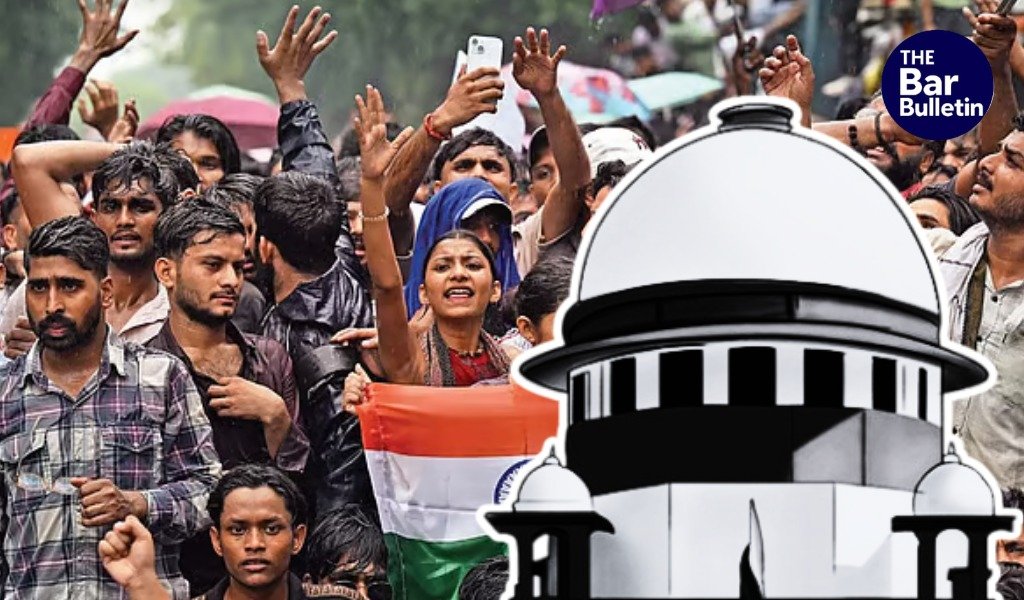
The Supreme Court on Monday clarified that its earlier order would not prevent the NCT of Delhi or other States from closing, withdrawing or otherwise dealing with criminal cases registered against student protesters in accordance with law, while recording the Union government’s assurance that it remained committed to finding a legally permissible mechanism to provide relief to bona fide students.
Clarifying its order dated July 28, the Bench observed that the States would be free to adopt any legally permissible course in respect of the FIRs.
“
“As regards paragraph 8, clause 4, it is clarified that the NCT of Delhi or any other States shall be at liberty to deal with the criminal cases…”
The Solicitor General Tushar Mehta, appearing for the Centre, informed the Court that discussions with the protesters’ representatives were progressing and that the issue was no longer about the government’s intent but about identifying a legally sustainable course of action. Mr Mehta submitted that while withdrawal of FIRs may not be legally feasible, the government was examining other lawful alternatives.
“
“The Government stands on that commitment. Those who were protesting, whichever way we decide, the legally permissible way, will be done. But those who had criminal antecedents… murder, dacoity and other serious offences… except them, everything can be taken care of.”
The Solicitor General further suggested that representatives of the protesting students continue discussions with the government so that the legal framework for resolving the issue could be worked out collaboratively.
Senior AdvocateVrinda Grover, appearing for student protesters, informed the Court that discussions with the Solicitor General were underway and stressed that the future of the students should remain the primary concern.
“
“These are young students. They have their life ahead. The youth need to move on and look forward to taking their life forward. This was about improving an education system.”
She, however, pointed out that blanket FIRs naming thousands of “unknown persons” had enabled arbitrary arrests and urged the Court to devise a comprehensive mechanism for dealing with such cases.
During the hearing, the Bench observed that the identification of FIRs capable of being withdrawn or otherwise closed would require cooperation between both sides, followed by segregation of genuine student protesters from those allegedly involved in serious criminal activity. It also clarified that its earlier order permitting investigation would not stand in the way of the government adopting any legally permissible course for resolving the cases.
The Court also heard submissions seeking accountability for alleged police excesses during the protests. Senior Advocate Abhishek Manu Singhvi argued that irrespective of any settlement on the FIR issue, allegations of assault by police officers required independent examination and could not be allowed to fade into the background. He urged the Court to ensure that the affidavits to be filed by the authorities specifically addressed the allegations against police personnel.
The Bench of Chief Justice Surya Kant, Justice Joymalya Bagchi and Justice V Mohana indicated that it was considering constituting a high-level committee, instead of a conventional Special Investigation Team (SIT), to examine the allegations. It observed that such a committee would require carefully framed terms of reference and sought suggestions from all parties.
The Court also took note of submissions raising concerns over the alleged use of facial recognition technology to identify protesters and allegations regarding the use of pellet guns during the protests, directing that these issues could be addressed in the affidavits to be filed by the authorities.
At the conclusion of the hearing, the Bench directed the Union and the States to file their affidavits and listed the matter for August 18 at 2 PM, when it will consider the constitution of the proposed high-level committee and its terms of reference
Appearances
Senior Advocates N Hariharan, Gopal Sankarnarayanan, Dr Abhishek Manu Singhvi and Vrinda Grover