
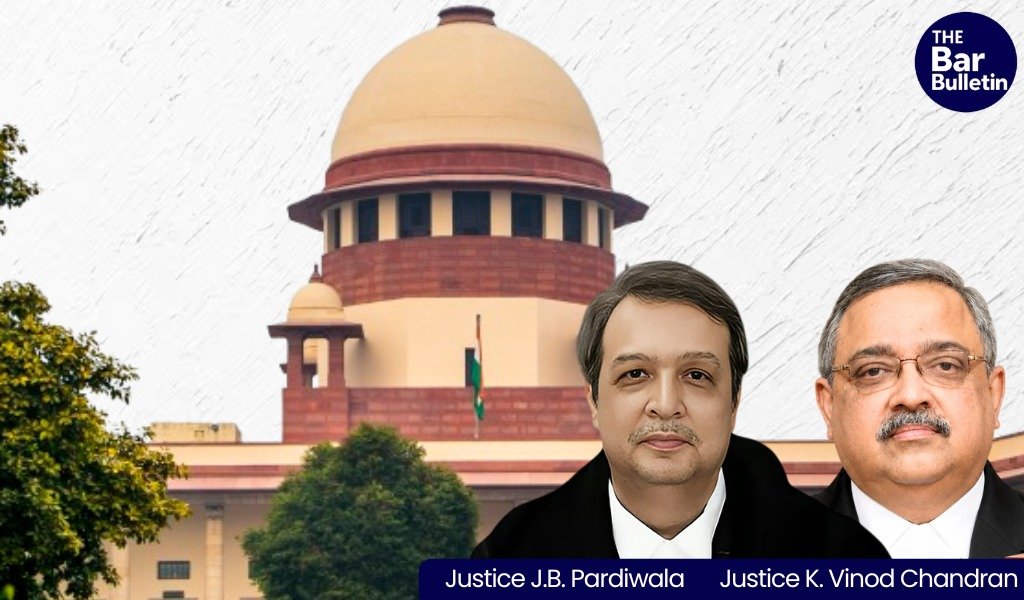

The Supreme Court has referred to a Larger Bench the question whether a notification under the Commercial Courts Act, 2015 designating the Civil Judge (Senior Division) as a Commercial Court can override Section 134 of the Trade Marks Act, 1999, which mandates that infringement suits be instituted only before a District Court or a Court superior to it.
The Court observed that the Trade Marks Act is a special legislation and intellectual property rights, including trade marks, constitute only a species under Section 2(1)(c)(xvii) of the Commercial Courts Act, which deals with the genus of commercial disputes. The Court held that the legislative intent behind Section 134 of the Trade Marks Act cannot be diluted by executive notifications issued by High Courts, and that uniform law must apply across all States rather than leaving jurisdiction to vary based on differing notifications.
A Two-Judge Bench comprising Justice J.B. Pardiwala and Justice K. Vinod Chandran observed that the Trade Marks Act is a special legislation dealing with intellectual property rights, which under Section 2(1)(c)(xvii) of the Commercial Courts Act constitutes only a species of the larger genus of ‘commercial disputes’. The Court noted that Section 3 of the Commercial Courts Act empowers High Courts to notify Commercial Courts at the District Judge level, and Section 21 gives the Act overriding effect only to the extent of any inconsistency with other laws.
The Court further observed that the real problem arises only when notifications constitute Civil Judges (and not District Judges) as Commercial Courts, since the Trade Marks Act expressly prohibits institution of infringement suits before any Court inferior to a District Court.
The Court also took note of three key precedents. In Kandla Export Corporation v. OCI Corporation [Civil Appeal No. 1661-1663 of 2018], the Supreme Court held that the Arbitration and Conciliation Act, 1996 is a self-contained code and a special legislation that prevails over the Commercial Courts Act. Further, in Jaycee Housing Pvt. Ltd. v. Registrar (General), Orissa High Court [(2023) 1 SCC 549], the Orissa High Court held that Sections 9, 14 and 34 of the Arbitration Act must concede to the Commercial Courts Act, treating the latter as a special enactment. The Court noted the apparent conflict between Kandla Export and Jaycee Housing, on whether the Arbitration Act or the Commercial Courts Act is the special legislation.
Briefly, the appeal arose from the State of Jharkhand, where the High Court, by a notification issued under the Commercial Courts Act, 2015, had designated the Civil Judge (Senior Division) [CJ(SD)] as the Commercial Court. The appellant, I.S.D.S. Private Limited, challenged this notification insofar as it applied to suits for infringement and related reliefs under the Trade Marks Act, 1999.
The appellant’s grievance was that Section 134 of the Trade Marks Act specifically restricts the institution of such suits to a District Court or any Court superior to it, and that designating the CJ(SD) as the Commercial Court would render this statutory restriction otiose. The appellant argued that this would also deprive litigants of a direct appeal to the High Court, leaving them only with the narrower remedy of revision or a writ under Article 227 of the Constitution, where re-appreciation of evidence is not permitted.
