
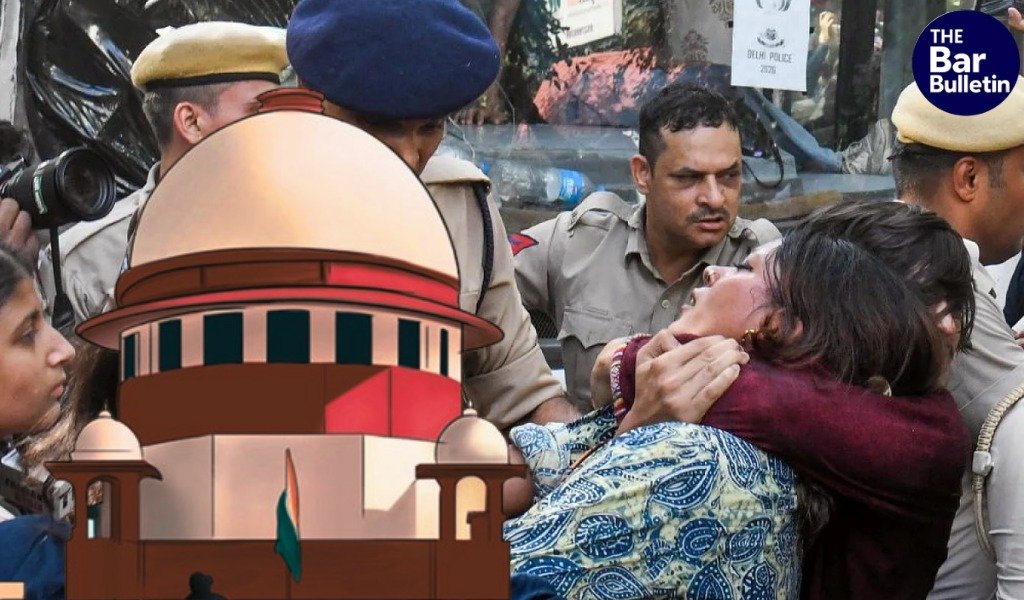
The Supreme Court on Thursday diected that no coercive action to be taked against a woman journalist who alleged sexual harassment by police personnel during the October protests, while directing the police to complete its inquiry into her complaint within a week and place its response on affidavit.
A Bench of Chief Justice of India Surya Kant and Justice Joymalya Bagchi was hearing petition filed by Network of Women in Media, India seeking protection for women journalists reporting from protest sites against alleged police violence, including sexual harassment, and seeking an independent committee to investigate complaints of such misconduct.
Senior Advocate Indira Jaising, appearing for the petitioner submitted that women reporters face particular risks while covering protests, alleging that they had been pushed and pulled around by police personnel, including male officers. She submitted:
“
“This is a petition which specifically addresses the needs of women journalists during the course of duty, employment, when they go onto a protest site. They constitute a class by themselves because they not only have the right to speech, not only have the right to protest, but also the right to work. They go there to perform their duties in exercise of the right to work. Now, being women, they are particularly abused, being pushed and pulled around, especially by male police officers, which is not to say that the women police officers did not push them. They did.”
She argued that such conduct could amount to sexual harassment and sought the constitution of an independent committee to examine complaints of violence, including sexual violence, against women journalists.
Ms Jaising submitted that the proposed committee should be headed by a woman and comprise predominantly women former judges, retired police officers and members of civil society. She also sought permission to place details of the complainants before the Court in sealed covers to protect their identities.
The CJI agreed that the committee should comprise predominantly or exclusively women former judges, former police officers and social workers with experience in workplace-related issues. The Court asked Ms Jaising to submit the relevant material and suggested names in separate sealed envelopes.
Ms Jaising also raised concerns about alleged retaliatory complaints against women journalists who had reported police misconduct. She sought protection against coercive action, pointing out that one journalist’s complaint had not resulted in an FIR, while a police officer allegedly facing accusations had approached the Delhi High Court under the Scheduled Castes and Scheduled Tribes (Prevention of Atrocities) Act.
The Bench emphasised the need to balance the journalist’s access to justice with the rights of others to lodge complaints. It directed the police to complete the inquiry into the specific complaint promptly.
Solicitor General Tushar Mehta assured the Court that the inquiry would be completed within a week and a response filed by way of affidavit, the CJI said the allegation was serious and that the authorities were answerable.
The Court subsequently recorded the assurance that the particular woman journalist would not be arrested, subject to her cooperating with the inquiry. It also indicated that it was examining whether the allegations against specific police personnel should be investigated at the appropriate senior level or by an independent agency.
Ms Jaising also argued that journalists must be able to exercise their right to report without obstruction and that the protocol should recognise journalists working for media houses as well as independent and freelance reporters.
The CJI observed that the Court would examine the broader question of protections for different categories of journalists at the final hearing. The Bench also indicated that the proposed committee and the larger issues concerning journalists’ safety would be considered in the ongoing proceedings.