
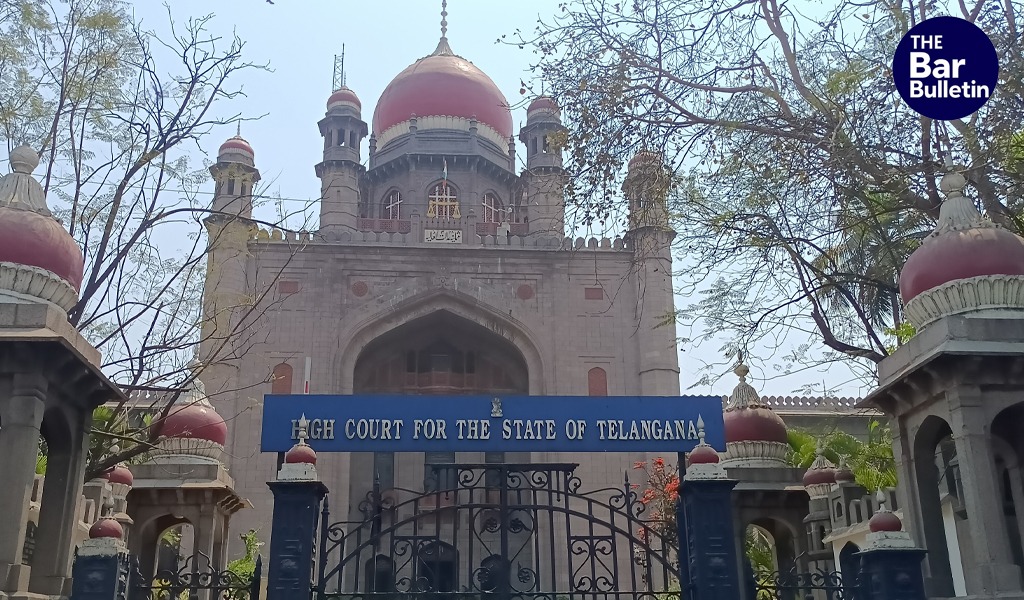

The Telangana High Court (Hyderabad Bench) has clarified that where a dealer markets goods under its own trademark or brand name, and the sale is covered by the statutory deeming fiction under Section 5AA of the APGST Act, that dealer can be treated as the deemed first seller and made liable to tax under that provision. The fact that the dealer used taxed inputs or that the trademark may be unregistered does not by itself take the case outside Section 5AA.
The Court effectively held that the Tribunal had correctly applied Section 5AA to the petitioner’s branded sales of blended coffee. Since the petitioner marketed the product under its own brand, the Tribunal was justified in affirming the levy.
Also Read ECI Can Deploy Government Teachers for SIR Duty, But Must Ensure They Are Not Overburdened: Delhi HC
The Division Bench comprising Justice P. Sam Koshy and Justice Narsing Rao Nandikonda closely examined Section 5AA, which creates a deeming fiction: whenever a dealer holding a trademark or patent sells goods, other than declared goods, at a point other than the first point of sale, that dealer is deemed to be the first seller in the State and is made liable to tax accordingly, with deduction for tax already levied at the preceding point of sale on the same goods.
The Court noted the factual position that the petitioner was not merely reselling raw coffee or chicory as purchased. It was engaged in manufacturing and marketing blended coffee by roasting and grinding coffee seeds and then blending them with chicory before selling the final product in the market. The Court also recorded the petitioner’s own stand that blended/French coffee is a distinct commercial commodity falling under Entry 34A.
The petitioner argued that under the APGST scheme, tax is generally attracted only at a single point, and that Entries 33, 34 and 34A separately recognize pure coffee and blended/French coffee as different products. Its submission was that once tax had already been paid on coffee seeds and chicory, the later sale of blended/French coffee should not be taxed again. The State, however, pointed out that the petitioner was marketing the product under its own trade name and brand, “ABC Coffee Day.” On that basis, the State argued that the petitioner squarely attracted Section 5AA as a trademark holder marketing goods under its own brand and could therefore be treated as the deemed first seller for tax purposes.
The High Court accepted the State’s position, particularly in light of earlier precedent. It referred to the ruling in Aditya Music, where it had been held that for Section 5AA, it does not matter whether the trademark is registered or unregistered. The Court also reiterated that a dealer marketing goods under a trademark or brand name at a point other than the first point of sale is liable under Section 5AA regardless of registration status.
Briefly, the dispute arose from the petitioner’s claim that its secondary sales of blended coffee powder were exempt under Section 5 read with Entry 34A of the APGST Act, 1957. The exemption claimed was Rs. 60.50 lakhs for 2000–2001 and Rs. 1.24 crores for 2001–2002. The assessing authority rejected that claim and instead taxed the turnover at 10% under Section 5AA of the APGST Act. Tax liability was computed at Rs. 2.60 lakhs for 2000–2001 and Rs. 7.02 lakhs for 2001–2002.
The petitioner’s case was that it purchased coffee seeds and chicory from sellers who had already charged and collected tax at the relevant first sale point. It then roasted and ground the coffee seeds, mixed them with chicory, and sold the resulting product as blended French coffee. According to the petitioner, since both inputs had already suffered tax and the final product fell under Entry 34A, no further levy could be imposed on its sales.
The central legal issue raised was whether Section 5AA could apply where the petitioner argued that its sales were first sales and that the provision itself only applied when a trademark holder sold goods at a point other than the first sale point. The petitioner specifically argued that Section 5AA excludes first sales from its scope and therefore could not be invoked against it.
