
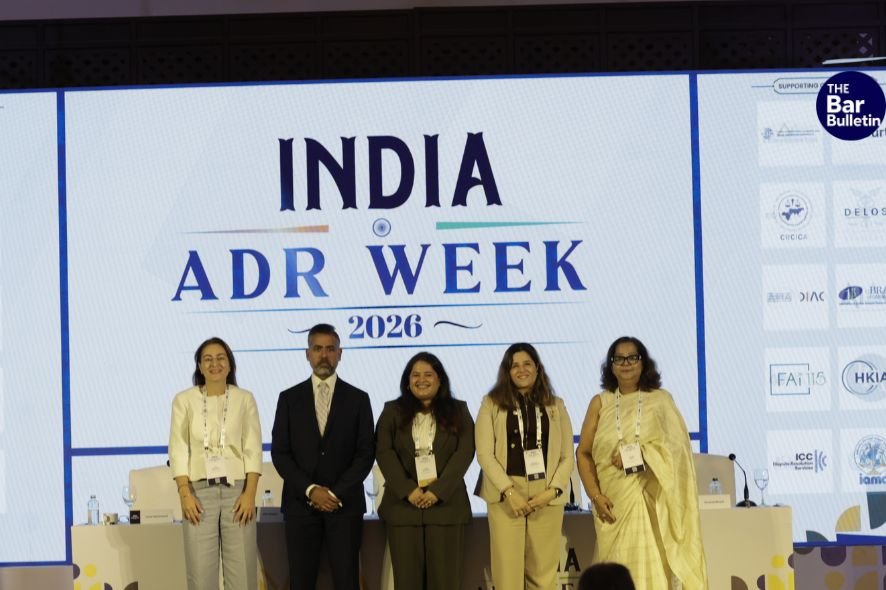

The India–MENA arbitration corridor needs stronger institutional and enforcement mechanisms, with the absence of the UAE from India’s notified reciprocating territories emerging as one of the key issues discussed at India ADR Week 2026during the session titled “The India–MENA Arbitration Corridor: Challenges and Opportunities” moderated by Lara Hammoud, Independent Arbitrator.
Shweta Bharti, Managing Partner, Hammurabi & Solomon Partners, said that addressing the reciprocity issue should be an immediate priority. Referring to the absence of the UAE from India’s list of reciprocating territories for enforcement of foreign judgments, Bharti said, “It is now time to highlight this issue a little bit more at the government level” to find a solution.
The panel examined the growing commercial relationship between India and MENA, the choice of arbitral seats and institutions, enforcement of awards, governing law, bilateral investment treaties, mediation and the increasing movement of arbitrators between the two regions.
Ms Bharti said that the first step would be notification of the UAE as a reciprocating territory, describing it as an important issue for the development of the India-UAE arbitration corridor.
Khushboo Shahdadpuri, Partner, Dispute Resolution, Al Tamimi & Company, highlighted the practical implications of enforcement uncertainty. She noted that converting a UAE arbitral award into a judgment in India is not a straightforward process and that there is no sure-shot route, with judicial discretion potentially introducing uncertainty for parties considering the UAE as a seat.
She also observed that parties are increasingly choosing jurisdictions where their projects are located, pointing to Mumbai, Dubai International Arbitration Centre (DIAC) and Abu Dhabi as increasingly relevant arbitral seats. She emphasised that the quality of case management, speed, judicial support, institutional rules and the functioning of arbitral courts or committees are important considerations in institutional arbitration.
Priya Dhankhar, Associate Partner, SKV Law Offices, noted that construction and infrastructure continue to be major sectors generating disputes, while technology-related disputes and joint-venture disputes are also increasing. She also pointed to the regulatory framework surrounding India’s renewable energy sector as an area with significant potential for disputes.
Discussing enforcement and seat selection, Shweta Bharti said parties consider factors including the location of assets, availability of interim relief, emergency arbitration mechanisms and the enforceability of awards. She noted that while Singapore continues to be a natural choice for Indian parties, Dubai is increasingly emerging as another significant option.
Alim Khamis, Partner and Head of Disputes (Middle East), Gateley Middle East, stressed that the MENA region cannot be treated as a single homogeneous market. He pointed to distinct India-UAE, India-Saudi Arabia and other bilateral relationships, noting that the region is fluid and the choice of dispute resolution mechanism must be assessed in the context of the particular commercial relationship.
Khamis also highlighted the growing importance of cost considerations in institutional arbitration. While describing the ICC as the “Rolls-Royce” of arbitration institutions, he noted that its cost structure may lead parties to consider institutions such as DIAC and Abu Dhabi’s arbitral institution as alternatives, alongside considerations of track record and administrative experience.