
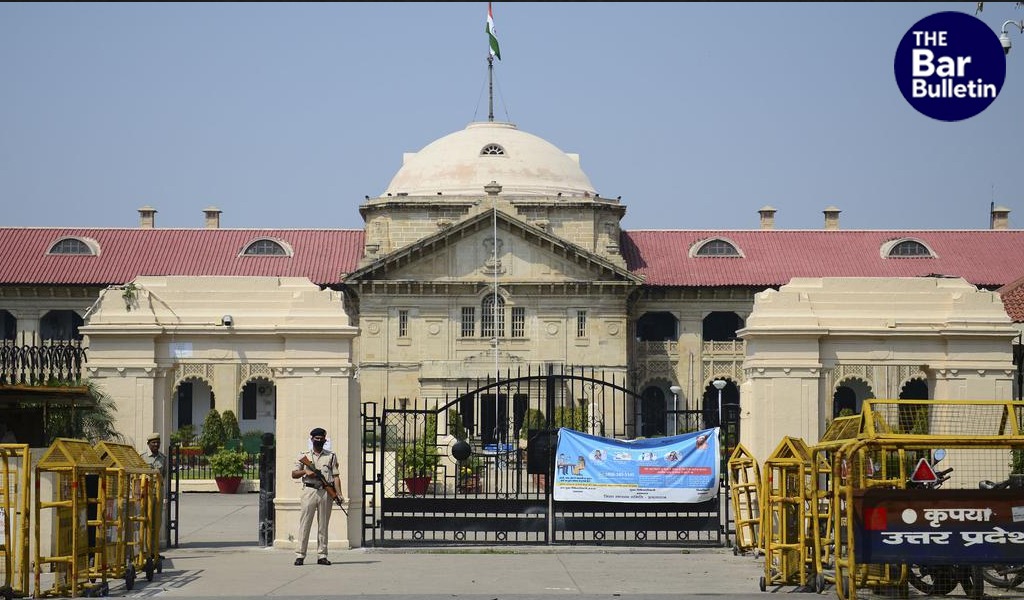

The Allahabad High Court has reiterated that a trial court cannot act as a rubber stamp or post office while deciding an application for discharge under Section 239 of the Code of Criminal Procedure, holding that such applications require a meaningful application of judicial mind to the material collected during investigation. Setting aside a non-speaking order rejecting a discharge plea, the Court observed that the stage of discharge is an essential safeguard against unnecessary criminal prosecution and cannot be reduced to a mere procedural formality.
Justice Shree Prakash Singh was hearing an application challenging the rejection of a discharge plea in a case arising out of allegations relating to the misuse of educational certificates for appointments in Kasturba Gandhi Balika Vidyalayas. The applicant contended that the Magistrate had dismissed the discharge application without examining the material on record and had instead deferred consideration of the defence until the trial, effectively rendering the statutory stage of discharge meaningless.
Also Read BCI Draft Bill Proposes Recognition of Law Firms, Advocate Welfare Fund and Legal Education Reforms
Agreeing with the contention, the High Court found that the trial court had failed to consider the grounds raised in the discharge application and had erroneously observed that the truthfulness of those pleas could be examined only after evidence was led during trial. The Court held that Section 239 CrPC specifically requires a Magistrate to examine the police report and the accompanying documents to determine whether the charge is groundless, and that this exercise cannot be treated as an empty ritual.
Explaining the scope of discharge, the Court observed that while a trial court is not expected to conduct a mini trial or assess the evidentiary value of the prosecution’s case, it must nonetheless evaluate whether the material, taken at face value, discloses the essential ingredients of the alleged offences and justifies proceeding to trial. It emphasised that the distinction between mere suspicion and a prima facie case must be carefully maintained at this stage.
Also Read Beyond Terms of Reference: The 2026 ICC Rules in Perspective
Relying on a series of Supreme Court decisions, the High Court noted that discharge is not a technical indulgence but an essential safeguard. It observed that allowing a prosecution to continue in the absence of a prima facie case exposes an accused to the strain, stigma and uncertainty of criminal proceedings without legal necessity, and reminded trial courts that the process itself can become the punishment if discharge applications are not decided with due care.
Finding the Magistrate’s order to be vitiated by non-application of mind, the High Court set aside the order rejecting the discharge application and remitted the matter to the trial court for fresh consideration in accordance with law within eight weeks. The petition was accordingly allowed.
