
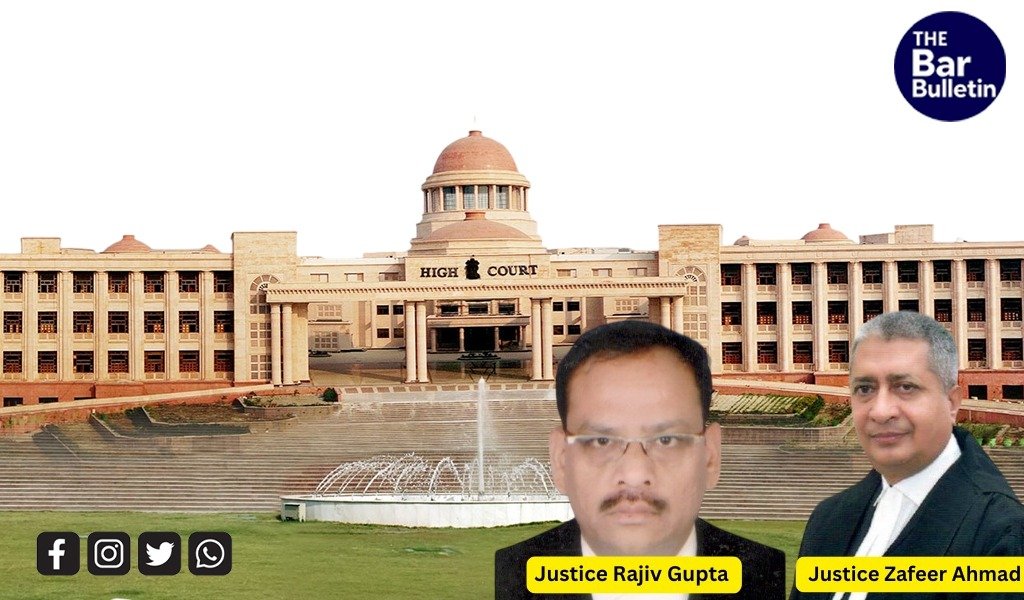

Holding that ocular testimony of related witnesses, corroborated by medical evidence, proves guilt beyond reasonable doubt despite investigative lapses, the Allahabad High Court (Lucknow Bench) has upheld the conviction under Sections 302/149 and 148 IPC for the murder of Amin Mirza, a farmer from District Sultanpur, who was murdered in April 1980 over a personal dispute with the accused regarding the placing of a khalihan (threshing floor) beneath a Mahua tree in his orchard.
The Court pointed out that the testimony of related witnesses can form the basis of conviction if found trustworthy upon cautious scrutiny, and that minor contradictions on peripheral details do not affect the core of the prosecution case. The Court further held that a defective investigation does not automatically lead to acquittal where the substantive evidence is otherwise found reliable, and the lapses must have a demonstrable bearing upon the reliability of the substantive evidence to warrant acquittal.
At the same time, the Court held that enmity alone does not establish false implication, and where the prosecution relies upon direct ocular testimony which is otherwise found trustworthy, the proof of motive is not indispensable to the establishment of guilt. Accordingly, the Court imposed an additional fine of Rs. 20,000/- on each surviving accused-appellant, aggregating to Rs. 60,000/-, to be distributed equally as compensation to the legal heirs of the deceased after due identification and verification.
The Division Bench comprising Justice Rajiv Gupta and Justice Zafeer Ahmad observed that PW-1 and PW-2 are the sons of the deceased, while PW-4 Shafiq Mirza is the brother of the deceased, and their relationship is not in dispute, requiring their testimony to be examined with care. However, the Court emphasized that the mere fact that a witness is related to the deceased does not render his evidence inadmissible or inherently unreliable, and a witness cannot be characterised as an interested witness merely because of his relationship with the victim; the Court must find some circumstance showing that the witness has a particular interest in securing the conviction of the accused.
The Court placed reliance on Sudhakar v. State (2018) 5 SCC 435], which emphasised that “related” is not synonymous with “interested” and that the evidence of an interested witness requires cautious scrutiny, but the said decision turned upon its own facts where the evidence of material witnesses suffered from contradictions on the occurrence itself, the presence of the witnesses, the subsequent conduct of the parties and other material circumstances. The Court further relied upon Shanker v. State of M.P.(2018) 15 SCC 725, which reiterates that it is the quality and not the quantity of evidence which is material and that minor contradictions, inconsistencies, embellishments or improvements which do not affect the core of the prosecution case cannot be made a ground for rejection of the evidence in its entirety.
The Court observed that when the testimony of PW-1, PW-2 and PW-4 is considered together, certain discrepancies regarding distances, the precise position of the witnesses and other peripheral details are undoubtedly noticeable, but the witnesses remain consistent regarding the essential occurrence, the presence of the accused persons at the spot, the weapons carried by them, the exhortation, the firing upon deceased, his falling down and the subsequent assault by the remaining accused. The Court noted that the maxim falsus in uno, falsus in omnibus has no application as a rule of law in India, and the duty of the Court is to separate the truth from exaggeration or embellishment and to determine whether the remaining portion of the testimony inspires confidence and is otherwise corroborated by the evidence on record.
On the issue of non-examination of independent witnesses, the Court relied upon State through the Inspector of Police v. Laly, 2022 SCC OnLine SC 1424, which reiterates that a conviction can be sustained on the testimony of even a sole eyewitness where such testimony is found trustworthy and reliable, and the absence of an independent witness cannot by itself constitute a legal impediment to acting upon otherwise reliable direct evidence.
On the alleged contradiction between ocular and medical evidence regarding the distance from which the firearm was allegedly discharged, the Court observed that medical evidence in a criminal trial is ordinarily an aid to the appreciation of ocular testimony and does not, in every case, displace direct evidence, and the decisive question is whether the medical findings completely rule out the manner of assault deposed to by the eyewitnesses. The Court found that the medical evidence did not have the effect of rendering the alleged firearm assault impossible, as the existence of a firearm injury, the recovery of multiple metallic shots and wadding from the cranial cavity, and the doctor’s opinion that the injury was sufficient in itself to cause death provided substantial medical confirmation of the firearm assault.
On the alleged lapses in investigation, the Court drew a distinction between a defective investigation and a defective prosecution case, observing that the former does not, by itself, necessarily result in the latter. The Court held that where the substantive evidence is otherwise found trustworthy, an imperfect investigation cannot be converted into a ground for acquittal unless the particular lapse has a demonstrable bearing upon the reliability of that substantive evidence.
On the issue of motive and prior enmity, the Court observed that enmity is a double-edged circumstance which may furnish a motive for the accused to commit the offence, but at the same time may provide a reason for the witnesses to falsely implicate them, and the Court cannot treat the existence of enmity, by itself, as either corroborating the prosecution case or discrediting the prosecution witnesses. The Court further observed that enmity is a circumstance relevant to the assessment of credibility, it is not itself a test of credibility, and the mere existence of hostility tells the Court that the possibility of exaggeration or false implication requires examination but does not establish that the witness has, in fact, falsely implicated the accused.
On the issue of contradictions under Section 145 of the Indian Evidence Act, the Court relied upon Alauddin v. State of Assam, (2024) 12 SCC 224, which held that a previous statement cannot be treated as a proved contradiction merely because an omission or variation is pointed out in cross-examination, and where the previous statement is intended to be used for contradiction, the witness’s attention must be drawn to the specific portion of the previous statement relied upon; thereafter, the relevant portion must itself be duly proved.
Briefly, the prosecution story, as narrated by complainant Mirza Qabir Ahmed, was that there existed a long-standing dispute between his father, Amin Mirza (deceased), and Accused Sher Mohammad over the placing of a khalihan (threshing floor) beneath a Mahua tree situated in the orchard opposite A1’s house. Although the dispute had earlier been settled through village panchayat intervention, the hostility revived when family members of A1 again attempted to place the khalihan at the same place a few days prior to the incident.
On April 12, 1980, when the complainant along with his father were proceeding to irrigate their agricultural field, A1 and A4 armed with spear (ballam), A2 armed with a country-made pistol (katta), and A3 and A5 armed with knives, emerged from the western embankment of Jabbar’s field, exhorted that the deceased should not be allowed to escape, where A2 fired at the deceased causing him to fall to the ground, and the remaining accused assaulted him with spear and knives. Upon alarm being raised, Safiq Mirza, Rahim Mirza, Kasmir Mirza and other villagers reached the spot, whereupon the accused fled towards the south-west, and the deceased succumbed to the injuries at the place of occurrence.
The FIR was registered on the same day under Sections 147, 148, 149 and 302 IPC against all the accused-appellants. Investigation was conducted by S.I. Lal Chand Dubey, who proceeded to the place of occurrence on the same day and conducted the inquest proceedings, and charge-sheet was submitted against all accused-appellants on May 16, 1980. During trial, it was found that the original site-plan proved by IO was wrong, and on Jan 09, 1982, the IO was directed to visit the place of occurrence again in the presence of Add. District Government Counsel (Criminal) and counsel for the accused-appellants, and prepare a fresh site-plan which was proved.
Appearances:
Counsel for Appellants: Kunwar Shanti Prakash, Kunwar Sushant Prakash, Mridul Rakesh, Mukul Rakesh, Ms. Saniya, Prasoon Singh
Counsel for Respondents: Government Advocate