
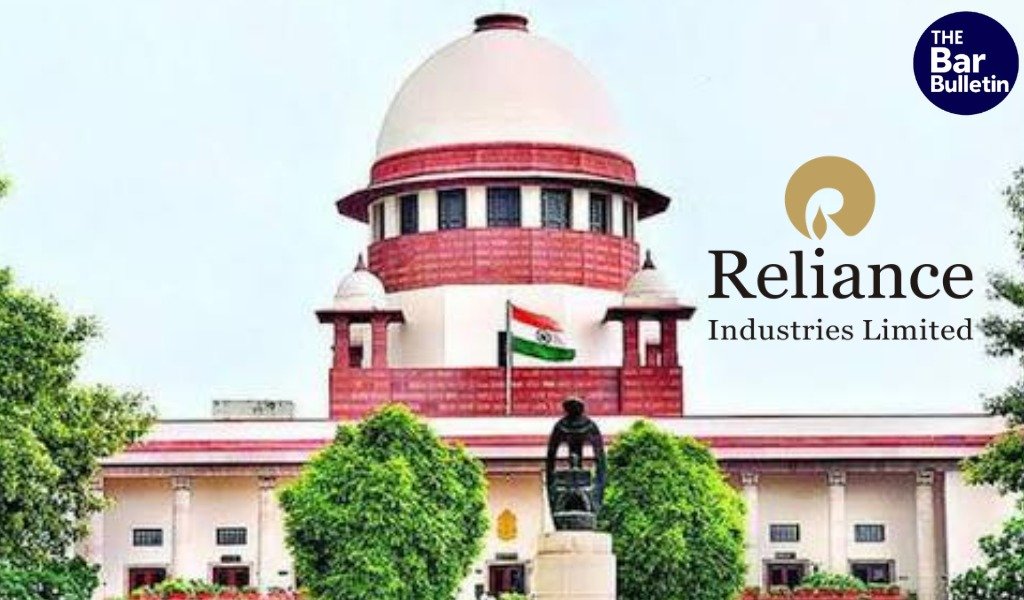
The Supreme Court has dismissed an appeal filed by Reliance Industries Limited (RIL) against a Bombay High Court order concerning the redaction of portions of its witness’s examination-in-chief affidavits in a long-pending commercial suit filed by NTPC Limited, and imposed ₹10 lakh costs on RIL for prolonging the litigation. The Bench of Justice P.S. Narasimha and Justice Alok Aradhe directed RIL to pay the costs to the Supreme Court Advocates-on-Record Association within five weeks.
The dispute arises from NTPC’s 2004 Request for Qualification inviting bids for the supply of natural gas to its power plants. RIL submitted a financial proposal, following which NTPC issued a Letter of Intent dated June 16, 2004. NTPC subsequently instituted a suit seeking a declaration that a binding contract existed between the parties and specific performance of the alleged contract for supply of 132 trillion BTU of natural gas over 17 years.
The Supreme Court traced several rounds of litigation arising during the pendency of the suit. RIL had initially sought discovery and inspection of NTPC’s internal documents relating to negotiations and internal meetings. The Bombay High Court rejected the application in 2014, holding that the documents sought were irrelevant to determining whether a concluded contract existed and that the request amounted to a fishing enquiry. The Division Bench subsequently dismissed RIL’s appeal and observed that repetitive applications could not be used to frustrate the progress of the trial.
RIL subsequently sought permission to introduce additional internal documents. The High Court rejected most of the request, holding that the internal documents were irrelevant to the question of whether a concluded contract existed. RIL challenged the order before the Supreme Court but later withdrew the SLP.
Thereafter, RIL filed a second examination-in-chief affidavit of its witness. NTPC sought redaction of portions referring to internal documents and communications which had previously been held inadmissible. The Bombay High Court redacted portions of the affidavits but retained statements concerning facts personally perceived by the witness, including his state of mind and his perception of communications exchanged between the parties.
The Supreme Court had, in an earlier judgment dated February 28, 2019, already held that RIL could not indirectly introduce through oral testimony the contents of documents which had been excluded from evidence by orders that had attained finality. The Court had clarified that while internal correspondence could not be introduced through oral evidence, the fact that discussions took place was not necessarily excluded where the evidence did not seek to introduce the contents of the excluded documents.
In the present proceedings, the Supreme Court examined whether the Bombay High Court had correctly applied its earlier directions while scrutinising the two affidavits paragraph by paragraph. The Court found that the High Court had neither misunderstood nor exceeded the mandate of the Supreme Court. It upheld the High Court’s decision to retain portions dealing with the witness’s personal perception and state of mind while redacting portions that sought to introduce the contents of previously excluded internal communications.
The Court also refused to reopen the issue under Section 60 of the Indian Evidence Act, 1872, noting that the same arguments had already been considered in the earlier proceedings and that the Court was neither in a position nor inclined to revisit its 2019 judgment.
Expressing concern over the extraordinary delay, the Bench noted that the NTPC suit, instituted in 2005/2006, had still not progressed beyond the evidence stage after nearly two decades. The Court observed that the first round concerning discovery took four years, the second concerning production of internal documents took more than a year, and the third round concerning redaction of inadmissible statements took three years. It further noted that even after the Supreme Court directed in 2019 that the commercial suit be concluded within nine months, seven years had passed without its disposal.
The Supreme Court accordingly dismissed RIL’s appeal with ₹10 lakh costs, payable to the Supreme Court Advocates-on-Record Association, and reiterated its request to the High Court to take up and dispose of the long-pending commercial suit as expeditiously as possible.
Appearances:
For Petitioner(s): Dr. Abhishek Manu Singhvi, Sr. Adv. Mr. Shyam Divan, Sr. Adv. Mr. Sameer Parekh, Adv. Ms. Sonali Basu Parekh, Adv. Mr. Rubin Vakil, Adv. Mr. Ishan Nagar, Adv. Mr. Avishkar Singhvi, Adv. Mr. Rishit Badiani, Adv. Mr. Ashwin Dave, Adv. Mr. Ketan Dave, Adv. Mr. Gaurav Gangal, Adv. Mr. Abhishek Thakral, Adv. Ms. Ruchi Krishna Chauhan, Adv. Ms. Aditi, Adv. Mr. Nidhiram Sharma, Adv. Mr. Adith Deshmukh, Adv. Ms. Suvasita Chopra, Adv.
For Respondent(s): Mr. Tushar Mehta, Solicitor General Mr. Rishir Daulat, Adv. Ms. Bindu Saxena, Adv. Mr. Digvijay Dam, Adv. Ms. Aparajita Swarup, Adv. Mr. Shailendra Swarup, AOR