
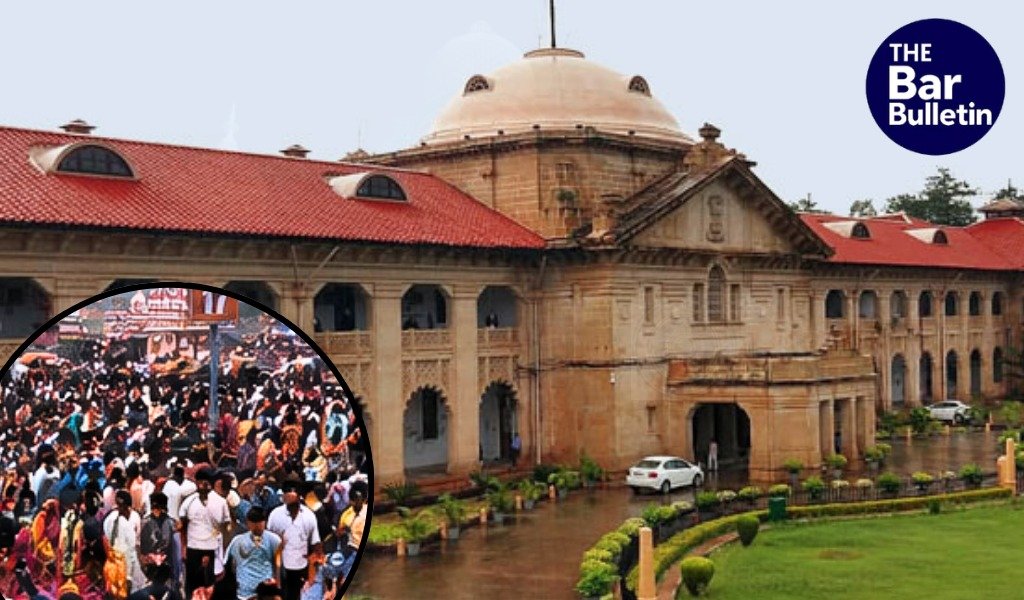
The Allahabad High Court has recommended that the Uttar Pradesh Government institutionalise the scientific study of crowd behaviour, introduce it as an academic discipline in universities, and establish a dedicated Centre of Excellence for Crowd Science, Mass Gathering Safety and Urban Risk Management to prevent recurring stampedes and crowd-crush incidents at religious gatherings.
Justice Vinod Diwakar, while deciding a petition concerning unauthorised construction in Mathura, expanded the scope of the proceedings to examine systemic deficiencies in crowd and crisis management following recent crowd-crush incidents, including those at the 2025 Maha Kumbh in Prayagraj and the 2022 Banke Bihari Temple stampede in Vrindavan. The Court observed that authorities have traditionally treated crowd management merely as a law-and-order exercise instead of a behavioural science requiring research and evidence-based policymaking.
Also Read Supreme Court Upholds Insolvency Proceedings Against Rana Kapoor-Linked Bliss Companies
The Court held that deployment of additional police personnel, barricades and standard operating procedures would not, by themselves, prevent future tragedies unless governments develop a scientific understanding of how crowds form, move, react and transition into dangerous crush situations. It distinguished crowd management from traffic management, observing that the latter cannot substitute the former.
Expressing concern over the absence of any structured academic curriculum on crowd behaviour despite India hosting some of the world’s largest religious gatherings, the Court recommended that universities introduce dedicated courses covering crowd psychology, crowd flow dynamics, risk assessment, safety planning, computational modelling, crowd management law and comparative studies of major crowd disasters.
Also Read Supreme Court Reserves Verdict On Challenge To 3-Year Practice Rule For Entry Into Judicial Service
The High Court further recommended that the State establish a Centre of Excellence in collaboration with institutions such as IIT Kanpur or IIT Roorkee to undertake interdisciplinary research, maintain a database of crowd-related incidents, advise authorities, train officials and collaborate with international experts in crowd science. It also suggested mandatory engagement of certified crowd behaviour experts while planning major religious, political, cultural and public events.
The Court also criticised the existing planning framework for Mathura, observing that preparing a master plan for only ten years was wholly inadequate for a city of immense religious and historical significance. It remarked that cities such as Mathura, Ayodhya, Varanasi and Chitrakoot require long-term, multi-generational planning rather than short-term development strategies.
Addressing the issue of unauthorised constructions, the Court described them as a serious public safety hazard, particularly in pilgrimage towns, noting that illegal constructions obstruct emergency access and aggravate crowd-related risks. It observed that such constructions are often driven by a nexus between builders, vested interests and regulatory failures, requiring strong institutional will rather than merely stricter laws.
On the merits of the petition, the Court disposed of the matter by granting liberty to the petitioner to approach the Mathura Vrindavan Development Authority afresh in light of recent State Government circulars issued pursuant to the Supreme Court’s directions on demolition of unauthorised structures. The impugned appellate order was kept in abeyance, and the Registrar was directed to forward a copy of the judgment to the Chief Secretary, the University Grants Commission and the Ministries of Higher Education at the State and Union levels for future reference.
