
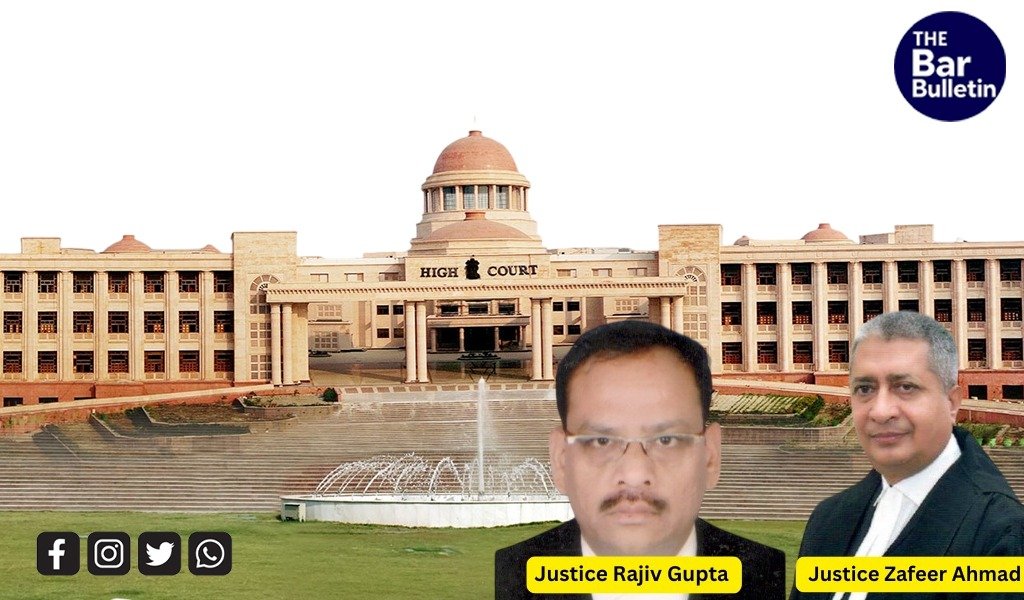

The Allahabad High Court, Lucknow Bench, has dismissed a Government Appeal challenging the acquittal of the accused in a 1977 murder case, holding that the prosecution failed to establish its case beyond reasonable doubt due to material inconsistencies in the eyewitness account, contradictions with medical evidence, unexplained investigative lapses, and the absence of corroboration from independent witnesses.
A Division Bench of Justice Rajiv Gupta and Justice Zafeer Ahmad affirmed the trial court’s judgment acquitting the accused of offences under Sections 147, 148, 302 and 149 of the Indian Penal Code, reiterating that an appellate court should not interfere with an acquittal unless the findings are manifestly erroneous or perverse.
The prosecution alleged that the deceased was murdered due to political rivalry stemming from a village Pradhan election. According to the prosecution, the accused, armed with firearms and lathis, intercepted the deceased near the Gomti river and shot him dead in furtherance of their common object.
Upon reappreciating the evidence, the High Court found significant contradictions regarding the place from which the accused allegedly opened fire. While the eyewitnesses attempted to place the accused closer to the deceased during trial, their versions differed materially and were inconsistent with the site plan as well as the medical evidence. The post-mortem doctor had opined that certain firearm injuries bore signs of close-range firing from about six to ten feet, whereas the prosecution’s own evidence suggested that the firing took place from a distance of approximately 60 to 70 paces. The Court held that this inconsistency struck at the root of the prosecution’s case.
The Bench also examined the effect of the long-standing hostility between the parties, observing that while relationship or enmity by itself does not discredit a witness, such evidence requires greater caution where there is a history of political rivalry, criminal cases and civil litigation.
Also Read MP High Court: Blacklisting of Contractors Is Civil and Commercial Death; Writ Remedy Available
Significantly, the Court observed:
“
“Enmity is a double-edged weapon. While it may furnish a motive for the commission of the offence, it equally provides a motive for false implication.”
The Court further noted that statements of key eyewitnesses under Section 161 CrPC were recorded after an unexplained delay, despite their availability immediately after the incident. While reiterating that every delay in recording statements is not fatal, the Bench held that such unexplained delay assumes significance where eyewitness testimony itself is under scrutiny, as it raises the possibility of embellishment and improvement.
Another factor weighing against the prosecution was the failure to examine independent witnesses specifically named in the FIR. Although conviction can be sustained even on the testimony of a solitary witness, the Court held that the unexplained withholding of independent witnesses became an important circumstance when viewed alongside the inconsistencies in the prosecution case.
Rejecting the State’s reliance on Section 149 IPC, the Bench observed that constructive liability cannot be invoked merely because several persons are alleged to have been present at the scene. The prosecution must establish, through cogent evidence, that each accused was a member of an unlawful assembly sharing the common object of committing the offence. Since the prosecution failed to prove the participation and common object of each accused beyond reasonable doubt, the Court held that Section 149 IPC could not be attracted.
Concluding that the prosecution case suffered from material infirmities and that the trial court had rightly extended the benefit of doubt, the High Court dismissed the Government Appeal and affirmed the acquittal, holding that no compelling circumstance existed to warrant interference with the trial court’s well-reasoned judgment.
Appearances
Counsel for Appellant(s) : G.A., Uday Pratap Singh
Counsel for Respondent(s) : Ram Kumar Singh, Sunil Kumar Singh, Vivek Kumar Divedi