
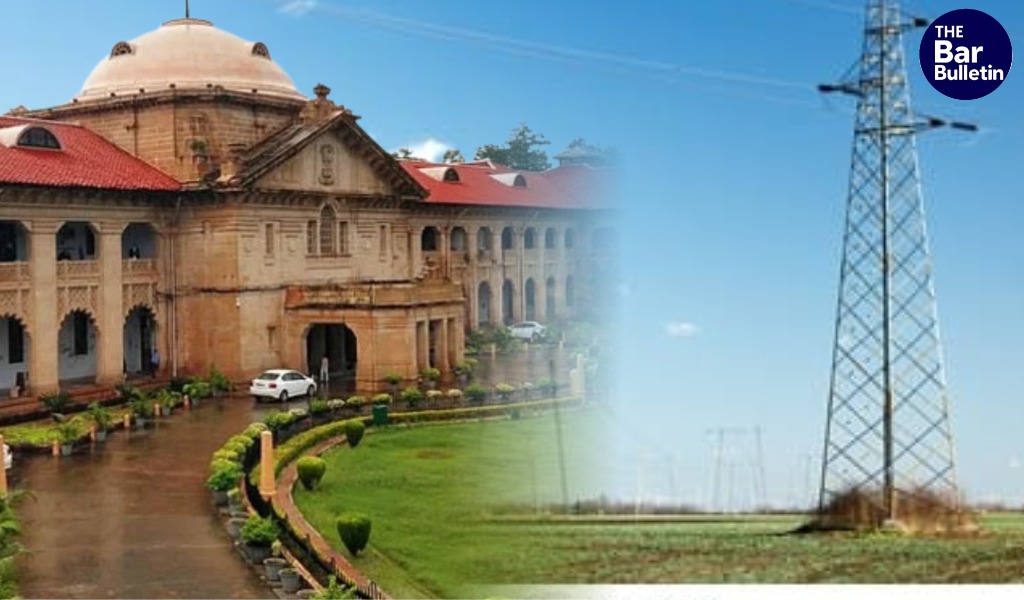

The Allahabad High Court has held that the State of Uttar Pradesh cannot selectively implement Central Government guidelines on compensation for land affected by high-tension electricity transmission lines and must compensate farmers for the loss of land value caused by Right of Way (RoW) corridors.
A Division Bench of Justice Arindam Sinha and Justice Prashant Kumar allowed a writ petition filed by four farmers from Shamli district whose agricultural lands were traversed by a 220 KV transmission line. The petitioners contended that while limited compensation had been paid for crops, trees and tower base areas, no compensation was awarded for the corridor area beneath the transmission line, despite severe restrictions on the use of the land.
The farmers argued that the Ministry of Power’s revised compensation guidelines dated June 14, 2024 increased compensation for tower base areas to 200% of land value and provided compensation equivalent to 30% of land value for the RoW corridor. However, Uttar Pradesh had continued to follow the older 2015 framework and denied compensation for the corridor area.
The State defended its action by contending that the supplementary guidelines issued on March 21, 2025 applied only to inter-state transmission systems and were therefore inapplicable. The transmission company further argued that the Central guidelines were not enforceable through a writ petition.
Rejecting the State’s stand, the High Court observed that although land is not formally acquired for transmission projects, landowners effectively lose several valuable rights over their property. The Court noted that construction activities cannot be undertaken beneath transmission lines, trees cannot be planted, and the utility of the land is significantly diminished because of the restrictions imposed by the transmission corridor.
Drawing a comparison with other infrastructure projects, the Bench observed that while compensation is routinely paid when land is acquired for roads, dams or other public projects, transmission projects often impose comparable burdens without acquisition of land. The Court remarked:
“
It is clear that setting up of the transmission line is a public interest project which can be put at par with other public projects like setting up a dam or building a road. In the other infrastructure projects land is acquired by the Government and handed over to the licensee and a compensation is paid to the owner of the land however, in this case land has not been acquired but at the same time, a number of restrictions have been imposed on the land owners. For example, they cannot have trees on that area and no construction can be carried out in the RoW area and there are several other restrictions which the owners have to face for the land adjoining the RoW with the result the value of the land is drastically diminished. The Government refuses to pay a compensation on the ground that the land has not been acquired however, without even acquiring the land all the valuable rights of the land owners are being taken away from the land owners and that too without providing any compensation.
The Court further held that there was no rational basis for Uttar Pradesh to implement the Centre’s 2015 compensation guidelines while refusing to adopt the revised 2024 guidelines that enhanced compensation for affected landowners. It observed that the State could not be “choosy and selective” when it came to compensating farmers whose lands had been used for public infrastructure projects and whose land values had been substantially diminished.
Holding that the Ministry of Power’s June 14, 2024 guidelines must be followed, the Bench directed the authorities to grant compensation for the transmission corridor area in accordance with the revised framework. Since the transmission line in question was not an inter-state transmission line, the Court clarified that the March 21, 2025 supplementary guidelines would not apply.
The Court also took note of the fact that despite an earlier direction to decide the petitioners’ representations, the authorities had proceeded to energise the transmission line and only thereafter rejected their claims. It observed that the Central Government itself recognised the need for upfront compensation before transmission infrastructure is installed.
Accordingly, the Court quashed the order dated March 10, 2026 rejecting the farmers’ representations and directed the respondents to pay compensation in terms of the Ministry of Power’s June 14, 2024 guidelines within four weeks.
